
Negro bug
Thyreocoris scarabaeoides
Description
How to identify
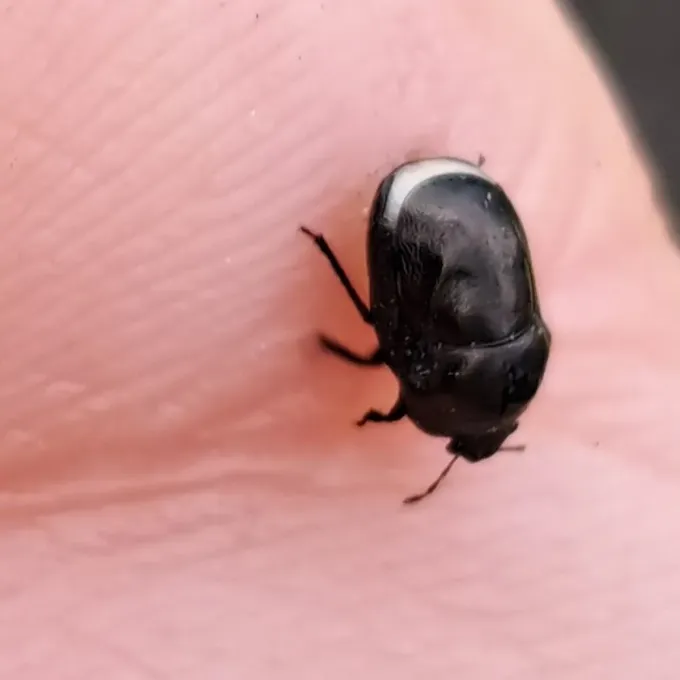
The Negro bug (Thyreocoris scarabaeoides) is a member of the Thyreocoridae family within the Hemiptera order. These insects are small, typically measuring between 3 to 4 mm in length, and possess a distinct, highly convex body.
The coloration of the adult bug is uniform, ranging from deep brown to glossy black. Its head is tightly integrated into the thorax, which, combined with its compact, shield-like appearance, allows it to move easily through dense vegetation.
Nymphs resemble smaller versions of the adults but lack functional wings. Throughout their development, they progress through five distinct instars, gradually increasing in size and complexity with each molting stage.
These insects are highly agile during warm, sunny weather. However, when sensing movement or vibration, they instinctively drop from the plant to the soil, where their dark, rounded bodies make them nearly impossible to detect.
A key identifying feature is the enlarged scutellum that covers almost the entire abdomen. This morphological trait provides significant physical protection and is characteristic of the Thyreocoridae family of bugs.
What it damages
Both adults and nymphs feed on the sap of various plants. They utilize a piercing-sucking mouthpart to puncture the stems and leaves, injecting enzymes that liquefy the plant cells for easier consumption.
In agricultural settings, they are known to attack various cereal crops. Young seedlings are particularly vulnerable to sap depletion, which can lead to stunted growth and, in severe cases, the death of the plant.
The damage is often localized. Since these bugs often prefer wild grasses as primary hosts, they tend to move into agricultural fields from surrounding weeds, field edges, and overgrown meadows.
Feeding leads to physiological stress in the plant, manifesting as yellowing or wilting leaves. The depletion of nutrients forces the plant to divert energy toward recovery rather than towards grain development.
Furthermore, the punctures create entry points for secondary infections. Fungal and bacterial pathogens can easily penetrate the damaged tissue, further weakening the plant and potentially leading to crop yield losses.
When it appears
The Negro bug overwinters as an adult in sheltered locations. Common overwintering sites include leaf litter, deep in the soil, or within thick clumps of perennial grasses found along the perimeter of agricultural fields.
Activity resumes in early spring once soil temperatures reach 10-12 degrees Celsius. Initially, they feed on early-season weeds before migrating to more favorable hosts, including emerging agricultural crops.
Mating occurs in late spring, and females lay eggs on or near the host plants. This timing ensures that nymphs have immediate access to food sources upon hatching, which promotes high survival rates.
The development cycle from egg to adult takes approximately one and a half to two months. By mid-summer, population activity peaks, after which the adults prepare for their period of winter dormancy.
As autumn temperatures drop, the bugs search for suitable winter refuges. Their ability to survive cold temperatures is largely dependent on the depth of their hibernation site and the protective cover provided by organic debris.
Signs of infestation
The primary visual indicator of an infestation is the appearance of small, chlorotic spots on the foliage. These spots represent the exact locations where the bug has pierced the tissue to feed.
As the damage progresses, affected leaves may turn yellow, curl, or prematurely wither. Inspecting the base of the plant often reveals the presence of these small, black, glossy insects clinging to the stalks.
- Chlorotic spots on leaves indicating feeding damage.
- Wilting or yellowing of young plant tissue.
- General stunted growth of affected field patches.
- Observation of small, black insects near the root zone.
Monitoring is most effective during the early morning hours. During this time, the bugs are less mobile and are typically positioned lower on the plants or on the surface of the soil, making them easier to spot.
Severe infestations often result in weakened plant stands. Visually, this is seen as uneven crop development where patches of the field look significantly less vigorous than the surrounding healthy plants.
Control measures
Effective management begins with mechanical control. Deep autumn plowing is highly recommended as it buries organic debris, effectively destroying the overwintering sites and reducing the spring population.
Sanitation of field edges is critical. By removing weed hosts and clearing surrounding thickets, you deprive the bugs of the resources they need to thrive before moving into the main crop area.
Crop rotation serves as a powerful deterrent. Since these pests may build up in fields with long-term continuous cultivation of susceptible plants, rotating with non-host crops disrupts their life cycle.
When the population exceeds economic thresholds, targeted application of systemic insecticides may be necessary. Ensure application occurs during early developmental stages to maximize the effectiveness of the treatment.
Promoting a healthy environment for natural predators, such as predatory beetles and wasps, can help manage bug populations naturally. Biological control remains a sustainable way to limit long-term pest pressure.
Taxonomy
- Latin name
- Thyreocoris scarabaeoides
- Order
- Hemiptera (bugs, aphids, leafhoppers)
- Family
- Cydnidae
- EPPO code
- THRCSC
Discussion
No discussions yet — be the first.