
Negro bug
Corimelaena pulicaria
Description
How to identify
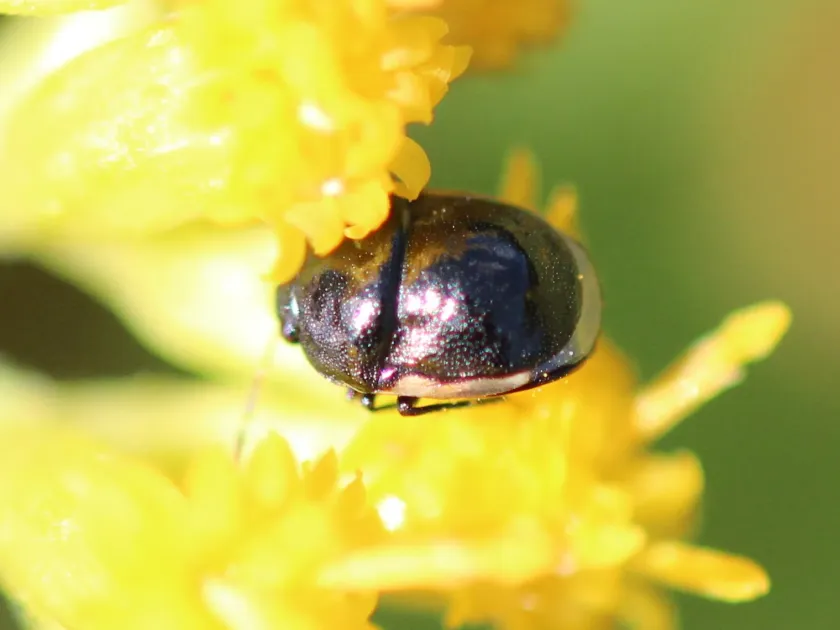
The Negro bug (Corimelaena pulicaria), belonging to the order Hemiptera and the family Thyreocoridae, is a small insect often misidentified as a beetle due to its body shape. It is characterized by a very convex, rounded form that resembles a small, polished black pea.
Adult bugs typically range from 2.5 to 3.5 millimeters in length. Their color is usually a shiny black or dark brown, sometimes displaying a subtle metallic sheen. The scutellum is highly developed, covering almost the entire abdomen and wings, which is a key diagnostic feature.
Nymphs resemble smaller versions of the adults but lack fully developed wings and hard wing covers. They progress through several instars, gradually darkening and hardening their outer skeleton as they mature into adulthood.
These insects are highly active but often drop to the ground or hide in plant debris when disturbed. Like many other true bugs, they possess scent glands that release a distinct, unpleasant odor when the insect is threatened or crushed.
Negro bugs overwinter as adults, seeking shelter in soil, leaf litter, or dense weed patches. As temperatures rise in the spring, they emerge to feed on developing host plants and begin their reproductive cycle.
What it damages
This pest is a generalist feeder that affects a wide range of agricultural crops, including fruits, vegetables, and grain plants. It uses its piercing-sucking mouthparts to extract vital fluids from young plant tissues.
Common host plants include strawberries, raspberries, onions, corn, various legumes, and certain cole crops. The damage caused by their feeding is often most severe during the early stages of plant growth and during the flowering phase.
Feeding on buds, flowers, and developing fruit causes significant deformities. Berries and fruits may become lumpy or uneven, which severely diminishes their marketability and lowers the overall yield quality.
Severe infestations during the flowering period often result in blossom drop. By extracting sap from the reproductive organs of the plant, the bugs deprive them of nutrients, causing flowers and young fruit to wither and fall off prematurely.
Furthermore, the physical wounds inflicted by the bugs create entry points for secondary infections, including various bacterial and fungal pathogens. This can lead to localized rot and the subsequent death of plant parts.
Signs of infestation
The earliest signs of infestation are small, pale or yellowish spots on leaves, which represent the locations where the bugs have pierced the tissue to feed. These spots can enlarge and eventually turn necrotic as the plant tissue dies.
Observing the crops closely often reveals stunted growth or a lack of vigor in young plants. On the stems and undersides of leaves, you might find tiny black fecal spots left behind by the feeding colony.
- Visual detection of the small, black, shiny bugs clustering around flower buds or in leaf axils.
- Unusual fruit deformities and stunted plant development despite adequate watering.
- The presence of a sharp, pungent odor characteristic of the Negro bug when plants are brushed or shaken.
Infestations often start in patches as the bugs move through a field. Early detection in these areas is crucial to prevent the population from spreading rapidly to other parts of the crop field.
Inspection should ideally be conducted during the early morning or late evening hours when the bugs are actively feeding and less inclined to hide or drop to the ground upon approach.
Control measures
Cultural control is the first line of defense. This includes deep tilling in the autumn to destroy overwintering sites, as well as rigorous weed control in and around fields to remove alternative hosts.
Crop rotation helps break the life cycle of the Negro bug by ensuring that host plants are not consistently available in the same location year after year, which significantly reduces local pest populations.
Biological control options, such as the use of entomopathogenic fungi, can be effective in reducing bug numbers without the use of broad-spectrum chemical insecticides, helping to preserve beneficial insect populations.
Chemical control should only be implemented when pest numbers exceed the economic threshold. If necessary, selective insecticides targeting Hemipteran pests should be applied according to regional regulations and safety guidelines.
Using monitoring tools like pheromone or sticky traps allows growers to track population trends and time their interventions accurately. Precision timing ensures that control efforts are effective while minimizing overall chemical use.
Taxonomy
- Latin name
- Corimelaena pulicaria
- Order
- Hemiptera (bugs, aphids, leafhoppers)
- Family
- Cydnidae
- EPPO code
- CORIPU
Discussion
No discussions yet — be the first.