
Cyrtomenus
Cyrtomenus
Description
How to identify
Cyrtomenus is a genus of burrowing bugs belonging to the family Cydnidae (order Hemiptera). These insects are recognized as significant agricultural pests, particularly the species Cyrtomenus bergi, which is notorious for attacking roots.
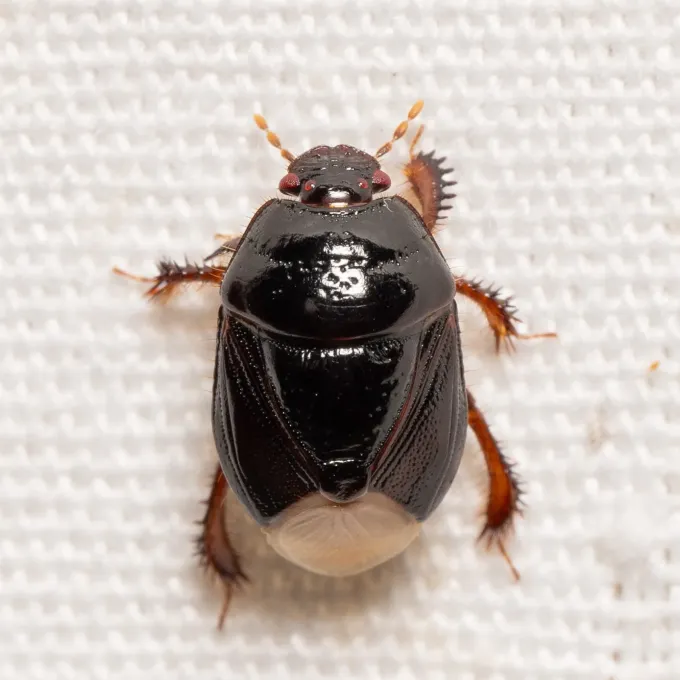
The adults are characterized by an oval, flattened body with a dark brown to black coloration. Their exoskeleton is tough and smooth, enabling them to navigate efficiently through subterranean environments.
The most distinctive morphological feature is their front legs, which are specialized for digging. These tibia are broad and heavily spined, functioning like shovels to move soil particles as the bugs burrow around root systems.
Nymphs undergo several instars of development. While they resemble adults, they are smaller and initially lack fully developed wings. Their coloration varies from pale yellow to light brown depending on their developmental stage.
Their entire life cycle, from egg to adulthood, occurs beneath the soil surface. This subterranean habit provides them with natural protection against many environmental factors and aerial predators.
What it damages
Cyrtomenus bugs are generalist feeders (polyphagous) that cause severe damage to a wide range of economically important crops. Common hosts include potatoes, onions, garlic, peanuts, sweet potatoes, and maize.
The primary damage is caused by both nymphs and adults feeding on the sap of roots, tubers, and underground stems. By piercing the plant tissues, they drain vital nutrients and water, causing significant physiological stress.
Feeding sites often serve as entry points for secondary pathogens, including bacteria and fungi, which trigger rotting of the roots and tubers. This often results in substantial yield loss even before harvest.
In seedlings, the attack is particularly devastating. Direct feeding damage to the developing root system often leads to yellowing, stunted growth, and death of the plant, resulting in irregular gaps in the field.
On harvested produce like sweet potatoes or tubers, the feeding damage appears as dark, depressed spots or necrotic lesions. This drastically reduces the market value and makes the produce unsuitable for storage.
When it appears
The activity of Cyrtomenus is heavily influenced by soil moisture and temperature. They thrive in irrigated environments where soil moisture remains consistently favorable for their reproduction.
In tropical and subtropical climates, they can maintain active populations year-round, continuously moving between crop cycles. They are especially active during the initial stages of crop growth.
During dry spells, the bugs often move deeper into the soil profile to access the required humidity. Conversely, when irrigation is applied, they migrate back towards the surface to feed on the root systems.
Overwintering occurs in the soil, often near the root zones of dormant plants or weeds. As soon as temperatures rise and irrigation begins, these overwintering populations become active and start colonizing new crops.
The predictability of their population cycles is often linked to the crop calendar, making early-season monitoring crucial for effective management of the pest.
Signs of infestation
The first sign of a Cyrtomenus infestation is often the patchy wilting of plants. Because the damage occurs underground, the symptoms may not appear until the infestation is already severe.
When affected plants are pulled, the roots often show visible punctures or localized necrosis. In advanced cases, large portions of the root system may be missing or completely decayed.
Small holes on the soil surface near the base of the plant can indicate the presence of tunnels. These burrowing marks are often left by adult bugs as they navigate through the soil.
If harvested tubers or roots are inspected, one can clearly see sunken, darkened spots. Cutting into these spots typically reveals dead tissue spreading from the initial feeding point.
Soil excavations around the base of affected plants usually reveal the presence of nymphs or adults, confirming that the damage is indeed caused by soil-dwelling pests.
Control measures
Managing Cyrtomenus is challenging due to its soil-dwelling nature. An integrated pest management (IPM) approach is required to achieve sustainable control.
- Crop rotation: Rotate susceptible crops with non-host plants to break the pest's life cycle.
- Soil tillage: Deep plowing before planting can disrupt tunnel networks and expose bugs to surface predators.
- Chemical control: Application of granular insecticides at planting time to provide protection to the roots.
- Weed management: Keeping field borders and fallow areas free of weeds that serve as alternative hosts.
- Biological control: Utilizing entomopathogenic fungi, such as Beauveria bassiana or Metarhizium anisopliae, which infect bugs within the soil.
Taxonomy
- Latin name
- Cyrtomenus
- Order
- Hemiptera (bugs, aphids, leafhoppers)
- Family
- Cydnidae
- EPPO code
- CYRTSP
Discussion
No discussions yet — be the first.