
Ebony bug
Corimelaena
Description
How to identify
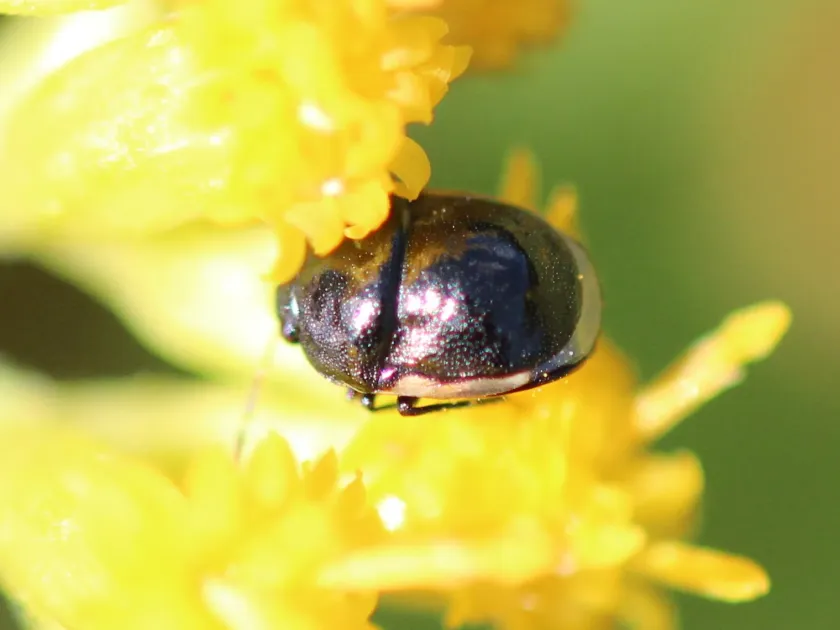
The ebony bug, belonging to the genus Corimelaena and the family Thyreocoridae, is a small insect often mistaken for a beetle due to its distinctive appearance. These bugs have a highly convex, almost hemispherical, and glossy black or dark brown body.
Adults typically measure between 3 and 6 millimeters in length. Their most prominent feature is the enlarged scutellum, which covers almost the entire abdomen and wings, giving them their characteristic round and compact shape. Unlike beetles, however, they possess a piercing-sucking mouthpart.
Nymphs are similar in shape to the adults but are smaller, often lighter in color or mottled, and lack fully developed wings. They undergo several molting stages, gradually increasing in size until they reach maturity.
Ebony bugs are known for their gregarious behavior, often clustering in groups on the stems or at the base of plants. When threatened, they emit a pungent, unpleasant odor from scent glands, which is a common defensive mechanism among shield bugs.
Their exoskeleton is notably tough and resilient, protecting them from various environmental stressors and some natural predators. This physical durability makes them well-adapted to surviving in diverse habitats, including agricultural fields and wild meadows.
What it damages
Ebony bugs feed on a variety of plants, including small fruits like blackberries and raspberries, as well as various grains and legumes. They use their specialized proboscis to puncture plant tissues and extract vital sap, causing significant stress to the host plant.
During the feeding process, the bugs inject saliva containing digestive enzymes into the plant tissue. These enzymes break down the plant cells, leading to necrotic spots, yellowing, and localized death of the plant's vascular tissue.
Fruits damaged by these insects often become deformed, unmarketable, and develop a persistent, unpleasant "buggy" flavor and odor. This renders the produce entirely unsuitable for fresh consumption or commercial food processing, leading to economic losses.
On cereal crops, the bugs focus on developing grains and stems. Feeding at the milky stage of grain development can lead to shriveled seeds, reduced germination rates, and an overall decrease in yield quantity and quality.
In addition to direct feeding damage, ebony bugs act as vectors for various plant pathogens. By creating openings through their punctures, they facilitate the entry of fungi and bacteria, which can cause secondary infections and potentially wipe out entire sections of a crop.
When it appears
The activity of the ebony bug typically begins in early spring as temperatures rise consistently above 12 degrees Celsius. Adults emerge from their overwintering sites, initially feeding on available weeds and grasses before moving to more suitable crops.
The period of peak reproduction and damage coincides with the flowering and fruit-setting stages of the host plants. During this time, they migrate in large numbers into fields, where they concentrate their feeding on the most succulent parts of the plants.
Depending on the climatic zone, these insects can complete one or more generations per year. Warm, dry weather conditions are generally optimal for their development, significantly speeding up the life cycle of the nymphs.
As late summer approaches, their activity declines as the population prepares for dormancy. Adults begin searching for protected overwintering sites, such as the soil, leaf litter, or debris, where they stay until the following spring.
Survival through the winter is a critical bottleneck for the population. Stable temperatures and sufficient snow or organic cover are essential for the insects to survive until the next growing season, after which the cycle repeats.
Signs of infestation
The initial signs of an infestation include the appearance of tiny pale or brown necrotic dots on the leaves and stems. As feeding continues, these spots enlarge, causing the leaves to curl, yellow, and eventually drop off prematurely.
One of the most telling signs is the presence of an unpleasant, characteristic smell when working near the plants. If the branches are shaken, the small, shiny black insects can often be seen falling to the ground or scurrying to hide.
On cereals, affected stalks may show signs of "white heads," where the upper portion of the plant dies back due to damage to the nutrient-conducting vessels. This is a clear indicator that the crop's vascular system has been compromised.
The presence of dark fecal spots on the foliage and the fruit surface is another common sign of a significant infestation. In severe cases, the entire plant may show signs of wilting and stunted growth long before harvest.
Monitoring the fields early in the morning when the insects are less mobile is the most effective way to detect them. Using yellow sticky cards or sweeping nets can help farmers identify the presence of the bugs before the damage becomes extensive.
Control measures
Integrated Pest Management (IPM) is the best approach, starting with good cultural practices. Keeping fields and perimeters free of weeds is crucial, as many weeds serve as early-season hosts for the ebony bug population.
Crop rotation is an effective way to break the life cycle of the pest, making it harder for the population to build up over consecutive seasons. Deep plowing in the autumn can help bury and destroy the sites where the bugs intended to overwinter.
If chemical intervention is necessary, insecticides with contact action should be applied during the nymphal stages, as they are most vulnerable before their shields harden. Always ensure products are approved for the specific crop and follow label rates strictly.
Biological control, such as encouraging natural predators like spiders, wasps, and predatory bugs, can help manage populations naturally. Microbial pesticides that target these specific insects are also becoming a viable alternative to harsh chemical treatments.
- Maintain weed-free field borders to eliminate host plants.
- Practice deep tillage after harvest to reduce overwintering success.
- Use pheromone or sticky traps to monitor population density.
- Apply selective insecticides during peak nymph activity periods.
Taxonomy
- Latin name
- Corimelaena
- Order
- Hemiptera (bugs, aphids, leafhoppers)
- Family
- Cydnidae
- EPPO code
- CORISP
Discussion
No discussions yet — be the first.