
Thyanta perditor
Thyanta perditor
Description
How to identify
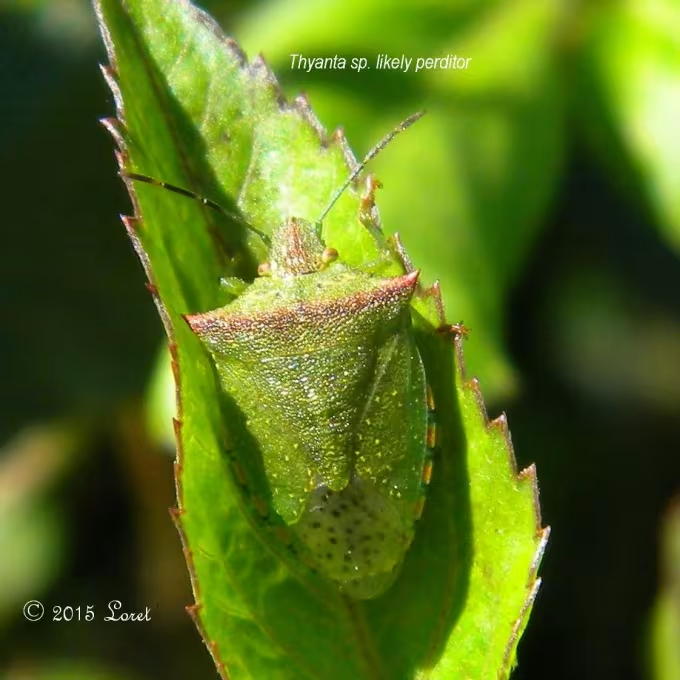
Thyanta perditor belongs to the order Hemiptera and the family Pentatomidae (stink bugs). Adult specimens exhibit the characteristic shield-shaped body typical of the family and are colored in bright green or yellowish-green hues.
The edges of the pronotum often feature pointed projections, and the upper part of the body may display dark or reddish spots, the intensity of which varies between individuals. The body length of the adults usually ranges from 8 to 12 millimeters.
The eggs of this species are barrel-shaped and are typically laid in clusters, adhering tightly to each other, most commonly on the underside of the host plant leaves.
Nymphs of the early instars differ visually from the adults: they have a more rounded shape and may change color during molting as they progress through several developmental stages.
This species is widely distributed in Latin American countries and regions with warm climates, where it remains active throughout most of the growing season.
What it damages
This pest is a polyphage and causes significant damage to many economically important agricultural crops, including soybeans, corn, beans, and other legumes.
Adult bugs and nymphs feed by piercing plant tissues with their piercing-sucking mouthparts and extracting cell sap from the plant's reproductive organs.
Crops are most sensitive to damage during the seed formation and filling periods, as punctures in the pods or ears lead to the development of pathogens and grain shriveling.
As a result of insect feeding activity, there is a significant reduction not only in yield quantity but also in the market quality of the produce.
Damaged seeds lose viability and possess low protein content, rendering them unsuitable for further processing or use as planting material.
When it appears
The activity of the bug is directly dependent on temperature and air humidity, so the peak reproduction occurs during the warmest months of the growing season.
Reproduction occurs over several generations, with the intensity of field colonization increasing in proportion to rising ambient temperatures during the spring and summer periods.
At the start of the season, pests migrate to fields from weeds or wild perennial plants, which serve as primary population reservoirs.
Optimal conditions for a rapid life cycle (from egg to adult) are created during consistently high temperatures, which allows the pest to increase its population density rapidly.
In autumn, as temperatures drop, bug activity decreases, and they enter diapause in shelters or plant debris to survive the winter.
Signs of infestation
The primary sign of the pest's presence in the field is the detection of adults or nymphs clustered on the surfaces of leaves and stems of cultivated plants.
Damaged soybean pods are often covered with tiny necrotic dots at the puncture sites, which may enlarge and darken over time.
Plants may exhibit stunted growth, and damaged organs (flowers or ovaries) often drop before a full harvest can form, leading to reduced plant stands.
- Yellowing or wilting of localized leaf areas.
- Deformation of seeds within the pods.
- Presence of empty egg shells on the underside of leaves.
- Development of fungal infections at the tissue damage sites.
When scouting fields, it is important to check the inner canopy of the crop, where bugs prefer to hide from direct sunlight during hot periods of the day.
Control measures
Population monitoring is the primary control method, based on regular field surveys using sweep nets to assess infestation levels.
Upon reaching the economic threshold of damage, the application of registered systemic insecticides is recommended to manage the pest population.
Agricultural practices play an important role: timely weed control in fields and surrounding areas significantly reduces the pest's concentration spots.
Crop rotation must be strictly followed, as monocultures create favorable conditions for pest accumulation in the soil and plant debris.
Biological control methods, including the preservation of natural enemies (such as egg parasitoids and predatory insects), help to limit bug numbers without relying solely on intensive chemical use.
Taxonomy
- Latin name
- Thyanta perditor
- Order
- Hemiptera (bugs, aphids, leafhoppers)
- Family
- Pentatomidae
- EPPO code
- THYNPE
Discussion
No discussions yet — be the first.