
Thyanta accerra
Thyanta accerra
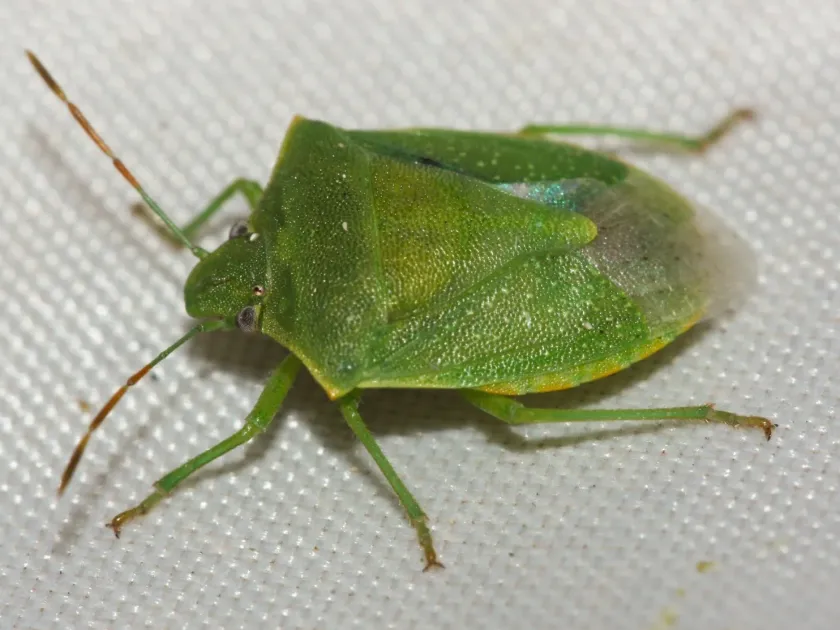
Description
How to identify
Thyanta accerra belongs to the family Pentatomidae, commonly known as stink bugs. The adults exhibit the typical shield-shaped body, with coloration ranging from light green to yellowish-green, often featuring a reddish or brownish border along the margins of the pronotum.
The insect's lifecycle comprises the egg stage, five nymphal instars, and the adult stage. Eggs are typically laid in clusters on the undersides of host plant leaves and are barrel-shaped, often changing color as the embryo matures.
Nymphs of early instars are often distinct in appearance from adults, going through several molts. Each developmental stage has specific morphological characteristics that allow entomologists to identify the species during field monitoring.
Adults possess a well-developed proboscis adapted for piercing plant tissues and extracting cell sap. High mobility in adults enables them to spread rapidly across fields when environmental conditions are favorable or when host plant resources become depleted.
For accurate identification in field conditions, agronomists use visual inspection of vegetative and reproductive parts of plants, as well as sweep-net sampling to assess population density and dynamics.
What it damages
This pest is a polyphage, though it shows a strong preference for members of the legume family. Primary damage is inflicted on soybean, bean, pea, and other pulse crops, which serve as essential nutritional sources for the insect.
Adult stink bugs and their nymphs damage both vegetative tissues and developing fruit. The greatest economic threat occurs when they feed on seeds within the pods during the seed-filling stage, which significantly reduces the quality of the harvested crop.
In addition to legumes, Thyanta accerra can feed on various weed species, which act as reservoirs for population growth at the start of the season. These include various grasses and members of the Asteraceae family.
In cases of heavy infestation, stink bugs can damage not only pods but also young stems, causing deformation and growth retardation. Damaged plant tissues serve as entry points for secondary infections, including various fungal and bacterial pathogens.
Economic losses include reduced seed germination, diminished marketability due to spotting or shriveling, and overall yield decline, which is critical for large-scale commercial agricultural production.
When it appears
The lifecycle of this pest is closely linked to the phenology of host plants and climatic conditions. Adults overwinter in plant debris, leaf litter, or other sheltered environments along field margins.
Emergence from diapause occurs in spring as stable, warm temperatures are established. The first generation typically develops on weeds before the pest migrates to commercial crop fields.
Population peaks and maximum activity often coincide with the flowering and pod-filling stages of soybeans. This period requires intensified scouting to manage populations before significant damage occurs.
The number of generations per season depends on the local climate; in regions with longer growing seasons, the pest can complete multiple cycles, increasing the risks for late-planted crops.
As temperatures decline and host crops reach maturity toward the end of the season, the insects begin searching for suitable overwintering sites, often migrating from fields into woodlots or non-cultivated areas.
Signs of infestation
Initial signs of infestation include the presence of adult bugs and nymphs on the undersides of leaves or on pods. Inspection may reveal small light-colored or necrotic spots at the feeding puncture sites.
Damaged pods often contain deformed or underdeveloped seeds with characteristic indentations. Such seeds frequently display color changes and a hardened texture, which complicates processing and storage.
Stink bug excrement on leaves and pods is another indirect sign of pest activity. Small, dark fecal spots may be visible on the surface of plant tissues where the insects have been feeding.
- Stunted growth of young shoots during heavy infestations.
- Premature shedding of blossoms and young legume pods.
- Presence of hollow or shriveled seeds during harvesting.
- Delayed maturity of plants that were damaged at early growth stages.
Special attention should be paid to field edges, where bug concentrations are typically higher. Detecting initial individuals serves as a trigger to implement protective measures to prevent widespread damage.
Control measures
Integrated Pest Management (IPM) for Thyanta accerra includes cultural, biological, and chemical methods. An important element is the management of weeds near field borders, which act as primary breeding sites.
Crop rotation and optimized planting dates help avoid peak pest populations during the most vulnerable crop development phases. Maintaining crop vigor helps plants better withstand insect feeding.
Chemical control involves the application of systemic or contact-stomach insecticides when economic injury thresholds are exceeded. Applications are most effective against early-instar nymphs.
Biological control strategies include the use of natural enemies, such as parasitoid wasps from the family Scelionidae, which can significantly suppress stink bug populations through natural regulation.
Consistent monitoring using pheromone traps or sweep-net sampling is essential to make timely, data-driven decisions regarding the necessity and timing of insecticide applications.
Taxonomy
- Latin name
- Thyanta accerra
- Order
- Hemiptera (bugs, aphids, leafhoppers)
- Family
- Pentatomidae
- EPPO code
- THYNAC
Discussion
No discussions yet — be the first.