
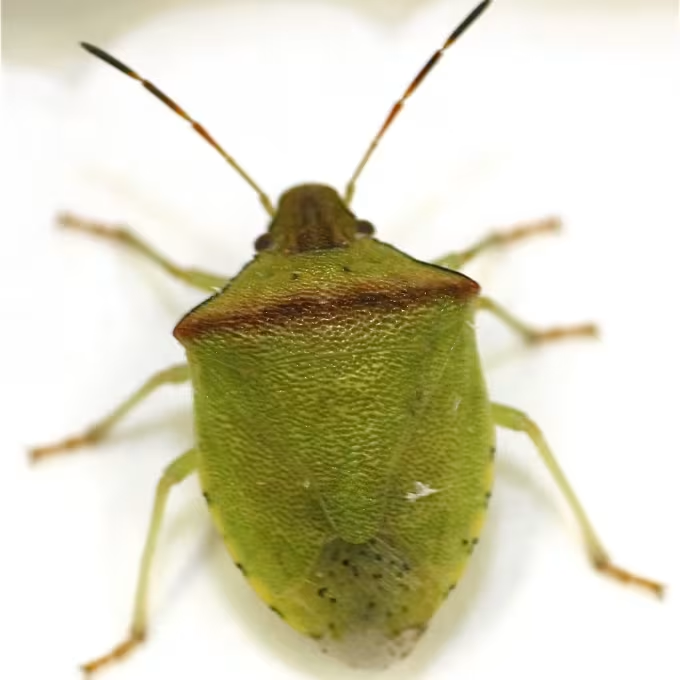
Green stink bug of the genus Thyanta
Thyanta
Description
How to identify
Bugs of the genus Thyanta belong to the Pentatomidae family, commonly known as stink bugs. Adults are generally shield-shaped and display a bright green or yellowish-green coloration, which serves as excellent camouflage.
A key diagnostic feature of this genus is the presence of pronotal angles, which can be sharp or obtuse depending on the specific species within the group. Adult body length typically ranges from 8 to 12 mm.
The eggs are barrel-shaped and are usually deposited in organized, neat rows on the undersides of leaves of the host plants, often numbering several dozen per cluster.
Nymphs undergo several instars during their development, during which they gradually transition in color and pattern, often showing stripes or spots on their abdomens.
The primary feeding tool is a piercing-sucking proboscis, adapted to penetrate plant tissues and extract sap, which is the hallmark of this insect's feeding behavior.
What it damages
Thyanta species are polyphagous pests that attack a wide variety of agricultural crops, including tomatoes, soybeans, beans, corn, and various fruit trees.
Damage is caused when the bug pierces plant tissue, introducing digestive enzymes through its saliva that cause localized necrosis and tissue collapse at the feeding site.
On tomato fruits, feeding results in the development of light-colored, discolored spots and internal corky tissues, significantly degrading both marketability and quality.
In soybean fields, feeding on developing seeds leads to shriveling, malformation, and reduced yield, often impacting the nutritional value and viability of the harvest.
Severe infestations can lead to stunted plant growth, fruit deformation, and premature abscission of buds and developing fruits, causing substantial yield loss.
When it appears
These insects overwinter as adults, seeking refuge in plant debris, under leaf litter, or in protected areas near field margins and woodlands.
As spring temperatures rise, the adults emerge from their overwintering sites and begin feeding on weeds and wild hosts before migrating to cultivated crops.
Population levels generally peak during mid-summer, when conditions are ideal for rapid reproduction and multiple generations may occur within a single growing season.
The number of generations depends heavily on regional climate and temperature, which dictates how long the pressure remains active throughout the summer months.
In the fall, triggered by shorter days and cooler temperatures, the bugs return to protected sites to enter diapause and complete their annual cycle.
Signs of infestation
Early signs of an infestation include the appearance of tiny puncture wounds on fruit surfaces, often surrounded by halos or mottled discoloration as the cells die.
Observation of the plants may reveal clusters of nymphs on the undersides of leaves or feeding directly on stems and reproductive parts like buds or pods.
Localized patches of stunted plants or deformed fruit are common indicators that a colony has established itself and is actively feeding on the crop.
The presence of a pungent, unpleasant odor, particularly when the insects are disturbed, is a strong indicator of a high concentration of stink bugs in the vicinity.
Visible wilting or yellowing of foliage in areas where the bugs congregate is common, especially during hot, dry weather when the plants are under stress.
Control measures
Cultural management is the first line of defense, focusing on the removal of weed hosts that provide early-season food and shelter for the bugs.
Implementing effective crop rotation and deep tillage post-harvest helps destroy the overwintering habitat and reduces the local population density for the next season.
Biological control, utilizing natural enemies such as egg parasitoids, can be an effective component of an integrated pest management strategy to suppress numbers.
Chemical intervention with insecticides may be necessary when thresholds are exceeded, ideally targeting early nymphal stages for maximum efficacy.
- Use of pheromone traps for monitoring.
- Selective application of contact insecticides.
- Clearing of crop debris to eliminate winter hideouts.
Taxonomy
- Latin name
- Thyanta
- Order
- Hemiptera (bugs, aphids, leafhoppers)
- Family
- Pentatomidae
- EPPO code
- THYNSP
Discussion
No discussions yet — be the first.