
Chinese slug moth
Thosea sinensis
Description
How to identify
The Chinese slug moth (Thosea sinensis) is a species of the Limacodidae family. The adult moth has a wingspan of approximately 30–40 mm and typically displays brownish hues on its wings.
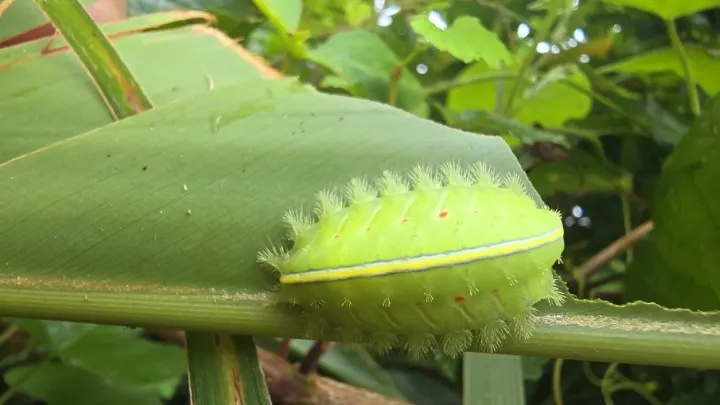
The larva, or caterpillar, is the most distinctive stage of its life cycle. It has a flattened, oval shape that lacks clearly visible legs, resembling a garden slug, which gives the family its common name.
The skin of the caterpillar is covered in specialized hairs and stinging spines. These spines are connected to poison glands, which can cause painful skin irritation or allergic reactions in humans upon contact.
The larvae are typically bright green or yellowish, often featuring longitudinal stripes or patterns that allow them to blend in perfectly with the foliage of their host plants.
The species undergoes complete metamorphosis: egg, larva, pupa, and adult. They typically overwinter as a pupa, protected by a hard, oval-shaped cocoon attached to bark or hidden in the soil near the host tree.
What it damages
This pest is highly polyphagous, meaning it feeds on a wide range of host plants, including apple, pear, plum, peach, and various citrus species, as well as some ornamental trees.
The larvae feed on the leaf tissues, initially consuming the epidermis and eventually skeletonizing the leaves, leaving only the primary veins intact.
Severe infestations can lead to significant defoliation, which impairs the tree's ability to photosynthesize, weakening the plant and negatively affecting future fruit yields.
In nurseries, these pests are particularly damaging to saplings, as they can stunt growth and ruin the quality of young shoots, making them unsuitable for sale or planting.
While leaf damage is the primary issue, larvae may also occasionally feed on young fruit, creating superficial scars or small lesions that lower the market value of the harvest.
When it appears
Adult moths usually emerge in late spring or early summer, depending on the climatic zone and temperature conditions of the region.
The larvae appear later in the season and are most active during the middle of the summer, which coincides with the period of peak foliage growth for most fruit crops.
Depending on the latitude and local climate, the species may produce one or two generations per year, with the second generation often causing more visible damage in late summer.
As autumn approaches, the final-stage larvae construct their cocoons to transition into the pupal stage, where they will remain until the following spring.
Monitoring the adult flight period is crucial for timing effective control measures, though the nocturnal nature of the adults makes them difficult to observe.
Signs of infestation
The most common sign of an infestation is the appearance of skeletonized leaves in the upper parts of the tree canopy, often accompanied by the presence of frass (droppings) on the leaves below.
During the winter, look for hard, small, spherical or oval cocoons attached to the branches or bark of the trees, which are often camouflaged to match the tree bark.
A burning sensation or localized skin irritation after brushing against tree branches is a common, albeit unpleasant, indicator that larvae are present in the foliage.
A noticeable decline in the health and growth rate of young shoots can indicate that larvae are feeding on the new, tender plant tissues.
In the event of a heavy infestation, the movement of the caterpillars or the sound of them feeding on leaves may become evident in quiet environments.
Control measures
Mechanical control, such as carefully removing and destroying cocoons during the dormant season, is an effective way to significantly reduce the pest population for the coming year.
Biological control, specifically using products based on Bacillus thuringiensis, is highly recommended as it targets the larvae effectively while remaining safe for beneficial insects and the environment.
Chemical control with approved insecticides should only be used if economic damage thresholds are exceeded, preferably during the early larval development stages.
Promoting local biodiversity by encouraging natural predators such as birds, parasitic wasps, and beetles helps keep the slug moth population under natural control.
- Prune trees to ensure adequate airflow and light, making the environment less attractive to the pest.
- Use pheromone traps to monitor adult moth population levels.
- Clear debris and weeds under the tree canopy to reduce potential pupation sites.
Taxonomy
- Latin name
- Thosea sinensis
- Order
- Lepidoptera (butterflies)
- Family
- Limacodidae
- EPPO code
- THOSSI
Discussion
No discussions yet — be the first.