
Nettle caterpillar
Thosea asigna
Description
How to identify
The Nettle caterpillar (Thosea asigna) belongs to the Limacodidae family, order Lepidoptera. While the adult is a nocturnal moth, it is the larval stage that is notorious for causing agricultural damage.
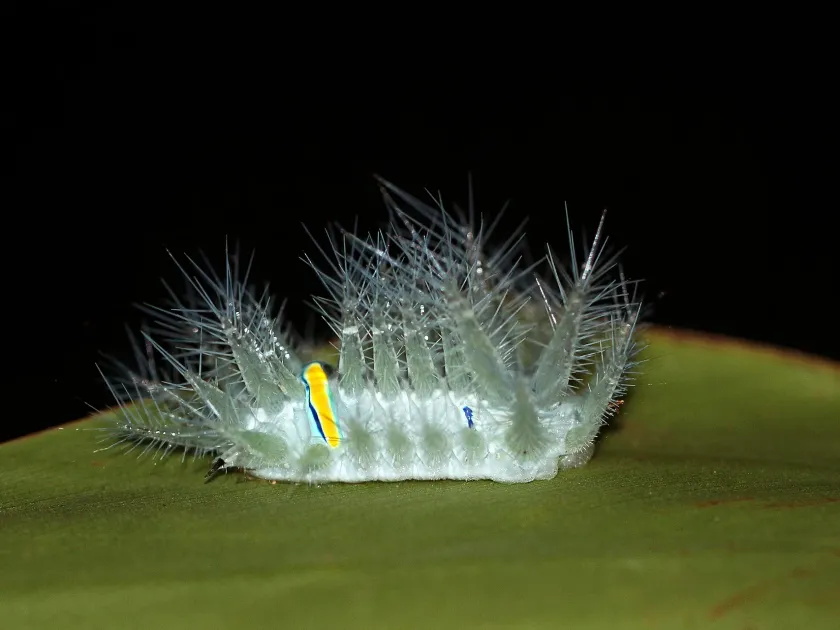
The larvae are characterized by a slug-like appearance, as they lack prominent prolegs and move in a gliding motion. Their bodies are covered in short, urticating bristles that can cause skin irritation upon contact.
Typically, these caterpillars are light green or yellowish, providing excellent camouflage against the foliage they inhabit. They often feature distinct longitudinal stripes or rows of bright spots along their backs.
Adult moths possess drab, brownish wings that allow them to blend into tree bark during the day. Their wingspan generally ranges from 3 to 5 centimeters.
The life cycle involves egg, larval, pupal, and adult stages. The duration of their development is highly dependent on regional temperatures and humidity levels.
What it damages
The primary host for Thosea asigna is the oil palm, making it a significant pest in tropical agricultural regions where these palms are cultivated commercially.
In addition to oil palms, they can infest cocoa trees, coconut palms, tea bushes, and various fruit trees. High populations can lead to complete defoliation of young seedlings.
The larvae possess strong mandibles that allow them to consume entire leaves, leaving behind only the tough veins. This significantly reduces the plant's capacity for photosynthesis.
Severe infestations result in stunted plant growth, weakened immunity, and substantial yield losses. The impact on production can be devastating if left unchecked.
The pest's ability to reproduce rapidly and spread across plantations makes it a high-priority threat for agronomists and plantation managers alike.
When it appears
Activity levels are directly linked to environmental conditions. In tropical climates, these caterpillars can remain active and continue their life cycle year-round.
Population surges frequently occur following rainy seasons when young, succulent foliage is abundant. This new growth provides optimal feeding conditions for the larvae.
During drier periods, pupation occurs within durable cocoons, often found in sheltered areas on the plant or in the soil, allowing the pest to survive suboptimal conditions.
Agronomic practices, such as intensive fertilization, may inadvertently trigger population spikes by promoting rapid vegetative growth that attracts the pests.
Ongoing monitoring is essential because generational overlapping is common, meaning larvae of different instars are often present simultaneously on the same host plant.
Signs of infestation
The first sign of infestation is skeletonized leaves, where the soft tissues have been eaten away. Egg clusters can often be found on the undersides of the leaves.
Locating the caterpillars themselves can be difficult due to their effective mimicry. However, a careful inspection of the lower leaf surfaces usually reveals their presence.
Frass (droppings) accumulation on the ground or on lower leaves is a clear indicator that the caterpillars are actively feeding in the upper canopy of the plant.
The discovery of oval, hard-shelled cocoons on leaves or tree trunks confirms that the life cycle is progressing and that further generations are likely to follow.
Widespread yellowing or premature drying of the foliage is a sign of advanced damage, signaling that the infestation has reached a critical level requiring intervention.
Control measures
Biological control is the primary strategy, utilizing natural predators such as parasitoid wasps and entomopathogenic fungi to suppress larval populations.
Manual removal of caterpillars and infested leaves is effective for smaller plots or in the very early stages of an outbreak to prevent further spread.
Chemical insecticides should be used as a last resort, strictly adhering to economic threshold values to avoid disrupting the balance of beneficial natural enemies.
Proper agronomic management, including weed control and maintaining overall plantation health, can significantly reduce the vulnerability of plants to these pests.
Using pheromone traps helps in monitoring the flight activity of adult moths, allowing for the precise timing of targeted treatments to maximize control efficiency.
Taxonomy
- Latin name
- Thosea asigna
- Order
- Lepidoptera (butterflies)
- Family
- Limacodidae
- EPPO code
- THOSAS
Discussion
No discussions yet — be the first.