
Vine bud moth
Theresimima ampelophaga
Description
How to identify
The Vine bud moth (Theresimima ampelophaga) belongs to the Zygaenidae family and is a significant pest primarily affecting cultivated grapevines.
Adult moths have a wingspan of approximately 20–25 mm, featuring a dark brown or black coloration with a distinctive metallic luster.
Larvae, commonly known as caterpillars, grow up to 10–12 mm long and are yellowish-green with dark longitudinal stripes, providing camouflage on the leaves.
They overwinter as second or third-instar larvae under the bark of old vines, in crevices of trunks, or within dry plant debris.
Pupation occurs in spring, with the insects forming dense, spindle-shaped cocoons attached to vine bark or supporting structures like trellises.
What it damages
The primary damage is caused by the larvae, which feed on various parts of the vine depending on the current stage of the plant's development.
In early spring, larvae attack the buds, which can lead to the destruction of entire shoots and a significant reduction in the expected harvest.
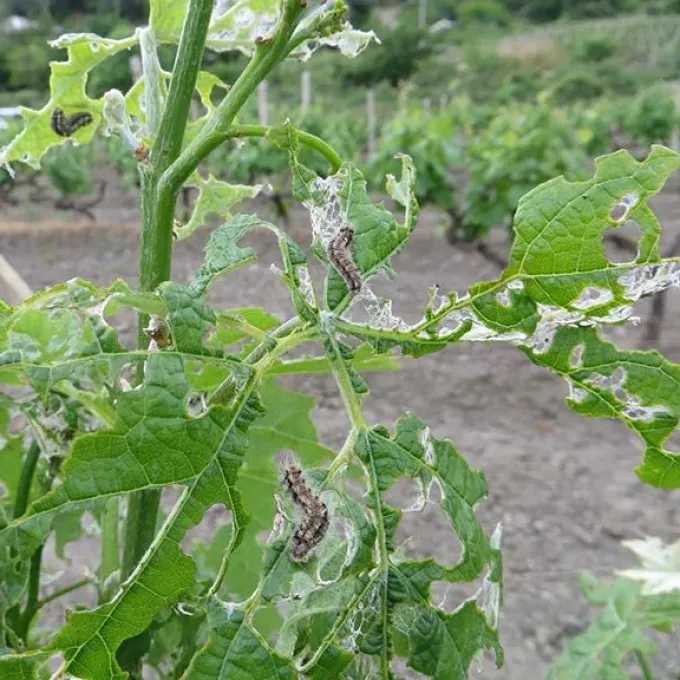
As the season progresses, the caterpillars switch to feeding on the leaves, consuming the leaf tissue and leaving only the skeleton of veins behind.
Severe infestations result in extensive defoliation, which severely hampers the vine's ability to undergo photosynthesis and store energy for the winter.
Weakened vines become more susceptible to frost damage and various secondary diseases, which can lead to long-term decline in plant health.
When it appears
The lifecycle is univoltine, meaning one generation per year, with adult moths emerging and flying between May and July.
Females lay their eggs on the underside of leaves, where they hatch into small caterpillars after approximately two weeks of incubation.
The peak activity and feeding period for the larvae occur during the summer months of June and July when vine growth is at its most vigorous.
At the end of the summer, mature larvae enter a dormant state, seeking out shelter in bark or debris to survive the winter season.
Climate variables such as spring temperature spikes can trigger earlier emergence, making monitoring in early spring crucial for effective management.
Signs of infestation
The most visible sign of infestation is "skeletonized" leaves, where the soft tissue has been consumed, leaving only a network of vascular veins.
Close inspection of the foliage often reveals clusters of larvae on the underside of leaves or small dark excrement pellets dropped onto lower leaves.
Cocoons can often be spotted on wooden posts or wires of the trellising system, indicating the presence and transition of the moth population.
Buds that fail to sprout in the spring despite warm temperatures are a tell-tale sign of previous caterpillar feeding damage during the early growing season.
- Circular or irregular holes in leaves.
- Complete loss of leaf lamina in severe cases.
- Presence of small dark droppings under feeding sites.
- Stunted shoot growth and premature leaf drop.
Control measures
Cultural control involves removing and burning old bark from the vines during the dormant season to eliminate overwintering larvae.
Biological control using Bacillus thuringiensis (Bt) products is highly effective against larvae and poses minimal risk to beneficial vineyard insects.
Chemical insecticides should be applied during the period of mass egg-hatching, usually shortly after the vine's flowering stage.
Monitoring the vineyard with pheromone traps can help track moth emergence and determine the optimal timing for protective interventions.
Integrated Pest Management (IPM) practices should be prioritized to reduce pesticide residues on the grapes while maintaining crop health and safety.
Taxonomy
- Latin name
- Theresimima ampelophaga
- Order
- Lepidoptera (butterflies)
- Family
- Zygaenidae
- EPPO code
- THEEAM
Discussion
No discussions yet — be the first.