
Yellow cereal fly
Thaumatomyia notata
Description
How to identify
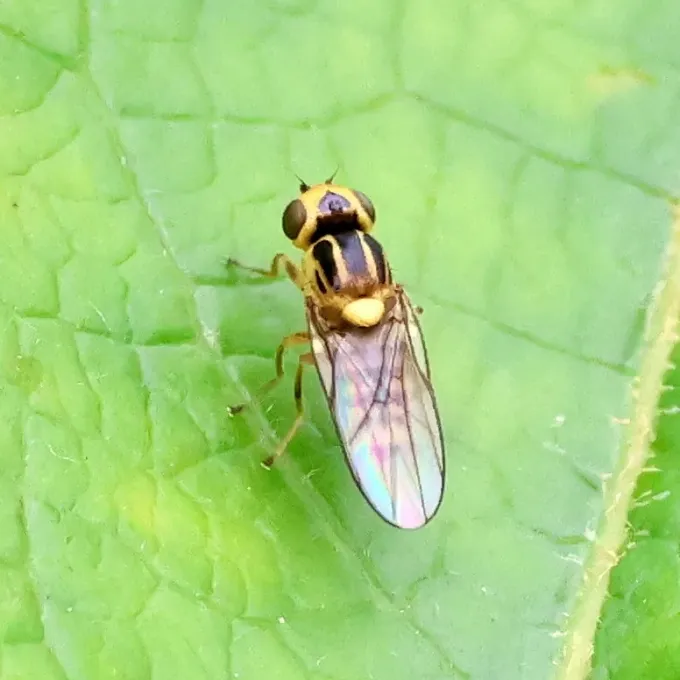
The yellow cereal fly (Thaumatomyia notata) is a member of the Chloropidae family within the order Diptera. Adults are small insects, typically 2–3 mm in length, easily recognized by their bright yellow bodies featuring distinctive black longitudinal stripes on the mesonotum.
The head of the adult fly possesses well-developed compound eyes and short antennae. Their wings are transparent with typical chloropid venation. The legs are also yellow, making them conspicuous against the green foliage of cereal crops.
The larvae are cylindrical, legless, and vary in color from whitish to pale yellow. They possess specialized posterior spiracles that allow them to breathe while residing inside the tissues of host plants.
The life cycle encompasses four stages: egg, larva, pupa, and adult. Females typically deposit eggs on the surface of host plants or near the root zone. Development is strongly influenced by temperature and environmental conditions.
This species exhibits remarkable ecological plasticity, allowing it to adapt to various climatic zones and successfully colonize diverse cereal crops throughout the growing season.
What it damages
The primary hosts of the yellow cereal fly are members of the Poaceae family. This includes major agricultural crops such as winter and spring wheat, barley, rye, and oats, as well as numerous wild grasses.
The larvae cause direct damage by feeding on the internal tissues of young shoots. By boring into the stems or leaf axils, they disrupt the transport of nutrients and water, severely affecting the plant's growth trajectory.
Damage is most critical during the tillering stage. The destruction of the central shoot often prevents the plant from developing a productive ear, which leads to a significant decrease in final grain yield.
In cases of high population density, the fly causes irregular crop stands. Damaged plants are often weakened, making them significantly more susceptible to secondary fungal infections and environmental stressors.
While adult flies mainly feed on nectar and aphid honeydew, the larval stage is the primary phytophagous phase. Their ability to switch between being plant-feeders and predator larvae makes them a complex component of the agro-ecosystem.
Signs of infestation
The earliest symptom of infestation is the yellowing and subsequent wilting of the central leaf in young shoots. Closer inspection of the stems reveals tunnels created by feeding larvae.
Affected plants often display stunted growth and excessive tillering, which is a physiological response to the loss of the central stalk. In some instances, necrosis and secondary rot may appear at the injury site.
During sunny periods, adults can be observed flying over the crop canopy. High levels of adult activity are a strong warning sign, indicating that eggs are likely being laid on the plants.
Uneven crop height and overall developmental delays compared to healthy fields are characteristic signs of infestation. In severe outbreaks, total loss of individual tillers is common.
Diagnosis requires careful examination of the stem base using a hand lens. Larvae are typically found within leaf sheaths or inside the stems, necessitating thorough scouting of the crop at the early growth stages.
Control measures
Managing the yellow cereal fly requires an integrated approach that combines cultural practices, biological control, and chemical interventions when necessary.
- Implementation of crop rotation to prevent the buildup of local populations.
- Effective post-harvest plowing and the destruction of cereal volunteers that act as reservoirs.
- Adjustment of sowing dates to avoid synchronizing the seedling stage with the peak fly activity period.
- Application of systemic insecticides based on economic threshold monitoring.
- Balanced nutrient management to promote rapid plant recovery following minor infestations.
Chemical control should be targeted based on scouting results. Pyrethroids and organophosphate insecticides are effective against adult flies and early larval stages if applied correctly.
Spatial separation of new cereal plantings from existing older fields helps restrict the migration of the pest. Monitoring programs remain the most critical tool for minimizing crop losses and ensuring agricultural productivity.
Taxonomy
- Latin name
- Thaumatomyia notata
- Order
- Diptera (flies)
- Family
- Chloropidae
- EPPO code
- THAYNO
Discussion
No discussions yet — be the first.