
Cereal fly Thaumatomyia
Thaumatomyia
Description
How to identify
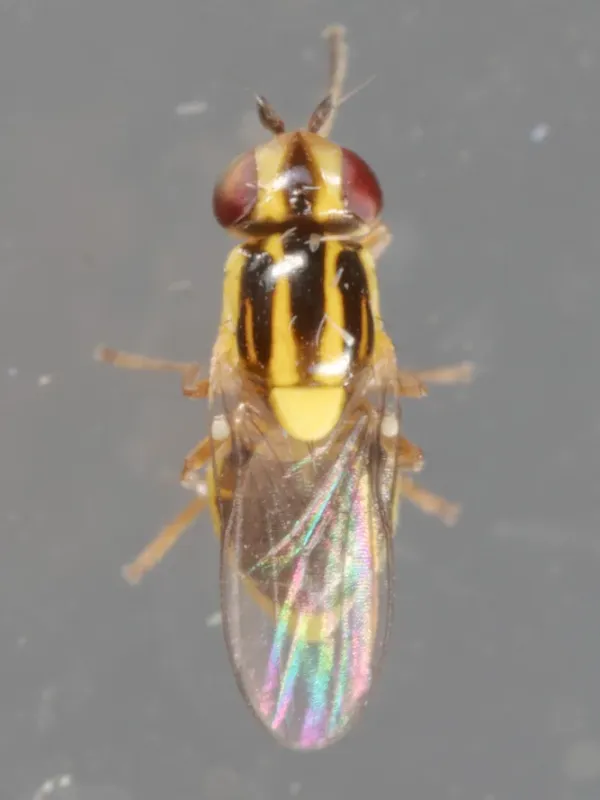
The cereal fly Thaumatomyia glabra belongs to the family Chloropidae within the order Diptera. These are small insects, typically measuring 2–3 mm in length, known for their yellow and black striped thorax.
Adult flies are highly mobile and use their well-developed wings to colonize new fields during the early stages of cereal development. The larvae are small, cylindrical, and white, specialized for living inside plant tissues.
Due to their small size and hidden lifestyle, identification of Thaumatomyia usually relies on detecting characteristic plant damage or finding pupae at the base of the stems.
The life cycle is closely tied to environmental temperatures, with moderate conditions favoring rapid development. They typically overwinter in the soil or crop debris as larvae or pupae.
It is essential to distinguish Thaumatomyia from other cereal flies to implement specific management strategies, as life cycles and susceptibility to control measures vary among species.
What it damages
The primary hosts for Thaumatomyia are cereal crops, including wheat, barley, rye, and oats. In some environments, wild grasses serve as alternative hosts, maintaining the pest population between crop seasons.
The larvae are specialized phytophages that feed on the soft tissues of developing stems. By attacking the apical meristem (the growing point), they cause severe physiological stress and growth arrest.
The most critical damage occurs during the tillering stage. When the main stem is damaged, the plant's development is stunted, leading to a significant reduction in grain yield and quality.
Larval feeding often creates entry points for secondary fungal and bacterial pathogens, which further complicate the health of the crop and can lead to total loss of individual tillers.
Infestations often result in uneven stands, where affected plants exhibit stunted growth, which reduces the overall photosynthetic capacity of the field.
When it appears
Adult activity typically begins in the spring when average temperatures consistently rise above +12 to +15 degrees Celsius. This timing aligns with the early tillering of winter and spring cereals.
Depending on the climatic conditions, multiple generations can occur during the growing season. The intensity of infestation is strongly correlated with rainfall and soil moisture during the oviposition period.
The peak risk period for crops is between May and June. During this time, monitoring using yellow sticky traps or sweep netting is highly recommended for threshold detection.
As summer wanes, the population enters a phase of diapause or seeks shelter for overwintering, significantly reducing the pressure on the crop until the next season.
Predicting the arrival of these pests depends on analyzing local temperature trends and monitoring the previous season's infestation levels to adjust planting schedules.
Signs of infestation
The most prominent sign of infestation is the yellowing and wilting of the central leaf on young shoots. This is a clear indicator that the apical meristem has been damaged.
Affected plants often show stunted growth and irregular development. The stems may appear thickened or twisted, as the plant attempts to compensate for damage by forming secondary tillers.
Patches of chlorotic plants scattered across the field indicate localized infestations. Close inspection often reveals the presence of larvae at the base of the stem or inside the sheath.
- Yellowing of the central leaf.
- Stunted growth and reduced vigor.
- Twisted or thickened stem morphology.
- Presence of larvae within the stem tissues.
Field scouting during the early morning hours, when adults are most active, allows for the visual detection of flies resting on leaves, which serves as a warning for impending egg-laying.
Control measures
Cultural management is the primary strategy, including strict adherence to crop rotation, which breaks the pest's cycle by removing the host plant for several years.
Deep plowing after harvest is highly effective, as it buries the overwintering pupae deep in the soil, preventing the emergence of adults in the spring.
Optimizing planting dates—avoiding the timing that coincides with peak fly activity—can significantly reduce the risk of infestation, allowing the crop to bypass its most vulnerable stage.
Chemical control involves the application of systemic insecticides during the peak of adult migration. Timing is critical to ensure efficacy before eggs are deposited on the plants.
Integrated pest management (IPM) practices, such as maintaining healthy soil fertility and utilizing resistant varieties, help crops recover more quickly from low-level pest stress.
Taxonomy
- Latin name
- Thaumatomyia
- Order
- Diptera (flies)
- Family
- Chloropidae
- EPPO code
- THAYSP
Discussion
No discussions yet — be the first.