
Thaneroclerus buqueti
Thaneroclerus buqueti
Description
How to identify
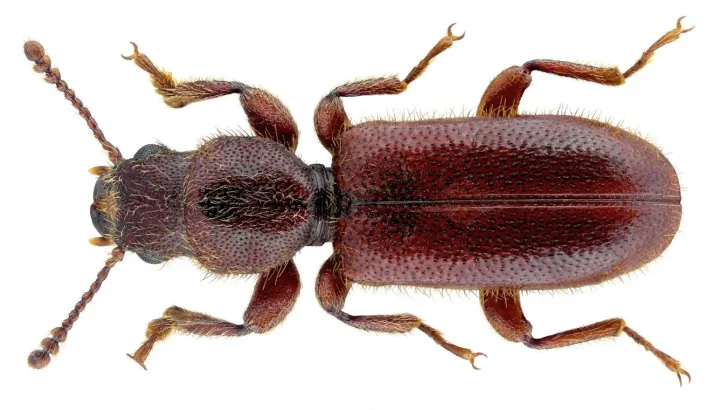
Thaneroclerus buqueti is a species of beetle belonging to the family Cleridae (checkered beetles). Unlike many other members of this family which are primarily predatory, this specific species is known as a pest of stored products.
The adult beetle is relatively small, measuring between 4 and 6 millimeters in length. Its body is elongated and typically dark brown to black in coloration, which helps it blend into dark environments.
Key morphological features include well-developed mouthparts and antennae. The larvae are elongated, worm-like, and adapted for boring into stored seeds, dried fruits, or nuts.
Taxonomically, it is classified within the order Coleoptera. Its presence in various regions is often linked to the global trade of dried food commodities, such as spices, herbs, and cereal products.
Professional identification usually requires microscopic analysis of the male genitalia or structural details of the elytra, as the beetle can be confused with other stored product coleopterans.
What it damages
This pest primarily attacks various dried goods including nuts, dried fruits, cereal grains, and pulses. It feeds on the internal tissues of the product, often leaving only hollow shells behind.
The larvae are the most destructive stage, causing significant damage by creating tunnels inside the product, which ruins its commercial value and makes it unfit for human consumption.
Infested products are further contaminated by the presence of larval frass, silk threads, and exuviae, leading to severe sanitary issues and regulatory rejections in food processing industries.
The pest is also known for its ability to penetrate packaging materials such as cardboard, paper, and thin plastic, facilitating its spread throughout the storage facility.
Mass infestations can result in total destruction of stored stocks if left unchecked, causing substantial financial losses for grain elevators and storage warehouses.
When it appears
In temperature-controlled warehouse environments, Thaneroclerus buqueti can breed continuously throughout the year, as it does not rely on seasonal changes to trigger its reproductive cycles.
The life cycle consists of egg, larval, pupal, and adult stages. Under optimal conditions (high temperature and sufficient humidity), the entire life cycle can be completed in a few months.
Increased activity is typically observed during warmer months when indoor temperatures in storage facilities rise, facilitating the flight and mating behaviors of the adult beetles.
The larval stage is highly resilient and can remain within deep piles of grain or dusty corners of a warehouse, making it difficult to eradicate with contact insecticides alone.
The beetle population remains most active when the storage facility lacks proper sanitation, as the accumulation of dust and spilled grain provides the necessary micro-habitats for development.
Signs of infestation
The most common signs of infestation include the presence of adult beetles crawling on the surface of stored containers, especially during the evening hours.
Small exit holes or entry holes found on the surface of packages and containers serve as a primary indicator of larval activity inside the goods.
The presence of fine powder or debris (frass) accumulating around containers is a hallmark sign that the beetle is feeding and tunneling within the product.
A musty or rancid odor emanating from the storage area can indicate heavy infestation and the subsequent growth of fungi, which the beetles often introduce to the product.
Expert diagnostic checks involve using sticky traps or pheromone traps to identify the presence of adults, combined with deep sampling of product bulk for larval presence.
Control measures
The cornerstone of management is strict warehouse sanitation, including regular cleaning of dust, spills, and debris from floors, walls, and equipment.
Chemical fumigation remains the most effective method for controlling established, deep-seated populations in large storage facilities and silos.
Implementing a strict temperature control program, maintaining storage temperatures below 15 degrees Celsius, can effectively slow or stop the development of the beetle.
Utilizing high-quality, pest-resistant packaging materials and keeping storage facilities sealed helps prevent the ingress of new pests and limits the cross-contamination of goods.
Monitoring programs using pheromone-based lures allow managers to detect early-stage infestations, enabling targeted control measures before a widespread outbreak occurs.
Taxonomy
- Latin name
- Thaneroclerus buqueti
- Order
- Coleoptera (beetles)
- Family
- Cleridae
- EPPO code
- THACBU
Discussion
No discussions yet — be the first.