
Ant beetle
Thanasimus formicarius
Description
How to identify
The ant beetle, scientifically known as Thanasimus formicarius, belongs to the family Cleridae, also known as checkered beetles.
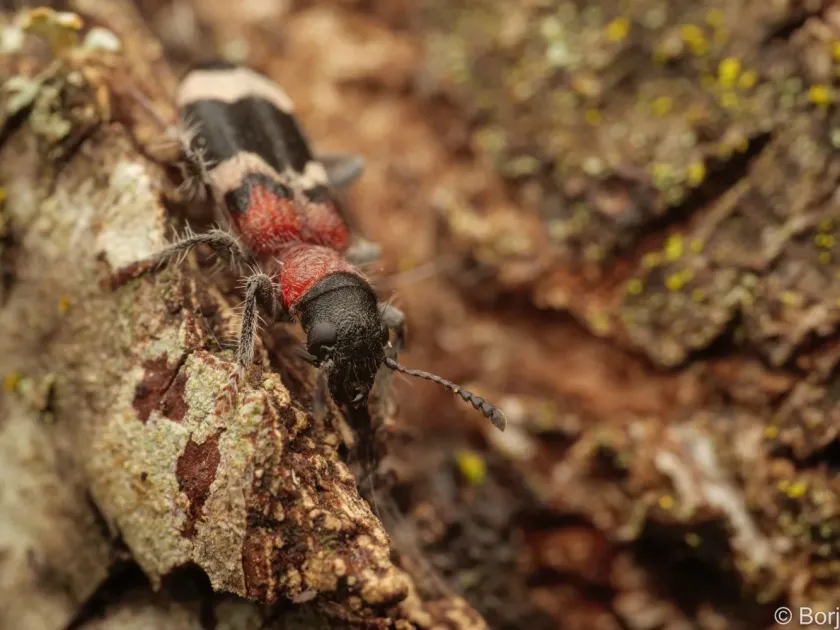
Adult beetles are 7–10 mm long, featuring a distinct red-brown coloration on the pronotum and legs, and a dark body with a prominent white transverse band on the elytra.
The common name refers to the adult insect's physical resemblance to a large ant, which allows it to blend into environments where ants might be present.
Larvae are characterized by a spindle-like shape and a bright pink or reddish color, making them easily identifiable during forest surveys.
This species is highly mobile and possesses strong, well-developed mouthparts used for hunting and consuming its prey on tree trunks.
What it damages
The ant beetle is not a plant pest; it is a beneficial insect and a specialized predator that targets stem-boring insects in coniferous forests.
It feeds primarily on bark beetles, including the European spruce bark beetle (Ips typographus), which causes significant damage to spruce and pine trees.
Both adult beetles and their larvae hunt the bark beetles; the larvae actively penetrate the bark to locate and destroy eggs, larvae, and pupae within the galleries.
Due to its voracious appetite for harmful borers, this beetle plays a vital role in natural forest hygiene and the regulation of pest outbreaks.
Its presence is considered a sign of a healthy, functioning ecosystem where natural biological controls are actively suppressing the proliferation of invasive pests.
When it appears
The active life cycle of the ant beetle begins in early spring, as temperatures rise and bark beetles emerge from their overwintering sites.
Adults are most commonly observed in April and May, mirroring the flight and mating periods of their prey, the bark beetles.
Female beetles lay eggs near the entry holes of bark beetle galleries, ensuring that the offspring hatch in immediate proximity to a sustainable food source.
The larval stage is active throughout the summer, with larvae feeding on bark beetle populations while moving within the protective cover of the tree bark.
By late autumn, the larvae migrate to the soil or leaf litter to pupate and overwinter, completing their life cycle before the onset of winter frost.
Signs of infestation
Visual identification of the ant beetle is often achieved by observing them directly on the bark of conifer trees affected by bark beetle infestations.
One common sign of their presence is the cleaning of bark beetle entry holes, as the predators frequently remove debris and remains of their prey.
Inspecting the under-bark area of infested trees often reveals the characteristic bright red larvae moving swiftly through the bark beetle galleries.
High concentrations of adult beetles on the sunny sides of tree trunks often coincide with heavy infestations of bark beetles, indicating an active predator-prey dynamic.
No damage to the wood is associated with the ant beetle, as their feeding activity is restricted exclusively to the predatory consumption of wood-boring insects.
Control measures
No control measures are directed against the ant beetle because it is a highly beneficial predator that aids in the protection of timber resources.
Integrated pest management strategies should prioritize the conservation of this species by avoiding the use of broad-spectrum insecticides in forest environments.
Selective sanitary logging practices are recommended to minimize disturbance to the natural habitats of beneficial predators residing under the bark and in the forest floor.
Maintaining biological diversity is key to supporting sustainable populations of ant beetles, which act as a natural firewall against forest destruction.
Monitoring the population trends of this beetle is often used by forest pathologists to assess the long-term resilience of forest stands against pest threats.
Taxonomy
- Latin name
- Thanasimus formicarius
- Order
- Coleoptera (beetles)
- Family
- Cleridae
- EPPO code
- THANFO
Discussion
No discussions yet — be the first.