
Dubius checkered beetle
Thanasimus dubius
Description
How to identify
Thanasimus dubius, commonly known as the Dubius checkered beetle, is a species of beetle belonging to the family Cleridae, also known as checkered beetles.
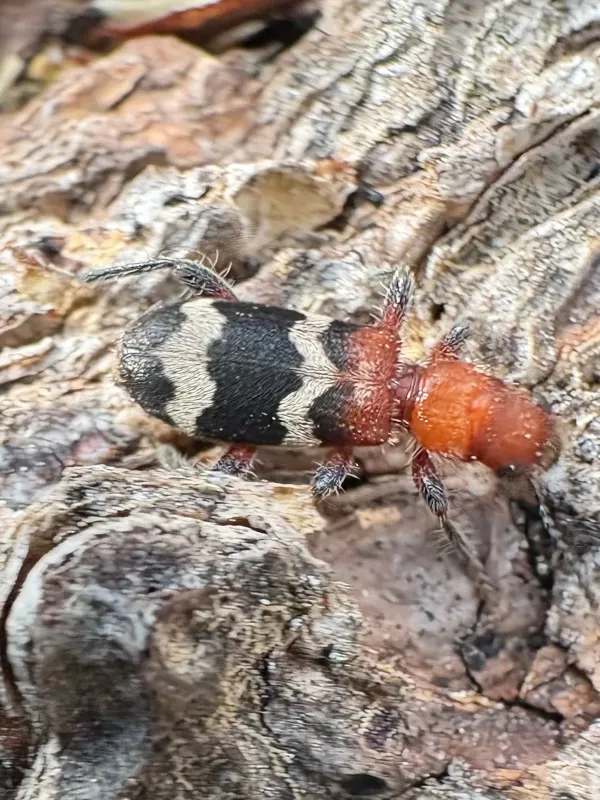
The adult beetle typically measures between 7 and 10 mm in length. It possesses a distinctive appearance with a bright red pronotum and dark elytra crossed by two transverse white or pale bands.
The larvae of this species are elongated, flattened, and range in color from pink to reddish. They are highly active predators that roam beneath the bark of coniferous trees.
This beetle is a significant entomophagous insect, meaning it feeds on other insects. It is well-adapted for life in forest environments, particularly in areas with high density of wood-boring insects.
The life cycle involves complete metamorphosis. Adults are frequently observed during the day, patrolling tree trunks to find mates and suitable locations for egg deposition.
What it damages
The Dubius checkered beetle does not cause damage to live timber or trees; instead, it is considered a beneficial organism in forest ecology.
Its primary role is the suppression of bark beetle populations, including species like the Ips engraver beetles, which are major pests in pine and spruce forests.
By consuming both the larvae and the adults of destructive bark beetles, this predator helps to naturally regulate pest outbreaks within forest stands.
No economic damage is attributed to the presence of these beetles. In fact, their absence in a forest with bark beetle activity can be a sign of ecosystem imbalance.
Forest managers often view the presence of these checkered beetles as a positive indicator of natural biological control occurring within their management area.
When it appears
The flight period for adult beetles generally begins in the spring, coinciding with the emergence of bark beetles as temperatures begin to rise.
Throughout the summer, the beetles are highly active. They lay eggs near the entry holes of bark beetle galleries to ensure that their larvae have immediate access to food.
Larval development continues throughout the warm season. The larvae move through the galleries carved by bark beetles, efficiently hunting their prey.
As autumn approaches, the beetles typically seek shelter for the winter. This can occur in the bark crevices of trees or within the leaf litter on the forest floor.
The species usually completes one generation per year, although warmer climates may influence the timing and duration of their developmental stages.
Signs of infestation
The most common sign of their presence is spotting the adult beetles on the bark of coniferous trees, especially those suffering from pest infestations.
During forest surveys, the presence of larvae under the bark of infested trees is a clear indicator that natural predators are actively working to curb the pest population.
They are frequently captured in pheromone-baited traps designed for bark beetles, as they are attracted to the same chemical signals produced by stressed trees.
Evidence of bark beetle activity, such as frass (bore dust) on the trunk, is almost always accompanied by the presence of these predatory checkered beetles.
Observations of the beetle's unique coloration and movement patterns on the bark can help foresters identify the species during routine field inspections.
Control measures
Control measures are generally not directed at the Dubius checkered beetle because it is a valuable predator that aids in forest protection.
The management strategy focuses on maintaining healthy forest stands and employing silvicultural practices that prevent massive bark beetle outbreaks.
When chemical control against bark beetles is necessary, it is vital to choose methods that minimize the impact on predatory insect populations.
Sanitation cutting, which involves removing infested trees, should be performed carefully to manage pest numbers while allowing predatory insects to relocate.
Encouraging the natural presence of these beetles is a key component of integrated pest management (IPM) in sustainable forestry operations.
Taxonomy
- Latin name
- Thanasimus dubius
- Order
- Coleoptera (beetles)
- Family
- Cleridae
- EPPO code
- THANDU
Discussion
No discussions yet — be the first.