
Ant beetle
Thanasimus
Description
How to identify
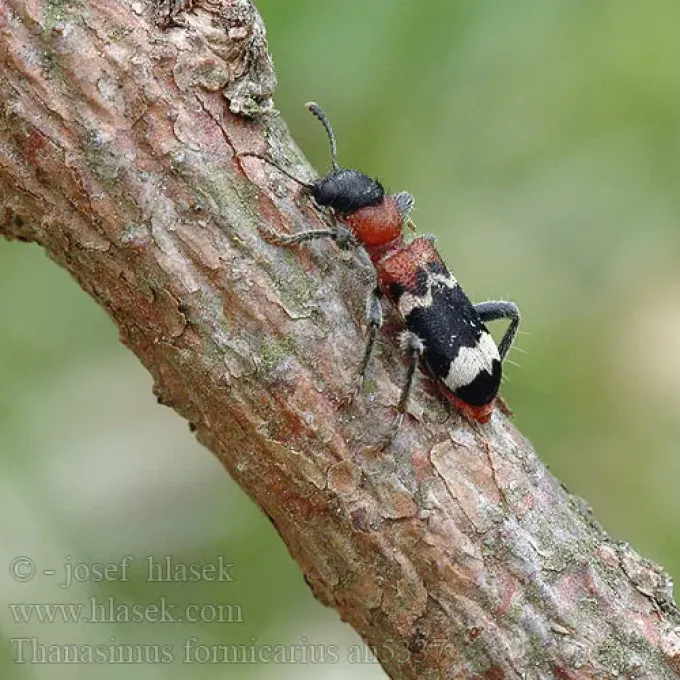
The ant beetle (genus Thanasimus) belongs to the family Cleridae, also known as checkered beetles, within the order Coleoptera. Adult beetles possess an elongated body with distinctively bright red, black, and white markings.
They earned their common name due to their striking resemblance to large ants, which helps them blend into certain forest environments while hunting.
The larvae are highly mobile and have a reddish or pinkish color, allowing them to navigate efficiently through the narrow galleries beneath tree bark.
Adults are aggressive predators with powerful mandibles, specifically evolved to capture and consume other small insects found on the bark surface.
This genus is widely distributed across the coniferous forest belts of the Northern Hemisphere, where it thrives alongside various bark-dwelling beetles.
What it damages
The ant beetle is not a plant pest; rather, it is a crucial beneficial predator that specializes in feeding on bark beetles and wood-boring insects.
Larvae primarily consume the eggs, larvae, and pupae of bark beetles, effectively infiltrating the galleries created by the pests under the bark of coniferous trees.
Adult beetles actively hunt adult bark beetles on the surface of the tree trunk, playing a significant role in reducing the impact of infestations.
While they do not harm the tree, their presence is sometimes observed in areas of heavy bark beetle infestation, where they naturally flock to a high-density food source.
Their economic importance lies in their ability to act as biological control agents, helping to maintain forest health without the need for synthetic pesticides.
When it appears
Activity usually commences in the spring when temperatures rise, signaling the emergence of both the ant beetle and its prey from overwintering sites.
The peak emergence of adults typically synchronizes with the initial flight period of bark beetles, ensuring an immediate food supply for the predators.
During the late spring and early summer, adults are most active, seeking mates and depositing eggs into crevices of the bark on coniferous trees.
Throughout the summer, larvae remain active beneath the bark, feeding voraciously and moving through existing pest galleries as they continue to develop.
As autumn approaches and temperatures drop, the larvae seek secure locations within the bark or forest litter to enter diapause and survive the winter months.
Signs of infestation
The presence of ant beetles can often be identified by observing the adults as they quickly move across the trunks of coniferous trees during sunny periods.
During forest health inspections, the presence of these predatory larvae can be confirmed by stripping small sections of loose bark from infested trees.
A reduced success rate of bark beetle colonization in certain areas, despite favorable conditions for the pests, may indirectly indicate the presence of ant beetles.
There are no specific signs of damage to the tree caused by the ant beetle itself, which distinguishes it from actual wood-boring pests.
Professional forest monitors often detect these beetles in pheromone traps designed for bark beetles, as they are frequently attracted to the same sites.
Control measures
Control measures are rarely required or recommended, as the ant beetle is a valuable natural ally in managing forest pest outbreaks.
In forest nurseries, standard sanitary practices, such as removing overly stressed or dead trees, are sufficient to maintain a healthy ecological balance.
Avoiding broad-spectrum insecticide applications in forest stands is vital to preserve the natural predator-prey dynamics that include the ant beetle.
By maintaining diverse forest structures, managers can support stable populations of these beetles, ensuring they continue to provide natural pest suppression.
Educational efforts in forestry focus on identifying these predators to prevent unnecessary extermination during routine forest management activities.
Taxonomy
- Latin name
- Thanasimus
- Order
- Coleoptera (beetles)
- Family
- Cleridae
- EPPO code
- THANSP
Discussion
No discussions yet — be the first.