
Litchi stink bug
Tessaratoma papillosa
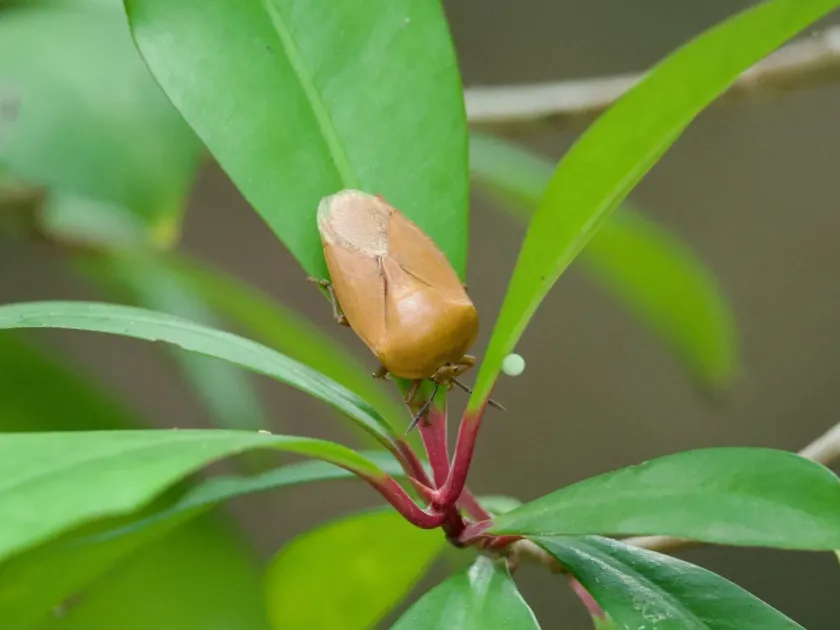
Description
How to identify
The Litchi stink bug (Tessaratoma papillosa) is a member of the Tessaratomidae family, order Hemiptera. Adults are large, shield-shaped insects reaching lengths of up to 30 mm.
Their coloration ranges from yellowish-brown to reddish-brown. A distinct feature is the white waxy secretion on the abdomen, which helps the insect manage moisture in humid tropical environments.
The life cycle consists of the egg stage, five nymphal instars, and the adult stage. Females typically deposit their eggs in orderly clusters on the undersides of leaves.
Young nymphs are often brightly colored, transitioning to darker hues as they progress through developmental stages towards adulthood.
In optimal tropical conditions, these insects can complete multiple generations per year, leading to rapid population growth during the fruit-growing season.
What it damages
The primary hosts of this pest include litchi and longan trees. It may also attack rambutan and various citrus species, causing significant agricultural damage.
Both nymphs and adults use their piercing-sucking mouthparts to feed on young shoots, flower spikes, and developing fruit, extracting vital plant sap.
The feeding process involves injecting toxic saliva into the plant, which causes wilting, necrosis, and the eventual death of young tissue and shoots.
Severe infestations during the flowering stage can cause widespread blossom blight, leading to total crop failure as the flowers and fruitlets drop prematurely.
Feeding punctures serve as entry points for secondary pathogens, such as fungi, which further degrade the tree's health and reduce overall photosynthetic capacity.
Signs of infestation
Key signs include the presence of egg clusters on the undersides of leaves, which are typically arranged in symmetrical batches of 10 to 14 eggs.
Sudden wilting and browning of tender terminal shoots are early indicators of nymph activity within the canopy of the host tree.
A strong, pungent, and unpleasant odor is often noticeable near infested trees, released by the scent glands of the bugs when they are disturbed.
Excretions from the bugs accumulate on leaves and fruit, promoting the growth of sooty mold, which appears as a black coating and reduces marketability.
Premature fruit drop and the presence of aborted fruitlets under the tree canopy are strong indications of a high infestation level that requires immediate action.
Control measures
Physical removal of adult bugs and the destruction of leaf clusters containing eggs remain the most environmentally friendly management practices for smaller orchards.
Biological control through the release of parasitoid wasps, such as Anastatus japonicus, has proven highly effective in maintaining pest populations below economic thresholds.
Chemical control involving systemic or contact insecticides should be applied strategically, targeting the most vulnerable life stages while minimizing impact on pollinators.
Cultural practices, such as proper pruning to open the canopy, reduce the micro-habitat conditions favored by the bugs for shelter and egg-laying.
- Regular monitoring during the flush and flowering periods.
- Use of entomopathogenic fungi as a biopesticide alternative.
- Timely application of pesticides to prevent peak nymph emergence.
Taxonomy
- Latin name
- Tessaratoma papillosa
- Order
- Hemiptera (bugs, aphids, leafhoppers)
- Family
- Pentatomidae
- EPPO code
- TESSPA
Discussion
No discussions yet — be the first.