
Common termite
Termes obesus
Description
How to identify
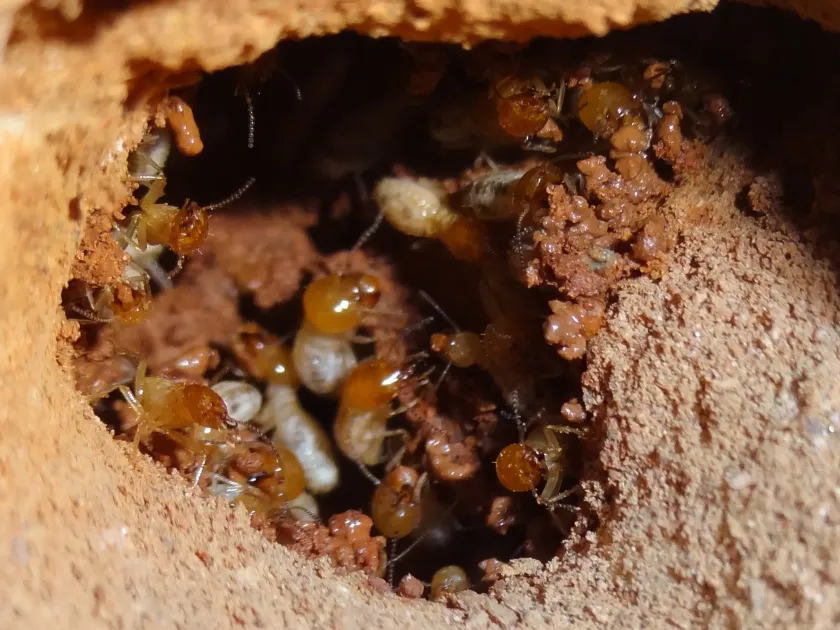
The common termite Termes obesus belongs to the order Isoptera, family Termitidae. These social insects operate in highly organized colonies consisting of workers, soldiers, and reproductive castes.
Worker termites are characterized by pale, soft bodies and are the primary agents responsible for consuming plant tissues. Soldiers possess large, sclerotized heads with powerful mandibles designed to defend the colony against predators.
The colony structure includes intricate systems of tunnels extending deep into the soil and often mound-like structures on the surface. These systems allow them to maintain the moisture and stable temperature required for survival.
Reproductive individuals, or alates, emerge during swarming events to establish new colonies. Their presence is often the first visible indicator of a well-established termite population in the area.
The life cycle is continuous, with the queen producing eggs that develop through nymphal stages into the various castes. This reproductive capacity ensures the rapid expansion of the termite population within suitable environments.
What it damages
This species is a significant threat to agricultural crops, including cereals, legumes, and vegetable crops. They primarily feed on cellulose, attacking roots, stems, and plant debris.
In arid regions, Termes obesus frequently targets living crops to satisfy their moisture requirements. This results in the destruction of root systems, leading to sudden wilting and eventual plant mortality.
The termites create internal galleries within the stems of plants, which compromises structural integrity. This causes the crop to lodge or break under minor physical stress, leading to significant yield loss.
By consuming organic matter and plant residues, termites also deplete soil organic carbon, which negatively impacts soil structure and long-term fertility in agricultural systems.
Damage is often cumulative, starting from the seedling stage and progressing throughout the growing season, potentially resulting in complete loss of plant stands in heavily infested fields.
Signs of infestation
The presence of Termes obesus is confirmed by the formation of earthen tubes or galleries on the surface of stems and over the soil. These structures protect them from desiccation and sunlight.
Sudden wilting of clusters of plants in the field is a classic sign. When pulled, these plants often exhibit completely excavated or consumed root systems, which is diagnostic of termite activity.
Visual inspection of crop stalks often reveals hollowed-out sections filled with soil particles. When these tunnels are broken open, active worker termites are usually found inside.
Mounds or exit holes appearing after rainfall indicate a large, active colony nearby. In some cases, the presence of cast-off wings from swarming alates on the soil surface confirms an active infestation.
A "hollow" sound when tapping the base of the stem or the presence of soil deposits within plant tissue are reliable physical signs of internal termite infestation.
Control measures
Effective management begins with deep tillage, which physically destroys the underground tunnels and mound structures, significantly disrupting the colony's operation.
Chemical control involving the use of systemic insecticides during seed treatment provides a robust defense for young crops, reducing the risk of early-season infestation.
Crop rotation and field hygiene are crucial; removing excess plant residues and crop debris eliminates food sources, making the field less attractive to colonizing termites.
Biological control agents, such as the entomopathogenic fungus Metarhizium anisopliae, can be applied to infested areas to naturally suppress the termite population without the use of harsh chemicals.
The implementation of cellulose-based monitoring traps throughout the fields allows for early detection of termite presence, enabling localized and timely intervention before widespread damage occurs.
Taxonomy
- Latin name
- Termes obesus
- Family
- Termitidae
- EPPO code
- TERMOB
Discussion
No discussions yet — be the first.