
Common termite
Termes classicus
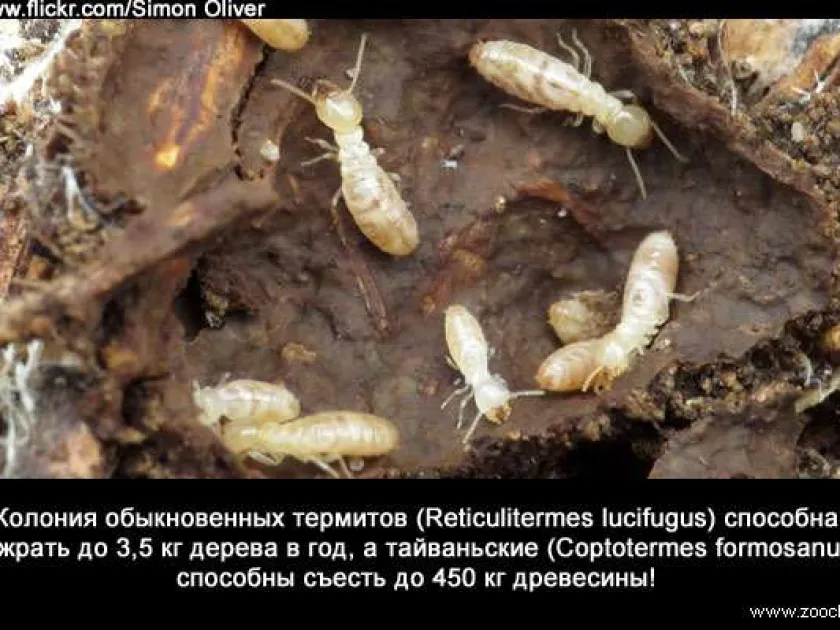
Description
How to identify
The common termite (Termes classicus) belongs to the order Blattodea and the family Termitidae. They are eusocial insects living in complex colonies.
A colony consists of several castes: workers, soldiers, and reproductives (alates). Each caste performs specific roles vital for the colony's survival and growth.
Workers are light-colored, wingless, and blind, responsible for foraging and nest maintenance. Soldiers have large mandibles for defense against intruders.
Reproductive individuals are winged and perform mating flights to establish new colonies. Once a mate is found, they shed their wings and burrow into the soil.
They can be distinguished from ants by their broad waist, uniform wing size in alates, and their consistent avoidance of direct sunlight.
What it damages
This species is a significant agricultural pest, primarily targeting cellulose-rich materials including living plant roots, stems, and decaying organic matter.
They cause severe damage to the root systems of young orchards, vineyard plantations, and various row crops in warmer climatic zones.
By consuming vascular tissues, they stunt plant growth and frequently kill seedlings, leading to significant economic losses in the agricultural sector.
Beyond live plants, they attack straw, hay, and paper-based agricultural supplies, often causing damage to equipment and wooden infrastructure in storage.
Plants damaged by termites often become susceptible to secondary pathogens, including fungi and bacteria, leading to rot and rapid decline.
When it appears
Termites remain active throughout the growing season, with their metabolic rate closely tied to soil temperature and moisture levels.
Peak foraging activity is observed during warm, humid periods when soil conditions allow for the expansion of tunnels and foraging routes.
Mating flights typically occur during the early rainy season, providing optimal conditions for new colonies to establish themselves in the soil.
During dry, hot spells, they retreat to deeper soil layers, where they continue to feed on roots and organic debris away from the heat.
Agricultural management during winter months, such as tillage, can effectively disrupt the colony structure and decrease local pest pressure.
Signs of infestation
The presence of earthen tunnels built by termites on the surface of tree trunks, stems, or soil is a primary indicator of an infestation.
Sudden wilting or death of plants despite adequate irrigation often points to root system destruction caused by termite foraging.
Observation of shed wings in the fields or near farm structures is a clear sign that a termite colony is active in the vicinity.
When inspecting plant bases, one can find hollowed-out areas covered by soil-like particles, which are used to maintain high humidity for the insects.
- Earthen mud tubes on wood or stems.
- Hollowed out stems or roots.
- Softened areas in soil around the plant base.
Control measures
The most effective strategy involves soil application of systemic insecticides at the time of planting to protect vulnerable root zones.
Baiting systems containing slow-acting active ingredients are highly effective as workers transfer the poison to the nest, eliminating the queen.
A critical agronomic practice is the thorough removal of crop residues and organic waste from the field to reduce food sources for termite colonies.
Biological control using entomopathogenic fungi such as Beauveria bassiana can be deployed to suppress colony populations naturally.
Proper field maintenance and avoiding over-mulching near the base of vulnerable plants can significantly reduce the risk of termite colonization.
Taxonomy
- Latin name
- Termes classicus
- Family
- Termitidae
- EPPO code
- TERMCL
Discussion
No discussions yet — be the first.