
Brown termite
Termes badius
Description
How to identify
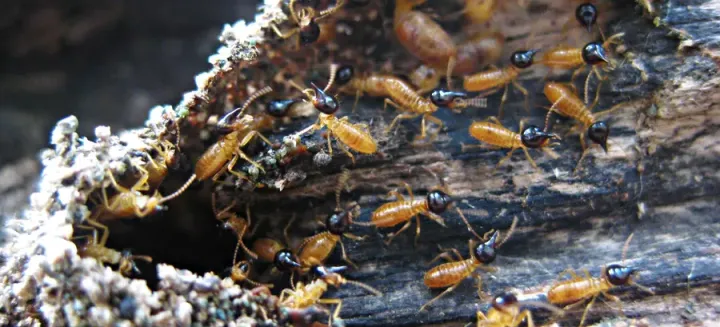
The brown termite (Termes badius) belongs to the order Isoptera, family Termitidae. These are social insects that live in complex colonies characterized by a rigid caste system, where workers, soldiers, and reproductives perform specific roles.
Soldiers are easily identified by their large, dark brown, heavily sclerotized heads equipped with strong, formidable mandibles used to defend the nest and protect the colony members.
Worker termites are smaller and paler in color, with soft bodies. They are the most numerous members of the colony and are responsible for foraging, nest maintenance, and caring for the larvae.
Colonies build intricate nest structures, both subterranean and mound-like, which serve as highly controlled microenvironments protected from predators and fluctuating weather conditions.
Reproductive winged adults, known as alates, emerge during specific swarming events to mate and establish new colonies, which allows the species to spread across agricultural landscapes.
What it damages
This species acts as a significant polyphagous pest, causing extensive damage to a wide range of crops, including cereals, legumes, and industrial plants by consuming cellulose-based tissues.
Termites primarily attack the root systems of young and mature plants, which severely restricts water and nutrient uptake, eventually leading to crop wilting and death.
By boring into the stems and stalks of plants, they weaken the structural integrity of the crop, causing plants to lodge or collapse under their own weight or wind pressure.
In addition to destroying living plants, these termites frequently consume agricultural debris and crop residues, which can shift the organic balance and soil composition in the field.
Large infestations can result in total crop loss, as the insects move systematically through rows, destroying roots and stems beneath the soil surface where they remain hidden from conventional visual inspection.
When it appears
Termite activity occurs throughout the year in warmer climates, though peak foraging and damage intensity are typically observed during the hot and dry seasons when moisture levels in the soil decrease.
Swarming events for reproduction usually coincide with the onset of the rainy season, as the high moisture content is vital for the survival of newly established colonies in the soil.
During cooler periods or periods of excessive water saturation, colonies retreat to deeper soil levels where the nest environment remains stable and protected from extreme conditions.
Agricultural monitoring should be consistent, but extra vigilance is required after field operations such as plowing or irrigation, which may disrupt colony behavior or alter the insects' foraging paths.
The long-term nature of termite colonies means that they persist in the soil for years, making consistent seasonal observation necessary to detect early stages of infestation.
Signs of infestation
The presence of mud-like tubes built over soil surfaces or along plant stems is the most reliable visual indicator, as these tubes protect the termites from sunlight and predators.
Unexpected chlorosis and wilting of plants despite adequate soil moisture often signal that the root system has been severely compromised by subterranean termite feeding.
Careful excavation around the base of a dying plant will often reveal soil-filled chambers and galleries, confirming the presence of termite workers and soldiers.
Plants affected by internal stem feeding often show hollowed-out centers packed with a mixture of soil and excrement, a telltale sign of their digestive activity.
The appearance of winged alates near fields or structures shortly after rainfall indicates that a mature, active colony is present in the immediate vicinity.
Control measures
Managing brown termites requires an integrated approach that combines cultural practices with targeted chemical treatments to disrupt colony stability and reduce population levels.
Deep tillage is a fundamental cultural practice that physically destroys subterranean galleries and nest sites, creating an environment that is unfavorable for colony maintenance.
Soil-applied insecticides are effective for creating a chemical barrier around the crop root zone, preventing workers from reaching the plant tissues and causing damage.
Baiting systems utilizing slow-acting active ingredients are highly effective, as worker termites unknowingly transport the toxic substances back to the nest, leading to the collapse of the entire colony.
- Implementing crop rotation to break the cycle of food availability.
- Removing harvest residues to eliminate cellulose sources that attract foragers.
- Using biological control agents such as entomopathogenic fungi to suppress populations.
- Ensuring proper irrigation management to discourage termites from seeking moisture in crop roots.
Taxonomy
- Latin name
- Termes badius
- Family
- Termitidae
- EPPO code
- TERMBA
Discussion
No discussions yet — be the first.