
Hibiscus harlequin bug
Tectocoris diophthalmus
Description
How to identify
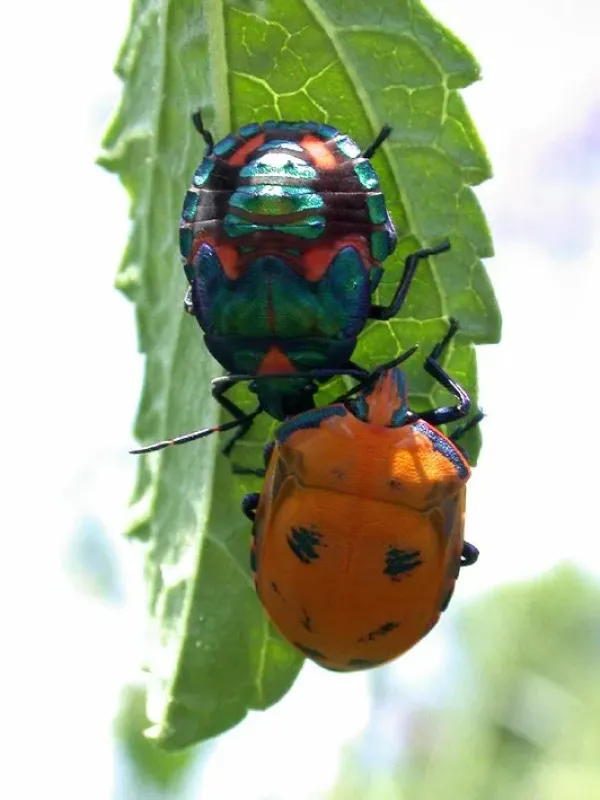
The Hibiscus Harlequin Bug (Tectocoris diophthalmus) is a member of the Scutelleridae family within the order Hemiptera. These insects are well-known for their striking, brilliant red or orange coloration adorned with iridescent metallic blue or green spots.
Adult bugs typically reach a length of about 20 millimeters. Their distinctive appearance serves as an aposematic signal, warning potential predators of their distasteful nature and chemical defense mechanisms.
The life cycle progresses through several nymphal stages, during which the insects change in size and pattern. Nymphs are often more cryptic and display varying levels of coloration compared to the highly visible adult stage.
Females deposit their eggs in tightly packed clusters on the stems or undersides of leaves of their host plants. The eggs themselves are barrel-shaped and often arranged in neat, geometric formations.
These bugs are predominantly diurnal and thrive in warm, tropical, or subtropical environments. They are capable of year-round reproduction in suitable climates, often forming dense colonies on their preferred hosts.
What it damages
The Hibiscus Harlequin Bug primarily targets plants within the Malvaceae family. Hibiscus, cotton, mallow, and various native ornamental shrubs are the most common victims of their feeding habits.
Both adults and nymphs possess piercing-sucking mouthparts which they use to penetrate plant tissues. They show a strong preference for feeding on succulent parts, including developing buds and immature seed pods.
Feeding activity on seed pods often causes them to wither, turn black, and drop prematurely. This prevents successful seed maturation and reduces the natural reproductive success of the affected plants.
When the bugs attack floral buds, the result is often severe deformation. The buds may fail to bloom correctly, or they may drop off entirely, leading to a significant loss in the ornamental value of the plant.
Furthermore, the injection of saliva containing digestive enzymes during the feeding process can cause necrotic lesions. These spots not only weaken the plant but also create entry points for secondary pathogens.
Signs of infestation
The most obvious sign of an infestation is the presence of the adult bugs themselves. Their vivid colors make them easy to spot as they cluster on the stems, leaves, or fruit of the host plant.
Closely inspecting the undersides of leaves often reveals the characteristic egg clusters. These distinctively patterned groups are a clear indicator that the next generation of bugs is developing.
Plants under stress from heavy feeding will exhibit patches of yellowing or brown necrosis on the leaves. Over time, these patches can expand, leading to significant leaf drop and reduced vitality.
Wilting of the terminal shoots is another common sign. Because these bugs target succulent growth, they effectively starve the growing tips of nutrients and water, leading to a loss of turgor pressure.
Sticky residues or sooty mold developing on the stems can be a secondary indicator, as these bugs may facilitate conditions that attract other pests or encourage fungal growth on the plant surface.
Control measures
Manual removal is a highly effective control measure for localized infestations. Due to their size and bright colors, adult bugs are easily hand-picked and disposed of in soapy water.
Sanitary pruning is essential for managing the population. By cutting off and destroying infested branches or seed pods, gardeners can effectively eliminate the source of eggs and young nymphs.
For larger infestations, contact-based insecticides such as pyrethroids can be utilized. Applications should be timed carefully to minimize impact on beneficial pollinators, preferably during evening hours.
Soft-bodied nymphs are susceptible to horticultural oils or insecticidal soaps. These treatments are safer for the environment and can be applied repeatedly to manage the colony throughout the growing season.
Cultural practices such as maintaining vigorous plant health through proper fertilization and watering ensure that plants can better withstand and recover from the pressure exerted by the bugs.
Taxonomy
- Latin name
- Tectocoris diophthalmus
- Order
- Hemiptera (bugs, aphids, leafhoppers)
- Family
- Scutelleridae
- EPPO code
- TECTDI
Discussion
No discussions yet — be the first.