
Tarsostenus univittatus
Tarsostenus univittatus
Description
How to identify
Tarsostenus univittatus, commonly known as a type of checkered beetle, belongs to the family Cleridae within the order Coleoptera.
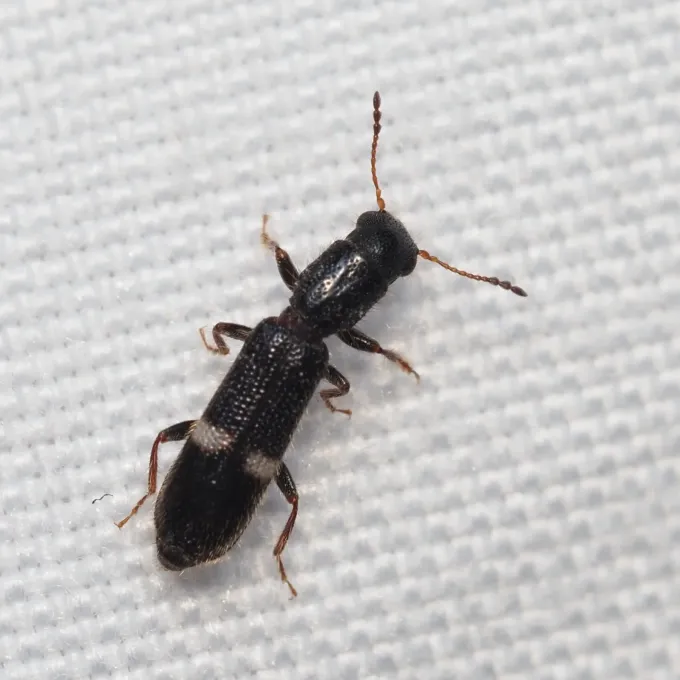
Adult beetles have an elongated body, typically ranging from 3 to 5 mm in length, characterized by a dark brown or black coloration with a distinct white transverse band across the elytra.
The head and pronotum are densely punctate, while the antennae and legs are often lighter in color, helping to distinguish it from other species of the Cleridae family.
The life cycle of this insect is closely linked to the presence of wood-boring beetle larvae, as Tarsostenus univittatus larvae are known to be predatory.
Adults are highly active and mobile, often seen exploring infested timber to locate suitable sites for egg-laying.
What it damages
This species is not a direct pest of living plants; rather, it is a significant pest of seasoned timber and wooden goods.
The damage is often indirect: the beetle frequently inhabits the galleries created by wood-boring beetles, such as Anobiidae, within timber structures.
Tarsostenus univittatus larvae act as predators, hunting the larvae of other wood-boring species, which leads to further structural degradation of the infested wood.
Infestations can affect building frameworks, antique furniture, wooden pallets, and stored lumber, significantly reducing their mechanical integrity.
In the agricultural sector, this pest can threaten wooden packaging and crates used for storage and transport of produce.
When it appears
Adult activity is primarily observed during the warmer months, as higher temperatures accelerate their reproductive cycle.
In climate-controlled environments, such as warehouses or heated buildings, the life cycle can continue year-round due to stable temperatures.
Emergence of adults after pupation typically occurs in spring and summer, when beetles leave their tunnels to mate and colonize new areas.
The developmental speed of the larvae depends heavily on the internal microclimate of the timber and the availability of prey species.
Under optimal conditions, the pest can produce multiple generations per year, leading to rapid increases in population density and damage severity.
Signs of infestation
The presence of small circular exit holes on the wood surface is the most common indicator that adult beetles have emerged from the timber.
Fine wood dust, often called frass, accumulating beneath wooden objects suggests active larval burrowing and structural feeding within the material.
Inspecting damaged sections often reveals a complex network of tunnels, where the tracks of the original wood-borers are intercepted by the predatory larvae.
Seeing adult Tarsostenus univittatus on windowsills or furniture surfaces during warmer months is a clear sign of an ongoing infestation.
A loss of structural integrity, occasionally accompanied by noticeable sound or crumbling fibers, indicates advanced degradation of the wood.
Control measures
Preventative measures focus on maintaining low moisture content in timber, as damp wood is highly attractive to various wood-boring pests.
Deep impregnation of lumber with insecticide solutions is an effective method to prevent initial colonization by beetles.
In cases of severe infestation, professional fumigation of buildings or storage facilities is required to penetrate deep into the wood galleries.
Regular monitoring of wooden structural elements and prompt removal or treatment of infested parts are essential for effective management.
- Application of wood preservatives.
- Fumigation of enclosed storage spaces.
- Control of ambient relative humidity.
- Heat treatment of timber products.
Taxonomy
- Latin name
- Tarsostenus univittatus
- Order
- Coleoptera (beetles)
- Family
- Cleridae
- EPPO code
- TASTUN
Discussion
No discussions yet — be the first.