
Spider wasp
Tachypompilus analis
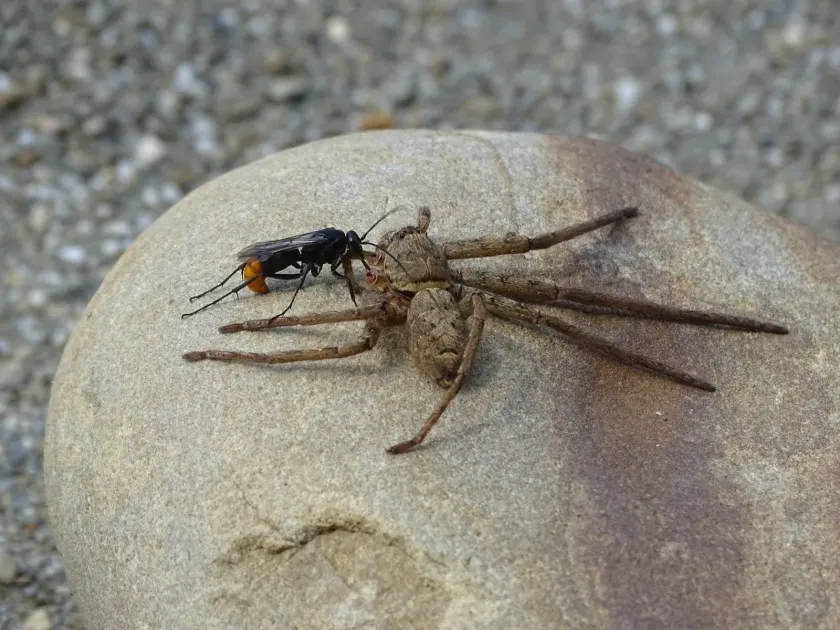
Description
How to identify
The spider wasp (scientific name Tachypompilus analis) belongs to the Pompilidae family within the order Hymenoptera. It is recognized by its slender, elongated body, typically exhibiting a dark or metallic blue-black coloration.
These insects are well-adapted for ground activity, possessing long, robust legs that enable them to move quickly over soil surfaces and excavate nesting burrows. Their wings are often dark, matching their shadowy hunting environments.
Females are significantly larger than males and carry a potent stinger used to paralyze spiders, which serve as the primary food source for their larvae. Unlike social wasps, these are solitary insects.
The total body length of a mature wasp ranges from 15 to 25 mm. Their movement pattern is very distinctive, characterized by short, darting flights and erratic running across the ground.
They do not construct paper nests; instead, they utilize pre-existing soil cavities or dig their own subterranean cells, making them highly integrated into the ground ecosystem.
What it damages
Spider wasps are not considered primary agricultural pests because they do not feed on plant foliage, fruits, or roots. Their adult diet consists mainly of nectar from flowers.
However, their economic impact stems from their predatory role. By actively hunting and consuming spiders, they remove natural predators of agricultural pests like aphids and mites.
A high density of spider wasps in a garden can upset the biological balance, leading to outbreaks of other insect pests that would otherwise be controlled by spiders.
To humans, they pose a safety concern primarily due to their painful sting. While they are generally non-aggressive, they will sting defensively if they feel their nesting site is threatened or if handled accidentally.
Physical damage can occur indirectly when wasps dig numerous burrows in seedbeds, potentially disturbing the root systems of young, fragile plant starts during the nesting process.
When it appears
The activity period for adult spider wasps occurs during the warmer months, spanning from late May through early September, peaking during the height of summer.
Early in the season, females focus on finding suitable nesting sites and hunting for prey. This is the period when they are most frequently observed by gardeners in open soil areas.
They are strictly diurnal, requiring high ambient temperatures for efficient flight and hunting. Their activity decreases significantly during cloudy or cool weather conditions.
As autumn approaches, the population naturally declines, as the adults complete their life cycle after ensuring the survival of the next generation in underground cells.
They overwinter in a larval or pupal state, sheltered deep within soil burrows, which provides protection from extreme winter temperatures until the following spring.
Signs of infestation
The primary sign of a spider wasp infestation is the presence of small, tidy holes in the soil, sometimes obscured by bits of debris or soil pellets from the excavation.
Observing a wasp dragging a paralyzed spider across the ground is the most definitive biological marker of their active presence on your property.
A noticeable reduction in spider populations and webs in the garden can suggest that spider wasps are successfully occupying the habitat and eliminating local arachnids.
Visual identification of large, metallic-looking solitary wasps patrolling the soil surface is a reliable sign of their nesting activity in the immediate vicinity.
Encountering painful stings during soil cultivation or weeding is a strong indication that you have inadvertently breached a nest chamber or disturbed a hunting female.
Control measures
Specific insecticides are rarely used against spider wasps as they are not primary pests. Management focuses on cultural practices to make the environment less favorable for nesting.
Frequent soil cultivation, weeding, and mulching help prevent the formation of burrows. A well-tended and covered soil surface is typically avoided by these wasps.
In cases where nests are established in high-traffic areas, localized treatment of the burrow with contact insecticides may be necessary, although this should be a last resort.
Reducing debris, such as piles of stones or old wood, helps remove potential nesting sites, encouraging the wasps to relocate to less populated areas.
- Wear gloves while performing garden maintenance or handling soil.
- Avoid walking barefoot in areas with exposed, loose soil.
- Use organic mulch or ground-cover plants to discourage burrowing.
Taxonomy
- Latin name
- Tachypompilus analis
- Order
- Hymenoptera
- Family
- Pompilidae
- EPPO code
- TACMAN
Discussion
No discussions yet — be the first.