
Spider wasp
Tachypompilus
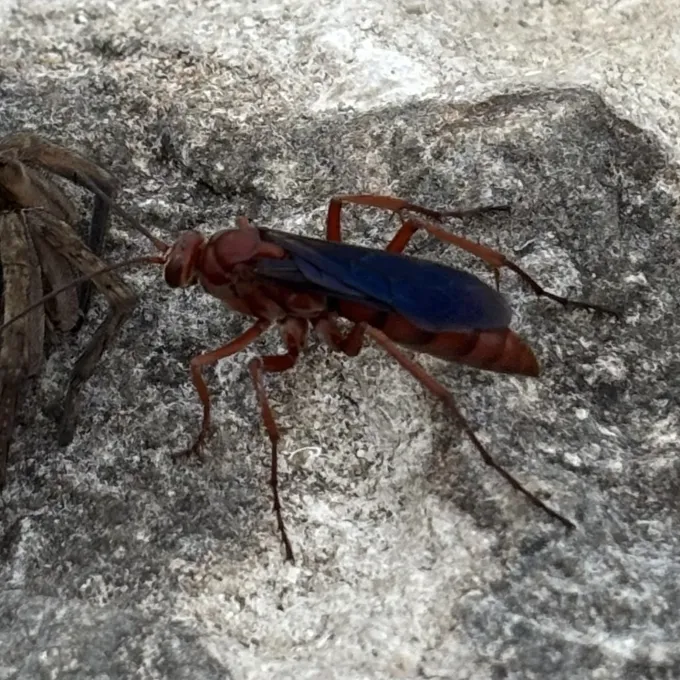
Description
How to identify
Spider wasps, belonging to the family Pompilidae and the genus Tachypompilus, are fascinating Hymenoptera. They are recognized by their slender bodies, often displaying metallic sheens, and long, spiny legs adapted for running quickly across the ground.
These wasps are characterized by a distinct sexual dimorphism in terms of size, though identifying them to the genus level usually requires examining their specific physical structures, such as the arrangement of spines on their legs.
Their coloration is typically dark, often marked with vibrant orange or red patches on the abdomen. This serves as a warning coloration to potential predators, indicating their ability to deliver a painful sting.
The genus Tachypompilus is known for its highly specialized predatory behavior. Unlike social wasps, these are solitary insects that spend most of their time patrolling the ground in search of their specific prey.
In the field, you can identify them by their quick, erratic movements on the soil surface, often flicking their wings, which is a hallmark behavior when they are actively hunting spiders.
What it damages
Spider wasps are not considered agricultural pests. They do not damage crops, foliage, or fruit. Their primary ecological role is that of a predator, specifically targeting spiders to provide food for their developing larvae.
Because they do not feed on plant tissues, they do not pose any threat to the health or yield of crops. From an agronomical perspective, their presence is generally viewed as neutral or even beneficial as part of the natural balance.
The only concern regarding their presence is the human safety aspect. They are capable of stinging if disturbed or trapped, and their venom can cause significant pain, which is why they are often discouraged from nesting near human dwellings.
They do not build large communal nests, which significantly limits the potential for large-scale conflict with human activities or farm operations.
Consequently, there are no established economic injury levels for this species, and no management strategies are required for the purpose of plant protection.
When it appears
The activity of spider wasps is closely linked to the warm season, peaking during the summer months when soil temperatures are high enough to support the development of their larvae.
Adults emerge as the weather warms, typically starting in late spring and reaching their peak activity in July and August. During this time, the females are hyper-focused on locating and paralyzing spiders.
The life cycle involves the female digging a burrow in the soil, transporting a paralyzed spider into it, and laying an egg on the prey. The wasp larva then develops inside the burrow, feeding on the paralyzed spider.
After the larval stage, the insect pupates in the soil. Depending on the species and climate, they may overwinter as pupae or larvae, emerging again the following spring or early summer.
As autumn approaches and temperatures drop, their activity diminishes. They generally do not migrate, but rather rely on the soil's thermal properties for protection during the colder months.
Signs of infestation
The most reliable sign of spider wasp presence is the appearance of small, neatly constructed holes in the ground, often found in undisturbed areas or near the foundations of structures.
Observing a wasp actively running along the soil surface, occasionally flicking its wings, is a clear sign of their presence. They do not congregate in hives, so you will typically see them as solitary individuals.
A decline in the local population of spiders can sometimes be attributed to the successful hunting activity of these wasps, although this is rarely quantified in a garden setting.
Finding a wasp dragging an immobilized spider towards a hole is the most definitive piece of evidence confirming that a spider wasp is actively using your property as a hunting ground.
These signs are usually isolated and scattered, reflecting the solitary nature of their reproductive strategy, unlike the clustered nesting patterns of social species.
Control measures
Active control of spider wasps is rarely necessary. Since they do not harm plants, they should be tolerated unless their presence directly poses a risk to human health in high-traffic areas.
To discourage them from establishing nesting sites, you can disrupt the soil surface. Mulching, planting dense ground covers, or maintaining a lawn makes the ground less attractive to these wasps.
If you need to limit their presence, manual removal of suitable nesting spots (like bare, loose soil patches) is much more effective and safer than applying chemical pesticides.
Chemical control is strongly discouraged as it kills beneficial pollinators and other insect predators, potentially leading to secondary pest outbreaks that are much more harmful to your plants.
Maintaining a healthy, balanced ecosystem on your farm or garden is the best long-term management strategy, ensuring that all insect populations, including predators like spider wasps, remain in check.
Taxonomy
- Latin name
- Tachypompilus
- Order
- Hymenoptera
- Family
- Pompilidae
- EPPO code
- TACMSP
Discussion
No discussions yet — be the first.