
Ceropales maculata
Ceropales maculata
Description
How to identify
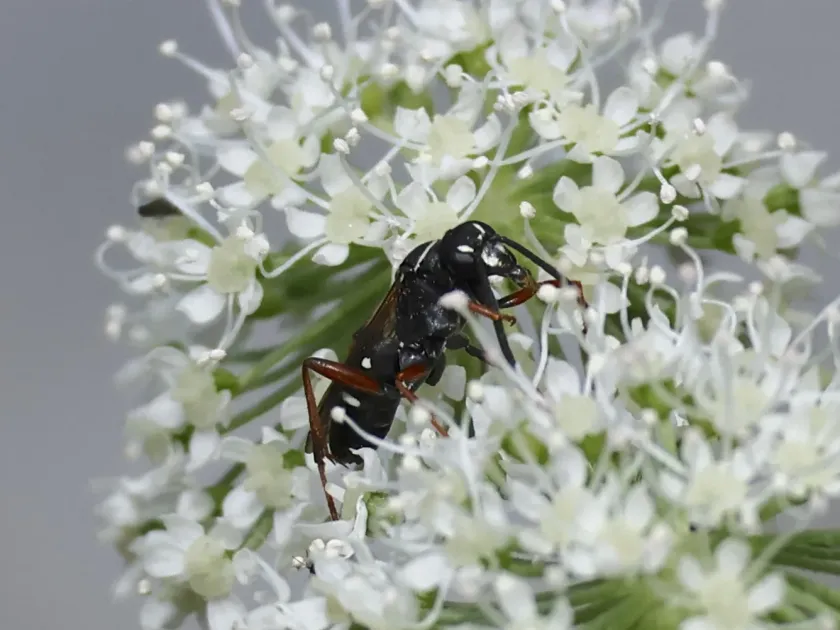
Ceropales maculata belongs to the family Pompilidae, commonly known as spider wasps. These are small insects, usually 8–12 mm long, with a distinct black body adorned with yellow spots.
The morphology of the adults includes a slender build and long, spiny legs, which are evolutionarily optimized for crawling through dense vegetation and soil surfaces.
They are easily identified by their unique kleptoparasitic behavior, where they target the prey of other spider wasps to deposit their own eggs.
As obligate kleptoparasites, they do not construct their own nests but rather infiltrate those built by other Pompilidae species.
Adults are frequently observed on flowers of the Apiaceae family, where they feed on nectar to sustain their metabolic activities.
What it damages
Ceropales maculata does not cause direct physical damage to agricultural crops or ornamental plants, as they do not feed on plant tissues.
From an agronomic perspective, their impact is considered indirect, as they may negatively influence the populations of beneficial predatory wasps.
By parasitizing the nests of other wasps, they reduce the effectiveness of natural biological control agents that help manage pest levels.
While they disrupt the natural ecosystem balance, they are rarely present in numbers large enough to cause significant economic losses for farmers.
Their role in the ecosystem is complex, and they should not be classified as primary agricultural pests requiring aggressive eradication efforts.
When it appears
The active life cycle of Ceropales maculata occurs primarily during the summer months, typically ranging from June through August.
During this timeframe, females are observed actively patrolling environments to locate the nests of host wasp species to lay their eggs.
The larvae develop throughout the summer inside the host's nest, consuming the provisions intended for the host's offspring.
Wintering occurs during the pupal stage, protected within a resilient cocoon inside the host's nesting chamber.
Emergence of the new adult generation takes place in the following spring once temperatures reach the necessary threshold for activity.
Control measures
Specific control measures for Ceropales maculata are generally unnecessary, given that they do not damage crops or garden produce.
Maintaining a healthy, biodiverse garden environment is the best approach to ensure that natural predator-prey relationships remain stable.
The use of broad-spectrum insecticides should be avoided, as it can inadvertently harm beneficial insect populations that provide natural pest control.
Proper soil management practices can help disrupt the nesting sites of various wasp species, which indirectly regulates their population growth.
Monitoring the insect population is recommended before considering any intervention to prevent unnecessary disruption of the local ecosystem.
Taxonomy
- Latin name
- Ceropales maculata
- Order
- Hymenoptera
- Family
- Pompilidae
- EPPO code
- KERPMA
Discussion
No discussions yet — be the first.