
Spider wasp
Pompilus
Description
How to identify
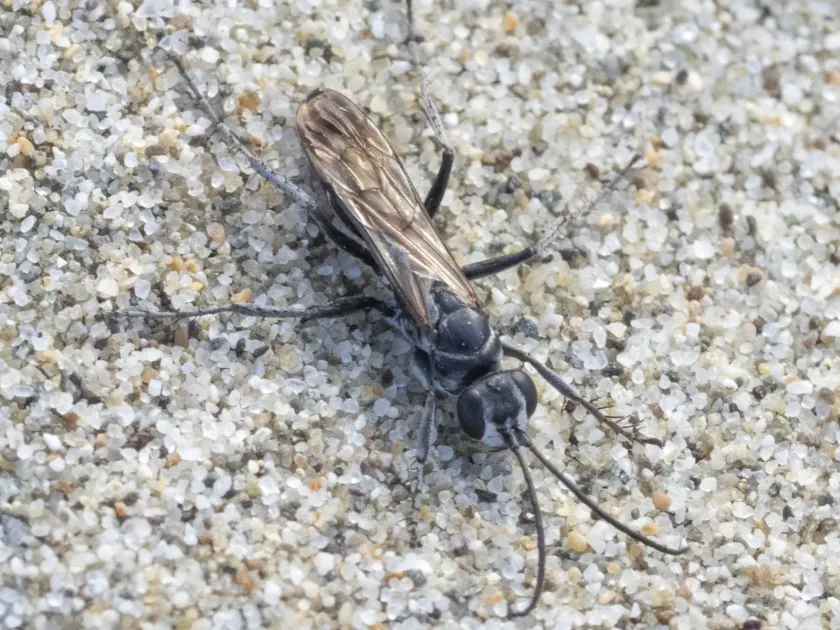
Spider wasps (Pompilidae) are a family of Hymenoptera distinguished by their slender bodies and long, spiny legs adapted for digging in soil. Adults often display dark coloration with metallic reflections or orange-red markings.
A distinctive behavior of these wasps is their restless movement on the ground, characterized by quick runs and frequent flicking of their wings. Their size varies significantly, typically ranging from 15 to 40 millimeters.
They are members of the order Hymenoptera. Unlike many other wasp families, they are solitary and do not build communal nests or colonies, which makes them less of a direct nuisance than social wasps.
The females are equipped with a powerful stinger used specifically to paralyze spiders. These wasps are not herbivores, meaning they do not feed on or damage any parts of cultivated plants.
They are frequently found in sunny locations with sandy or loose soil, which provides the ideal environment for the females to construct their underground brood cells.
What it damages
From an agronomic perspective, spider wasps are not classified as plant pests. They do not consume foliage, attack roots, or feed on fruits, and they pose no risk to crop yields.
Their ecological function is entirely predatory. They hunt spiders, which helps regulate the populations of various arthropods within the garden ecosystem.
The primary conflict with humans arises only if the wasps are disturbed, as they can deliver a painful sting in self-defense. However, they are generally non-aggressive toward people.
The presence of their small burrows in the soil is purely a result of their nesting habits and does not disrupt the root development or nutrient uptake of surrounding crops.
As they do not feed on plant tissues, there is no economic justification for treating them as pests; they are, in fact, part of the natural biological control system in any healthy garden.
When it appears
Spider wasp activity is most prominent during the warm months, typically spanning from late spring to early autumn. Their peak activity corresponds with higher soil temperatures and sunny weather.
The life cycle is closely tied to the ambient temperature and soil conditions. As the ground warms up in the spring, the new generation of adults emerges to begin the mating and nesting season.
They overwinter as larvae or prepupae inside a protected silken cocoon located deep within their underground tunnels, safely insulated from harsh winter temperatures.
Throughout the summer, females are actively involved in searching for spiders, paralyzing them, and dragging them into nesting chambers to provide food for their developing larvae.
Because they are solitary insects, you will not see massive infestations, but rather individuals working independently across the landscape throughout the growing season.
Signs of infestation
The most common indicator of spider wasp presence is the appearance of small, circular holes in the ground, often surrounded by small mounds of excavated soil or grit.
You may observe adult wasps moving rapidly across the soil surface in a jerking motion, sometimes carrying a paralyzed spider, which is a definitive sign of the Pompilidae family.
The lack of crop damage, such as leaf chewing or stem wilting, serves as strong evidence that these insects are not harmful to your garden or field plants.
If you see a spider wasp, it is a sign that there is a healthy population of spiders on your property, which the wasp uses as a food source for its offspring.
There are no specific pheromone traps or monitoring tools required for these wasps, as they are not a target for agricultural pest management programs.
Control measures
No specific control measures are needed to protect plants from spider wasps, as they are not agricultural pests and do not threaten horticultural crops.
If their activity creates discomfort in specific areas, mechanical methods such as lightly tilling or compacting the soil are effective ways to deter them from nesting in those locations.
The use of chemical insecticides should be strictly avoided, as it can eliminate these beneficial predators and disturb the balance of natural pest control in the garden.
When working in areas where they are active, wearing appropriate garden gloves and protective clothing is sufficient to prevent any accidental stings caused by defensive behavior.
The best practice is to coexist with them, as they play an important role in the environment by regulating spider populations and contributing to the biodiversity of the garden ecosystem.
Taxonomy
- Latin name
- Pompilus
- Order
- Hymenoptera
- Family
- Pompilidae
- EPPO code
- PMPLSP
Discussion
No discussions yet — be the first.