
Mexican lac scale
Tachardiella mexicana
Description
How to identify
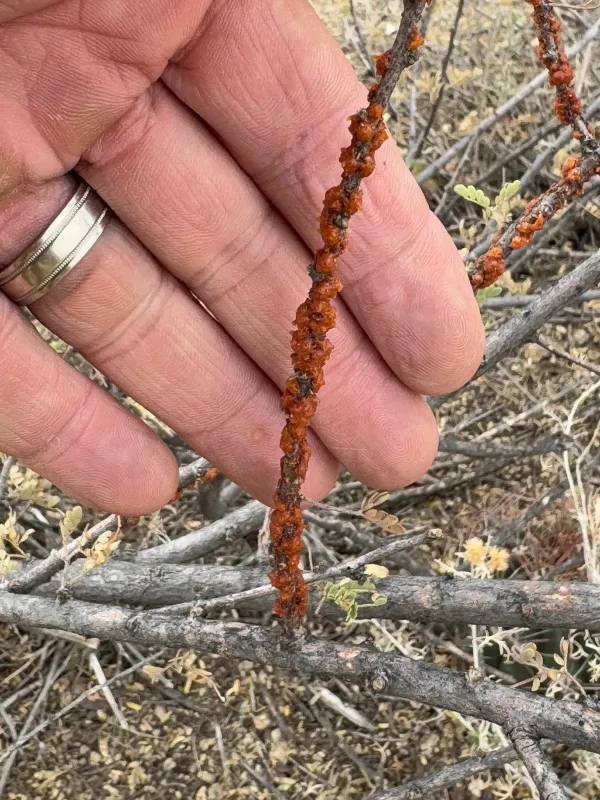
The Mexican lac scale (Tachardiella mexicana) belongs to the Kerriidae family, the group of lac insects. It is a small insect that produces a thick, resinous substance during its lifecycle, which forms a hard "lac" casing around the individual.
Adult females of this species are largely sessile, attaching themselves firmly to the bark of the host plant. Their body is protected by this hard resinous shell, which serves as both protection against predators and a nursery for their eggs.
These insects have a complex lifecycle typical of coccids. During certain phases, they emerge as mobile crawlers, actively searching for the best location on the plant's stems or branches to begin feeding.
The species is related to insects that produce natural shellac. In the wild, they have adapted to arid climates, where their resinous secretions provide vital moisture retention for their bodies, preventing desiccation.
Because their colonies look like natural bark abnormalities or minor surface defects, the Mexican lac scale often goes undetected until the colony size becomes significant and starts causing visible damage to the host.
What it damages
The primary damage is caused by the extraction of phloem sap. Both crawlers and settled females feed on the plant's resources, which leads to severe depletion of nutrients and a weakened immune system of the host plant.
Typical host plants include various woody shrubs and trees, with a notable presence on species in the Cactaceae family, as well as several broad-leaved trees found within their natural distribution range.
Symptoms include premature yellowing and leaf drop, stunted shoot growth, and distorted branches. In cases of severe infestations, individual branches may die back completely due to persistent resource drain.
A secondary issue is the clogging of the plant's vascular system by the insects' resinous buildup, which disrupts nutrient transport and makes the plant more susceptible to opportunistic fungal diseases.
The insects produce honeydew, which attracts sooty mold. This black, powdery fungus covers the leaves and bark, significantly reducing photosynthetic capacity and degrading the overall health and aesthetics of the plant.
When it appears
The insect's activity is closely linked to regional temperatures. The highest reproduction rates and crawler activity typically occur during the warmer spring and summer months.
They generally overwinter as fertilized females or advanced-stage nymphs under the protection of their resinous test, firmly attached to the woody surfaces of the host plant.
In spring, with the return of sustained favorable temperatures, crawler emergence begins. This period is the most critical window for monitoring and implementing control strategies.
Multiple generations can occur within a single year if the climate remains warm enough, potentially leading to rapid population growth that is harder to manage over time.
During dry or drought periods, the pest becomes particularly damaging as the host plant's internal turgor decreases, making it easier for the insect's mouthparts to penetrate the vascular tissues.
Signs of infestation
The most distinctive sign is the appearance of unusual, dark, resinous growths or wax-like droplets on the branches. Closer inspection reveals the insect protected within these hard encasements.
A sticky residue on the foliage or branches beneath the infestation area indicates the presence of these sap-sucking insects and their active honeydew production.
The presence of sooty mold—a black, soot-like fungal growth—on leaves and twigs is a strong secondary indicator that the scale colony has been present for a significant duration.
Generalized plant decline, including withered branch tips, bark distortion at the attachment site, and discolored leaves, are classic signs of chronic stress caused by Tachardiella mexicana.
When a resinous deposit is removed, the underlying bark often shows a concave or necrotic spot, confirming the exact site where the insect has been feeding.
Control measures
Mechanical control is effective for localized infestations: scrub the affected branches with a stiff brush, using soap or alcohol solutions to dissolve the resinous casings and expose the insects.
Systemic insecticides should be applied during the crawler emergence phase, as this is the only time the insects are vulnerable before they develop their hardened resinous coverings.
Horticultural oils work well by suffocating the insects under their shells, providing an environmentally safer method of management compared to broad-spectrum chemical treatments.
Maintaining vigorous plant health through proper irrigation and balanced fertilization helps the host plant better withstand stress and recover more effectively from scale damage.
- Pruning and destroying heavily infested branches to reduce local populations.
- Encouraging natural biological enemies like ladybird beetles and parasitic wasps.
- Utilizing sticky traps to monitor crawler emergence and timing treatment applications.
Taxonomy
- Latin name
- Tachardiella mexicana
- Order
- Hemiptera (bugs, aphids, leafhoppers)
- Family
- Kerriidae
- EPPO code
- TACAME
Discussion
No discussions yet — be the first.