
Lac insects
Laccifer
Description
How to identify
Lac insects of the genus Laccifer belong to the family Lacciferidae within the order Hemiptera. They are sessile scale insects known for producing resinous secretions.
The female lac insect is sedentary, spending its entire adult life feeding on sap and secreting a protective resinous coat that covers the entire colony.
The secretion produced by these insects is the raw material for shellac, a natural polymer used in various industries, making them economically significant.
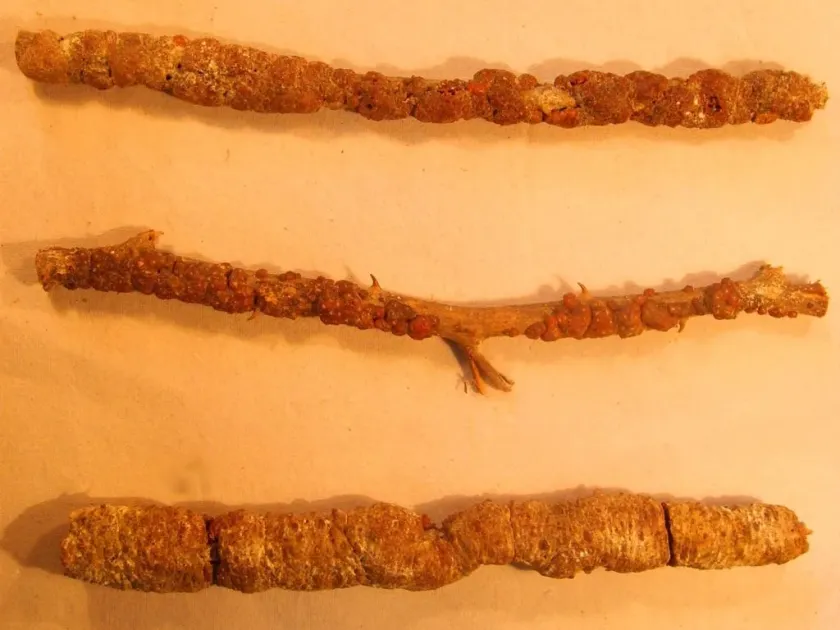
Adult females lack wings and legs, appearing as small, sac-like bodies embedded within the hardened resinous crust on the bark of host plants.
Males are generally rare, winged, and mobile; their primary function is to locate and fertilize females, after which they have a very short lifespan.
What it damages
Laccifer species primarily infest tropical and subtropical trees, such as Ficus, Acacia, and Ziziphus, causing significant stress to the host plants.
By constantly extracting phloem sap, these insects deprive the plant of essential nutrients needed for healthy growth and development.
Severe infestations can lead to the wilting and eventual death of branches, as the colonies effectively girdle the twigs, restricting sap flow.
The mechanical damage to the bark, combined with the removal of sap, weakens the tree's immune system, making it susceptible to secondary infections.
The sticky excreta produced by the insects create a medium for sooty mold growth, which blocks sunlight and hinders photosynthesis on the leaves.
When it appears
The life cycle is largely dependent on climate conditions; in tropical environments, reproduction can occur throughout the year without clear dormant phases.
The dispersal phase is dominated by the emergence of "crawlers," which are the first-instar nymphs capable of active movement to find new feeding sites.
Crawlers are highly sensitive to environmental conditions, and their successful settlement depends on humidity, temperature, and the absence of heavy rain.
Once a crawler finds a suitable spot on a young twig, it settles, inserts its stylets, and begins secreting the resin that forms its permanent protective cell.
Overlapping generations are common, meaning that at any given time, a colony may contain individuals at different developmental stages.
Signs of infestation
The most visible sign of infestation is the presence of hard, resinous, crust-like encrustations on the branches, often appearing as patches of brown or red.
The bark underneath these encrustations often shows signs of necrosis or cracking, indicating that the insect is physically impacting the plant tissue.
Presence of honeydew on the leaves below the infested branches often leads to a noticeable black or dark grey layer of sooty mold fungus.
Affected trees often exhibit general signs of decline, such as yellowing leaves, premature defoliation, and a significant reduction in new vegetative growth.
Examining the resinous crusts may reveal small holes where males have emerged or where nymphs are escaping, confirming the colony is currently active.
Control measures
Pruning and physically removing heavily infested branches is the most effective way to manage the population and prevent further spread in smaller plantings.
Systemic insecticides can be applied during the crawler stage, as they can be absorbed by the plant and ingested by the insects before they secrete the resin.
Once the protective resinous layer is fully formed, contact insecticides have very limited efficacy, as they cannot easily penetrate the hard shell.
Biological control, utilizing natural predators like ladybird beetles or parasitic wasps, can help keep lac insect populations in check in natural settings.
Maintaining tree health through proper fertilization and thinning of the canopy helps trees withstand the pressure exerted by these sap-sucking insects.
Taxonomy
- Latin name
- Laccifer
- Order
- Hemiptera (bugs, aphids, leafhoppers)
- Family
- Kerriidae
- EPPO code
- LACISP
Discussion
No discussions yet — be the first.