
Paratachardina
Paratachardina
Description
How to identify
Paratachardina is a genus of scale insects within the Kerriidae family, belonging to the order Hemiptera. These insects are known for their distinct ability to create thick, wax-like protective covers on the stems and branches of host plants.
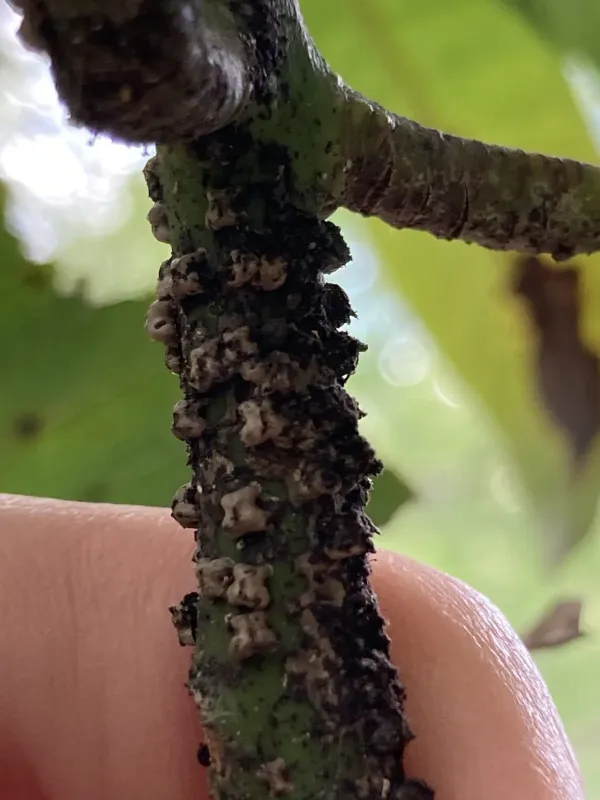
Adult females exhibit a rounded, almost globular body shape, which is permanently concealed beneath a hard, dark brown or black lacquer-like shell. These individual shells often coalesce into massive colonies, giving the branches a rugged, encrusted appearance.
The first-instar nymphs, commonly referred to as crawlers, are the only mobile stage of the insect. They are responsible for dispersal, moving across the plant to find suitable spots to settle and feed.
Many species within this genus reproduce parthenogenetically, meaning they do not require males to produce offspring. This biological trait allows them to establish large populations very quickly on a single host plant.
Due to their morphological similarity to bark texture or plant abnormalities, these pests are frequently overlooked during the early stages of an infestation, allowing populations to reach critical levels.
What it damages
Paratachardina is considered a significant polyphagous pest, meaning it attacks a wide variety of woody plants, including commercially valuable citrus species and numerous ornamental shrubs.
By inserting their mouthparts into the phloem of young stems, these insects extract vital nutrients and plant sap. This continuous feeding depletes the plant's resources, leading to severe vigor loss.
As they feed, they excrete large amounts of honeydew, a sugary substance that promotes the growth of sooty mold. This dark fungal growth coats the foliage, significantly reducing the efficiency of photosynthesis.
Heavy infestations typically result in stunted growth, leaf yellowing, and the eventual dieback of infested branches or twigs. In severe cases, the entire plant may struggle to survive.
The aesthetic damage to ornamental plants and the economic loss in fruit production make this genus a major concern for both commercial growers and private gardeners.
When it appears
The activity and development of Paratachardina are highly dependent on temperature, with the most rapid population growth occurring in warmer tropical and subtropical climates throughout the year.
Crawler emergence is most intense during periods of active plant growth, which typically aligns with spring and early summer in temperate regions. This timing ensures that young crawlers have access to nutrient-rich plant tissues.
During the summer months, the metabolic rate of these insects increases, leading to a surge in colonization. This period is critical for monitoring as it represents the peak window for spreading to neighboring plants.
Winter conditions generally slow the developmental cycle, though the insects remain protected under their hardy, wax-like scales, enabling them to survive lower temperatures in a quiescent state.
Effective management requires consistent observation throughout the growing season to detect the emergence of new generations before they secure their position on the host.
Signs of infestation
The most prominent sign of an infestation is the presence of numerous black or dark brown, raised, lacquer-like crusts on the bark of stems and branches.
An initial indicator is often the stickiness of leaves and stems caused by honeydew, which may attract ants, bees, and other insects that feed on the sugary waste.
The development of sooty mold, appearing as a dark, dusty layer on the leaves, is a secondary but highly visible sign that sucking insects are active on the host plant.
Visible decline, such as yellowing foliage, wilting tips, and premature leaf drop, suggests that the infestation has persisted for some time and is causing significant physiological stress.
Close inspection of the branch junctions and stems will often reveal the clustering of these scale insects, which may look like abnormal swellings if not identified correctly.
Control measures
Systemic insecticides are generally the most effective chemical control, as they are absorbed by the plant and ingested by the scale insects, providing protection against these hidden pests.
Horticultural oils or insecticidal soaps can be applied to effectively smother the insects and break down their protective waxy layer, resulting in rapid mortality through desiccation.
Strict phytosanitary measures are essential for prevention. Inspecting all new nursery stock before introduction is the best method to avoid bringing this pest into a new environment.
Mechanical control, including the pruning and immediate destruction of heavily infested branches, is highly effective for reducing the overall pest population in localized areas.
Biological control efforts often involve the introduction or preservation of natural enemies, such as parasitic wasps and predatory beetles, which can help regulate population densities in stable environments.
Taxonomy
- Latin name
- Paratachardina
- Order
- Hemiptera (bugs, aphids, leafhoppers)
- Family
- Kerriidae
- EPPO code
- PTACSP
Discussion
No discussions yet — be the first.