
Paratachardina pseudolobata
Paratachardina pseudolobata
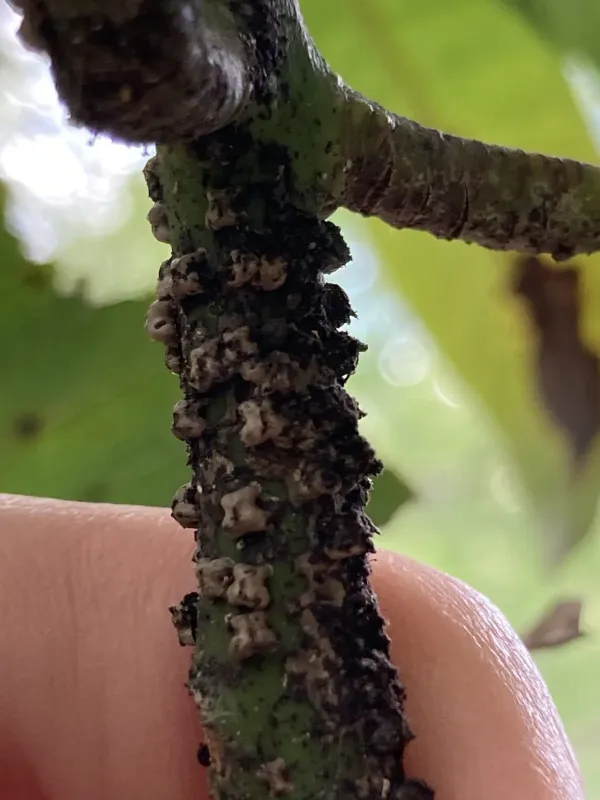
Description
How to identify
Paratachardina pseudolobata is a member of the Kerriidae family, known for its ability to produce substantial amounts of wax and lac-like secretions to protect its body.
The adult female is sessile, meaning it attaches itself to the bark of the host plant, and its body is covered by a hard, dark-colored, star-shaped or droplet-like wax cover.
These insects are extremely small, which makes early detection difficult for non-specialists, even though the damage to the host plant might be clearly visible.
The life cycle involves an egg stage, followed by several nymphal stages. The mobile phase, known as the "crawler" stage, is the only time the pest can easily spread to new host plants.
The species relies on plant sap as its primary source of nutrition, utilizing specialized piercing-sucking mouthparts to penetrate the phloem tissue of the host.
What it damages
This pest is a significant polyphagous species capable of attacking a wide variety of woody ornamentals, fruit trees, and various shrubs in warm climates.
By constantly draining plant sap, the infestation causes severe metabolic stress, resulting in stunted growth and a general decline in the plant's health.
The accumulation of honeydew secreted by the insects leads to the colonization of sooty mold, which blocks sunlight and reduces the efficiency of photosynthesis.
Severe infestations often result in branch dieback, cracking of the bark, and in extreme cases, the total death of the affected plant or tree.
- Leaf chlorosis and premature drop
- Reduced vigor and stunted branch development
- Development of secondary fungal pathogens on the bark
- Attraction of ants that protect the scale insect colonies
Signs of infestation
The presence of hard, reddish-brown to dark brown crust-like scales on the twigs and bark is the primary indicator of an infestation by this species.
Sticky honeydew residues covering the foliage and the eventual appearance of a black, powdery sooty mold indicate that the colony is actively feeding.
Plants often exhibit general signs of decline, such as yellowing leaves or thinner foliage canopy, which become more pronounced as the infestation spreads.
Checking the forks of branches and the undersides of leaves during the peak of the growing season is essential for spotting early-stage crawlers.
Cracking and peeling bark in areas with heavy insect density are clear signs that the pest has been present on the plant for a significant amount of time.
Control measures
Controlling Paratachardina pseudolobata is challenging because its waxy outer layer acts as a barrier, protecting the insect from many direct-contact chemical treatments.
Systemic insecticides are generally the most effective method, as they are absorbed by the plant and ingested by the pest during its normal feeding process.
Pruning and physically removing heavily infested branches is a recommended cultural practice to reduce the overall population pressure in the garden.
Horticultural oils or insecticidal soaps can be used during the crawler stage, as these young nymphs are much more vulnerable to topical applications.
Integrating chemical control with regular monitoring and improving plant health through proper fertilization can significantly increase the plant's resistance to future attacks.
Taxonomy
- Latin name
- Paratachardina pseudolobata
- Order
- Hemiptera (bugs, aphids, leafhoppers)
- Family
- Kerriidae
- EPPO code
- PTACPS
Discussion
No discussions yet — be the first.