
Tachardiella cornuta
Tachardiella cornuta
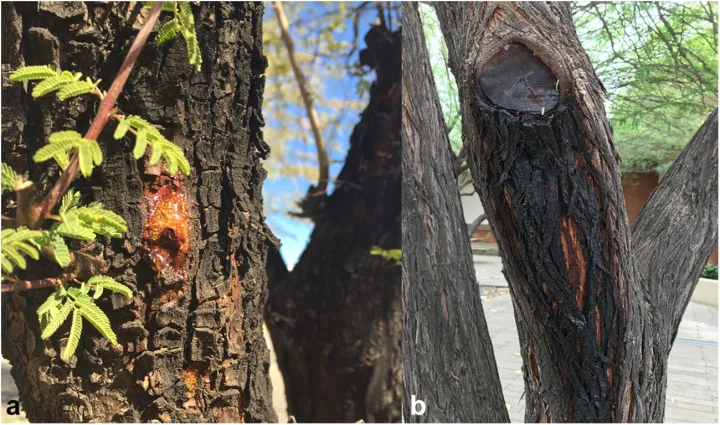
Description
How to identify
Tachardiella cornuta is a species of scale insect belonging to the family Kerriidae. These insects are biologically fascinating due to their ability to produce complex resinous tests that act as protective housing.
The adult females are sessile, meaning they spend the majority of their lives firmly attached to the host plant bark, protected by their hardened, often horn-shaped wax secretions.
The life cycle begins with mobile crawlers, which are the primary dispersal stage of the pest. These tiny nymphs navigate the plant surface to find suitable sites to settle and start their sedentary life phase.
Unlike many other insects, female Tachardiella lack wings throughout their adult life, which limits their mobility and necessitates reliance on environmental factors for colonization.
The insects belong to the suborder Coccoidea, a group characterized by significant sexual dimorphism, where adult males are typically small and winged, while females are specialized for feeding and reproduction.
What it damages
Tachardiella cornuta primarily attacks woody plants and shrubs. By inserting their specialized mouthparts into the phloem, they siphon essential nutrients directly from the host plant's vascular system.
Infestations typically occur on branches and stems, where the insects can access the flow of sap more effectively, leading to the exhaustion of local plant tissues.
The damage caused is twofold: direct loss of nutrients and the creation of secondary stress points that make the plant susceptible to environmental factors or diseases.
In addition to feeding damage, the production of honeydew promotes the growth of sooty mold, which coats the foliage in a dark film and restricts the plant's ability to undergo photosynthesis.
Significant infestations over time lead to branch dieback, stunted growth, and in severe cases, the eventual decline or death of the host plant if left untreated.
Signs of infestation
The most visible sign of infestation is the appearance of distinct, hard, horn-like or lumpy protrusions on the bark, which vary in color but are often brownish or reddish.
Sticky residue, known as honeydew, on leaves and twigs is a strong indicator of the presence of sucking insects, as this is a byproduct of their sap-feeding process.
A secondary sign is the appearance of black, powdery sooty mold on the leaves, which develops on the sugary honeydew excreted by the scale insects.
Increased ant activity on the stems and branches is often a sign of scale insect presence, as ants feed on the honeydew and often protect the scales from natural predators.
Leaf yellowing, premature senescence, and the wilting of new shoots are general symptoms of an infested plant struggling to maintain its physiological balance under the feeding pressure.
Control measures
Management begins with cultural practices, such as the pruning and safe disposal of heavily infested branches, which helps to reduce the local pest population immediately.
Chemical control via systemic insecticides is effective because these substances travel through the plant's vascular system and reach the insects feeding beneath their protective resinous shells.
The timing of treatment is critical; applying contact insecticides during the crawler stage provides the best results as the insects are not yet protected by their mature, hardened tests.
Horticultural oils can be used to coat the insects, creating a physical barrier that suffocates them without relying on toxic chemicals that might harm beneficial local fauna.
Promoting a healthy environment for natural predators, such as lady beetles and parasitic wasps, can provide long-term biological control and keep population levels manageable.
Taxonomy
- Latin name
- Tachardiella cornuta
- Order
- Hemiptera (bugs, aphids, leafhoppers)
- Family
- Kerriidae
- EPPO code
- TACACO
Discussion
No discussions yet — be the first.