
Broad-nosed pipefish
Syngnathus typhle
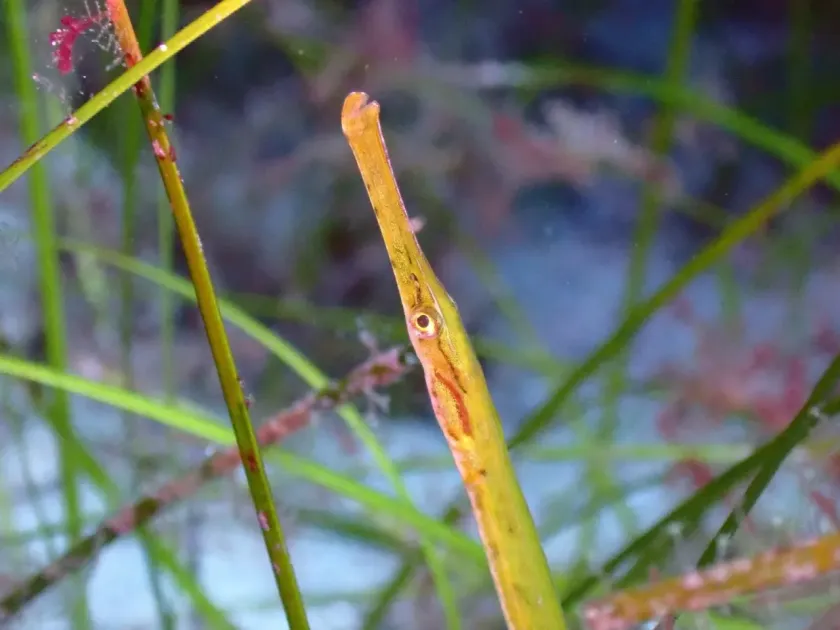
Description
How to identify
The broad-nosed pipefish (Latin: Syngnathus typhle) belongs to the Syngnathidae family, within the order Syngnathiformes.
These fish possess a distinctively elongated body protected by a series of bony rings, providing effective camouflage among aquatic vegetation.
A primary feature of the species is its long, tubular snout, which is specifically adapted for feeding on tiny crustacean prey.
Reproductive biology involves the males carrying the eggs in a specialized brood pouch located on their ventral side until they hatch.
They typically inhabit shallow coastal waters, often remaining motionless among seagrasses to mimic the structure of aquatic flora.
What it damages
The broad-nosed pipefish is not an agricultural pest and causes no damage to crops or any terrestrial plants.
As a species confined to marine or brackish water environments, it lacks any biological mechanism to interact with farming systems.
Their diet consists solely of microscopic marine organisms, meaning they pose zero threat to any commercial agricultural produce.
Categorizing this fish as a pest is scientifically inaccurate and fundamentally contradicts its ecological status.
Farmers should be aware that this marine organism has no negative impact on soil, foliage, or crop health.
Control measures
There are no control measures for the broad-nosed pipefish, as it does not pose a threat to agricultural activities.
The species is a natural component of coastal ecosystems and is often protected by local environmental laws.
No agricultural products, pesticides, or monitoring systems are needed to manage this aquatic inhabitant.
Focusing on genuine phytosanitary issues is the recommended approach for maintaining crop health and productivity.
Educating growers on distinguishing between marine fauna and real agricultural pests is essential for effective farm management.
Taxonomy
- Latin name
- Syngnathus typhle
- Family
- Syngnathidae
- EPPO code
- SYGNTY
Discussion
No discussions yet — be the first.