
Worm pipefish
Nerophis lumbriciformis
Description
How to identify
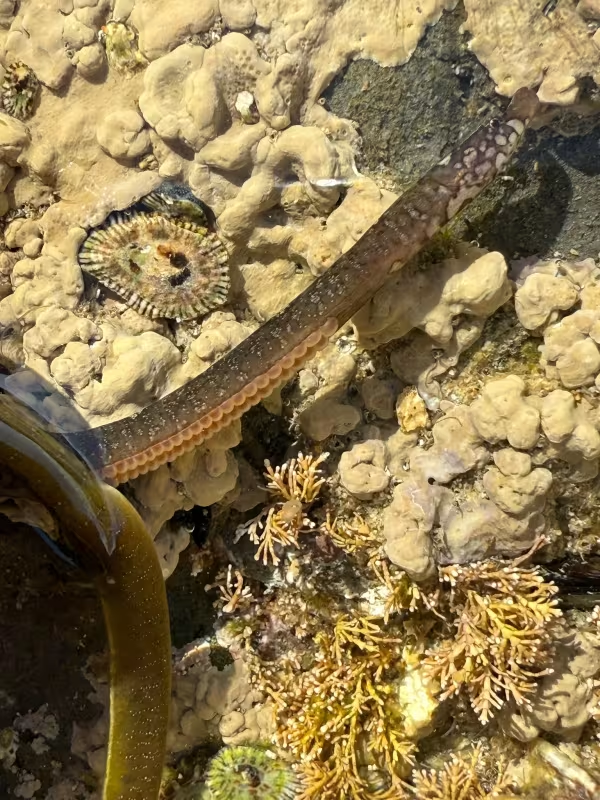
The worm pipefish (Nerophis lumbriciformis) is a small species of marine fish belonging to the family Syngnathidae, which also includes seahorses. It typically reaches a length of 15–17 cm and has a snake-like appearance.
Unlike most fish, it lacks a caudal fin, and its body is armored with bony plates arranged in rings. This structure provides protection and supports its slow, deliberate movement within marine habitats.
The fish exhibits a cryptic lifestyle, blending perfectly into rocky shores and seaweed forests due to its brownish or greenish coloration. This makes it very difficult to spot in its natural environment.
The mouth is formed into a small, tubular snout, specialized for suction feeding on tiny crustaceans. It is a slow-moving creature that often anchors itself to algae using its tail.
Reproduction involves parental care, as the males carry the eggs on their underside until they hatch. This species is native to the coastal waters of the northeastern Atlantic Ocean.
What it damages
The worm pipefish is not an agricultural pest. It is a strictly marine species that resides in salt water and has no biological link to terrestrial agriculture or garden plants.
This fish does not feed on plant tissue, roots, or fruits. Its diet consists of small aquatic invertebrates, which are found only in marine or estuarine environments.
There is no mechanism through which this creature could damage crops, as it is biologically incapable of surviving outside of water. It poses no threat to any known agricultural or horticultural crops.
Attributing pest status to this fish is incorrect and scientifically inaccurate. Its ecological niche is limited to the marine benthos, far from any agricultural production area.
No pest control measures are required for this species. It remains a fascinating subject for marine biologists but is entirely irrelevant to crop protection practices.
Taxonomy
- Latin name
- Nerophis lumbriciformis
- Family
- Syngnathidae
- EPPO code
- NEROLU
Discussion
No discussions yet — be the first.