
Greater pipefish
Syngnathus acus
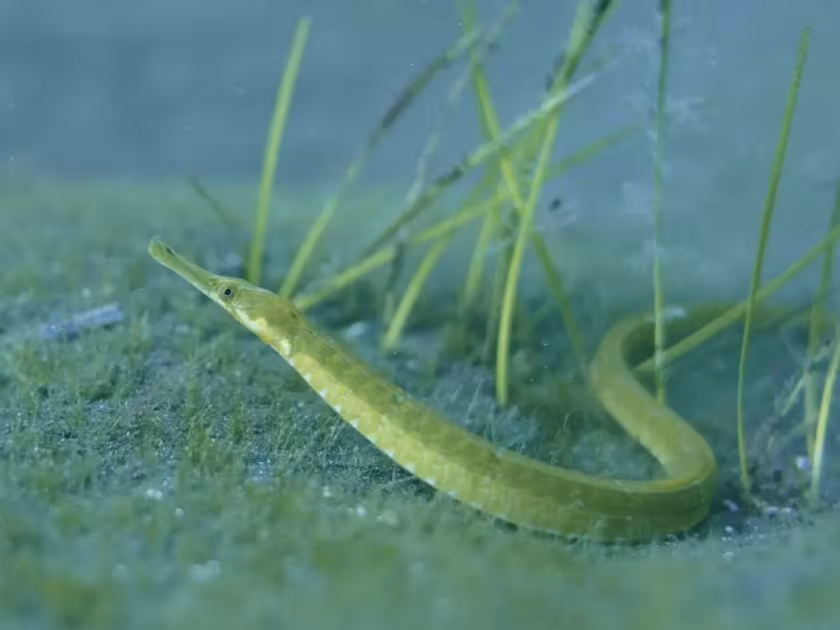
Description
How to identify
The greater pipefish (Syngnathus acus) is a species of pipefish belonging to the family Syngnathidae, characterized by its elongated, rigid body covered in bony rings.
Its slender form and camouflage capabilities allow it to blend seamlessly into seagrass beds, which serve as its primary habitat and hunting ground.
The head features a distinctive tubular snout, specialized for suction-feeding on tiny prey found within the dense aquatic vegetation.
Adult individuals can grow up to 45 centimeters in length and possess a small dorsal fin that aids in precise, slow-motion movement.
As an exclusively marine creature, this species is entirely unrelated to any type of land-based agricultural pest or crop destroyer.
What it damages
The greater pipefish causes no damage to crops or agricultural plants, as its biological requirements are strictly confined to aquatic ecosystems.
It feeds primarily on small crustaceans, copepods, and zooplankton, playing a specific role in the marine food web rather than an agricultural one.
It lacks the mouthparts and digestive system necessary for consuming terrestrial plant matter, including leaves, roots, or seeds.
There is no evidence of this species interacting with commercial crops, therefore it presents zero economic risk to farming activities.
The confusion regarding its status as a "pest" is likely a categorical error, as the species is harmless to all cultivated vegetation.
When it appears
The breeding season for the greater pipefish occurs throughout the warmer months, typically from spring through late summer.
During this period, the male plays a significant role in parental care, carrying fertilized eggs in a brood pouch until they hatch.
The population activity follows seasonal temperature patterns of the ocean, leading to shifts in distribution between shallow and deeper waters.
In winter months, metabolic processes slow down significantly, leading the fish to prefer more stable, deeper environments far from the shore.
This seasonal lifecycle operates independently of any agricultural calendar, confirming the lack of impact on crop growth stages.
Control measures
No pest control measures are applicable or necessary for the greater pipefish, as it is a beneficial part of the marine ecosystem.
Farmers and land managers should focus on maintaining water quality to prevent agricultural runoff from entering marine habitats where these fish live.
Protection of the environment is the only recommended action, as healthy populations of this species indicate stable coastal conditions.
The use of pesticides should be managed with strict regulations to ensure that no chemical residue harms these aquatic organisms.
There is no need for monitoring programs or mitigation strategies for this species within an agronomic or farming context.
Taxonomy
- Latin name
- Syngnathus acus
- Family
- Syngnathidae
- EPPO code
- SYGNAC
Discussion
No discussions yet — be the first.