
Apple ermine moth
Swammerdamia pyrella
Description
How to identify
The apple ermine moth (Swammerdamia pyrella) belongs to the Yponomeutidae family, known as ermine moths. It is a small lepidopteran pest that frequently affects orchard environments.
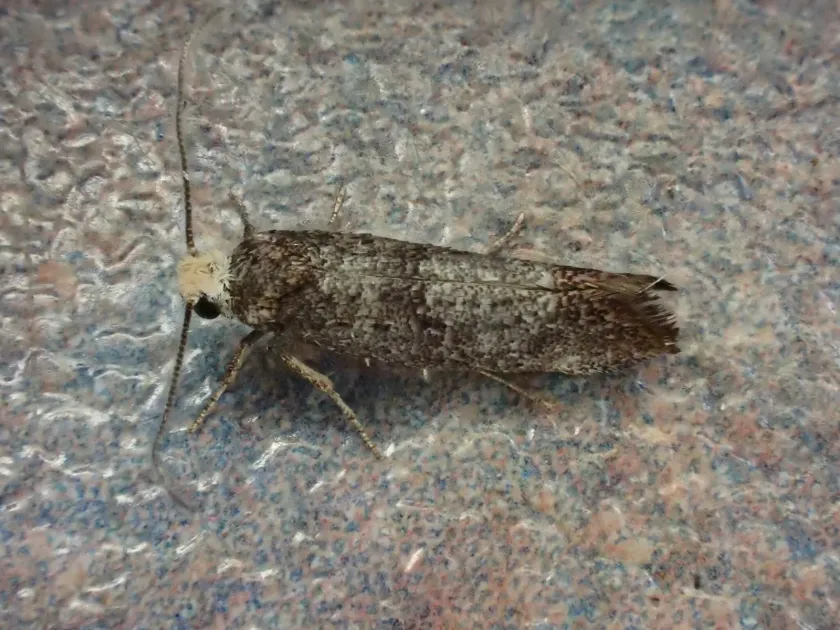
The adult moth has a wingspan of approximately 10–12 mm. The forewings are typically silvery-grey with brownish markings, providing effective camouflage against tree bark. The hindwings are paler with distinct fringes.
The larvae are about 8–10 mm long and exhibit a light green or yellowish body color with faint longitudinal stripes. They possess a dark head, which is a common diagnostic feature for this species.
Pupae are found within white, dense, spindle-shaped cocoons. These are often located within rolled leaves or in crevices of the tree bark, providing protection from predators and environmental stress.
The lifecycle includes a complete metamorphosis: egg, larva, pupa, and adult. Overwintering typically occurs as eggs or early-instar larvae protected on the tree branches.
What it damages
The primary hosts are apple trees, but the moth also frequently attacks pears, hawthorn, and mountain ash, which belong to the Rosaceae family.
Larvae feed on young leaf tissues, beginning immediately after bud burst. They mine the leaf parenchyma and eventually skeletonize the foliage, leaving only the veins behind.
Severe infestations cause leaves to curl, brown, and drop prematurely. This reduction in leaf area impairs the tree's photosynthetic capability, leading to weakened growth and reduced fruit yield.
In nurseries and young orchards, larvae can cause significant damage by consuming the terminal buds, which distorts the growth pattern and slows tree development.
Repeated yearly defoliation weakens the overall tree health, making it more susceptible to secondary infections, frost damage, and environmental stress.
When it appears
Adult moths are typically active during the summer months, specifically from June through August. They are nocturnal, making them difficult to detect during daylight hours.
Larval emergence coincides with the green-tip or bud-burst stage of apple trees. This is the period when larvae are most vulnerable to control measures.
Peak feeding activity occurs from late spring to early summer (May–June), during which time the larvae are most visible due to the creation of silken webs.
The species usually completes one or two generations per year, depending on regional temperature variations and microclimatic conditions within the orchard.
As winter approaches, fertilized females lay their eggs on the bark of shoots, where they remain dormant until the following spring, ensuring the continuation of the cycle.
Signs of infestation
Initial signs of infestation include small holes in buds or the presence of minute 'windows' in young leaves where the larvae have begun feeding.
The most recognizable symptom is the presence of silk webbing used by larvae to bind leaves together into "tents" or rolled tubes. These structures are clear indicators of the pest's presence.
Accumulation of frass (larval droppings) within the rolled leaves confirms an active infestation. Affected leaves often turn brown and become deformed as the larvae grow.
Visual inspection of the branches and bark may reveal white, spindle-shaped cocoons during the late spring period, indicating the pupation phase.
- Malformed or unopened buds.
- Visible silk webbing on leaf surfaces.
- Skeletonized or mined leaf tissue.
- Premature yellowing and leaf drop.
Control measures
Sanitation is a primary control method; pruning and destroying branches containing webbed nests significantly reduces the larval population in small gardens.
Biological control, using formulations of Bacillus thuringiensis, is highly effective against young larvae while sparing beneficial insects and natural predators.
Chemical control should be timed to coincide with the early larval stages before they form protective nests or migrate deep into the foliage.
Systemic insecticides can be used to protect the tree, as the active ingredient is absorbed into the leaf tissue, making it toxic upon larval ingestion.
Monitoring adult populations using pheromone or light traps is recommended to determine the optimal timing for protective spraying, ensuring maximum efficacy.
Taxonomy
- Latin name
- Swammerdamia pyrella
- Order
- Lepidoptera (butterflies)
- Family
- Yponomeutidae
- EPPO code
- SWAMPY
Discussion
No discussions yet — be the first.