
Meerkat
Suricata suricatta
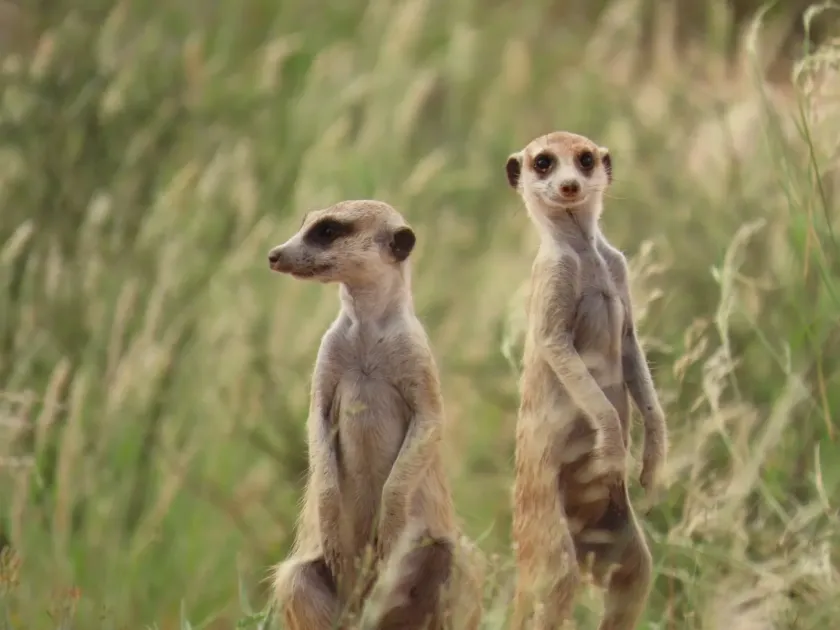
Description
How to identify
The meerkat (Suricata suricatta) is a small carnivoran belonging to the mongoose family (Herpestidae). Native to southern Africa, these social animals live in highly organized colonies within extensive underground burrow systems.
Physically, meerkats possess slender bodies, long tails, and dark patches around their eyes which help minimize glare from the sun. Adults typically weigh under one kilogram and have powerful forelimbs equipped with curved claws for digging.
While their primary diet consists of insects and small invertebrates, they are opportunistic feeders. In agricultural settings, their burrowing activities often conflict with crop production.
Meerkats exhibit complex social behavior, including the use of sentinels to monitor the environment for threats, which makes manual deterrence challenging for farmers.
Their adaptation to arid environments means they are exceptionally skilled at excavating deep tunnels in various soil types, creating challenges for land stability and agricultural machinery.
What it damages
The primary damage caused by meerkats to crops is mechanical root destruction. As they excavate and expand their tunnels, they disrupt the root systems of various plants, leading to wilting and death.
Vegetable crops such as potatoes, carrots, and beets are particularly vulnerable, as their succulent parts can become secondary food sources when insects are scarce.
Burrowing activities destabilize the soil, causing erosion and creating hazards for tractors and other agricultural machinery used during harvesting or soil preparation.
By excavating complex burrow systems, they can inadvertently damage irrigation pipes and disrupt water distribution, leading to uneven moisture levels in the fields.
Furthermore, constant digging brings nutrient-poor subsoil to the surface, which covers topsoil and negatively impacts the germination and development of young crop shoots.
When it appears
Meerkats are active throughout the year and do not hibernate. Their activity levels are generally consistent, though they tend to be most visible during the daylight hours.
The risk of damage is highest during the growing season when the soil is being frequently tilled and watered, attracting the animals to moist, easily diggable areas.
During the breeding season, colonies are more active in maintaining and expanding their living spaces to accommodate offspring, resulting in more significant soil disturbance.
In hot, dry months, meerkats may focus their burrowing efforts in or near irrigated fields to access moisture, increasing their interference with agricultural activities.
Post-harvest periods may see a decrease in activity as the animals shift their focus to other areas, but the damaged infrastructure of the burrows often remains, requiring remediation.
Signs of infestation
The most prominent sign of meerkat presence is the appearance of multiple burrow entrances surrounded by mounds of excavated soil and debris.
Direct observation of the animals, particularly their characteristic behavior of standing upright as sentinels on mounds or high spots, is a clear indicator of a colony.
Plants exhibiting unexplained yellowing or sudden wilting in distinct lines or patches often indicate that their root zones have been compromised by a tunnel network.
Well-worn paths or trails between burrows and foraging areas are frequently visible on the ground, especially in areas with loose soil or short vegetation.
Footprints showing four digits and distinct claw marks in soft, damp soil or near irrigation outlets confirm the activity of these burrowing animals.
Control measures
The most effective strategy for managing meerkat impact is the installation of physical barriers, such as buried wire fencing that extends 30–50 cm underground to prevent tunneling.
Ultrasonic deterrent devices can be employed to create an uncomfortable environment for the animals, encouraging them to migrate to non-agricultural areas.
A proactive approach involves regular soil cultivation and the immediate destruction of newly formed burrows to prevent the establishment of large, permanent colonies.
Strategic use of repellents, including scent-based deterrents, can provide short-term protection for valuable crop patches during critical development phases.
- Installing subterranean fencing to block tunnel access.
- Regular manual or mechanical destruction of burrow entrances.
- Using bioacoustic repellent systems to discourage territory establishment.
Taxonomy
- Latin name
- Suricata suricatta
- Family
- Herpestidae
- EPPO code
- SURITE
Discussion
No discussions yet — be the first.