
Southern dwarf mongoose
Helogale parvula
Description
How to identify
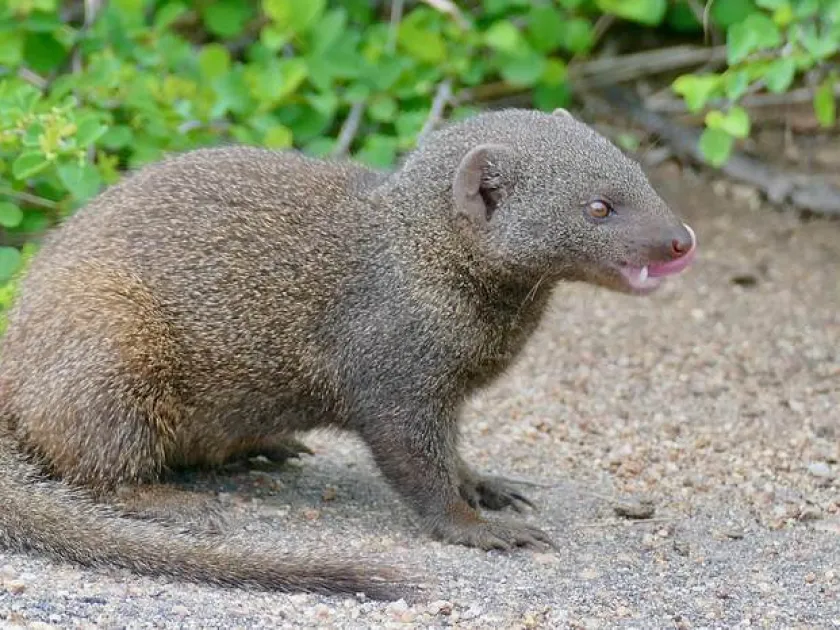
The southern dwarf mongoose (Helogale parvula) is the smallest member of the Herpestidae family, order Carnivora. Adult individuals typically weigh between 200 and 400 grams and reach lengths of 18–28 cm.
They possess a dense coat ranging from dark brown to reddish or grey, which serves as camouflage within arid to semi-arid environments where they are commonly found.
These animals are highly social, living in complex colonies of up to 30 individuals. Their social structure is led by a dominant breeding pair, which manages group activities.
Being diurnal, they are most active during the day, using sophisticated vocalizations to communicate within the group while foraging or surveying their territory.
Their morphological characteristics include a tapered muzzle, small rounded ears, and a long tail, which are distinct enough to separate them from other small carnivores found in similar habitats.
What it damages
Southern dwarf mongooses are primarily insectivorous and do not consume crops directly; therefore, they are not pests in the traditional sense of crop consumption.
The primary damage arises from their extensive burrowing activities, which can destabilize the soil structure, damage irrigation infrastructure, and mechanically harm plant root systems.
By preying on small birds and reptiles, they disrupt the local ecosystem's natural biological pest control, which may lead to an increase in harmful insect populations on the farm.
The accumulation of excavated soil around burrow entrances creates obstacles for tractors and other agricultural machinery operating within the field or orchard.
Furthermore, their presence in large colonies can lead to soil erosion and degradation of drainage systems, potentially impacting the water management of the agricultural plot.
When it appears
Active periods for these mongooses are largely year-round, as they maintain constant habitation in their communal burrows across changing seasons.
During the rainy season, when insect activity peaks, the colony becomes more energetic in foraging, often expanding their territory into cultivated land.
Dry seasons may drive them towards irrigated crops where water availability sustains their insect prey, bringing them into closer proximity with farming activities.
Diurnal activity cycles mean they are most visible during the brightest hours of the day, allowing farmers to monitor their movements easily during working hours.
Reproductive patterns are flexible and often peak after favorable weather conditions, which also correlate with periods of high burrowing activity.
Signs of infestation
The most prominent sign of a colony's presence is the appearance of multiple burrow entrances concentrated in specific areas of the farm, often along borders or fences.
Freshly excavated dirt piles, which remain unconsolidated for some time, clearly indicate active occupation of the tunnels beneath the soil surface.
Observation of the animals themselves, often resting on mounds near burrow entrances, is the definitive method for identifying their presence in a specific area.
Ground subsidence or collapse of soil in areas where irrigation pipes are buried often points to the structural damage caused by their tunneling activities.
Tracking their distinctive claw marks in the soil during early morning hours after irrigation helps confirm the scale and location of their colonial network.
Control measures
Physical exclusion remains the most effective control measure; installing buried wire mesh fences to a depth of at least 40 cm prevents them from gaining access to critical areas.
Regular tillage and deep plowing of fallow land are effective at destroying the underground burrow systems, forcing the colony to relocate to non-productive areas.
Maintaining a clean agricultural environment free of debris, fallen branches, or waste piles reduces the number of favorable nesting sites available to the colony.
Vibration-based deterrents can discourage them from settling, although these are rarely 100% effective and work best in combination with physical barriers.
Environmental management, including the restriction of easily accessible water sources, makes the farmed plot less attractive to mongooses, naturally limiting their interest in the area.
Taxonomy
- Latin name
- Helogale parvula
- Family
- Herpestidae
- EPPO code
- HLGEPA
Discussion
No discussions yet — be the first.