
Large marsh grasshopper
Stethophyma grossum
Description
How to identify
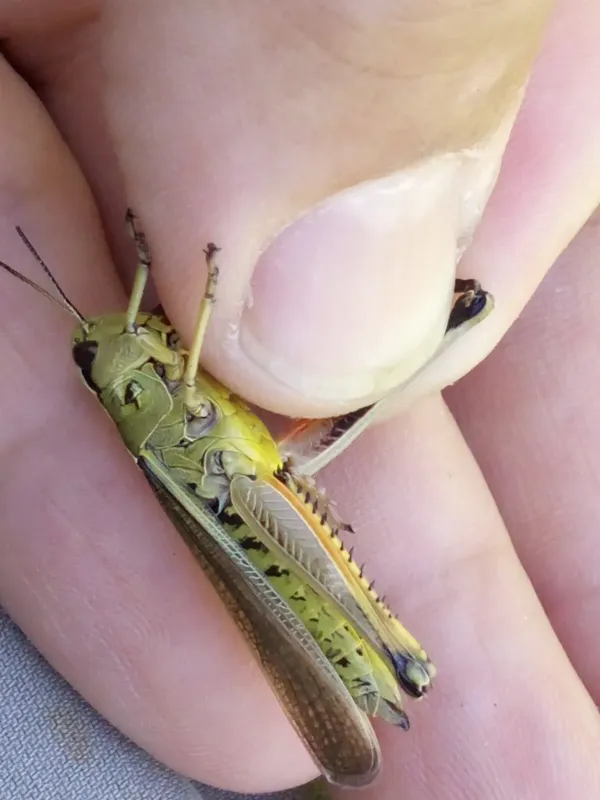
The Large marsh grasshopper, known scientifically as Stethophyma grossum, is a significant member of the Acrididae family. It is one of the largest grasshopper species in Europe, with females measuring up to 45 mm in length.
These insects exhibit a vibrant green or brownish coloration, which serves as camouflage in the lush, wetland vegetation they inhabit. A distinctive feature includes a yellow longitudinal stripe on the pronotum and bright yellow or red hind tibiae.
The head is conical in shape, and both males and females possess well-developed wings, allowing them to fly effectively between patches of suitable habitat.
Nymphs resemble smaller, wingless versions of the adults. Throughout their development, they undergo five distinct instars, gradually increasing in size and developing wing pads before reaching maturity.
This species is strictly hygrophilous, meaning it is restricted to damp environments such as marshes, river floodplains, and wet meadows with high humidity levels.
What it damages
Both nymphs and adults are polyphagous, primarily feeding on various grasses and sedges. When populations reach high densities, they can cause measurable economic damage to agricultural pastures.
The damage is primarily manifested as ragged, uneven edges on leaf blades. In severe cases, they can strip plants down to the midrib, severely impacting plant health and growth potential.
Cereal crops grown in fields adjacent to wetlands are particularly at risk. Grasshoppers often migrate from natural habitats into crop margins, causing significant loss of leaf area and reducing photosynthetic efficiency.
Beyond vegetative damage, they may feed on developing inflorescences. This destruction of reproductive organs directly affects seed set, which is a major concern for forage and cereal seed production.
The persistent feeding habits of this species reduce the biomass of pastures, leading to lower hay quality and decreased yield for farmers operating in low-lying, humid areas.
When it appears
The life cycle of Stethophyma grossum is univoltine, meaning there is one generation per year. Eggs overwinter in the soil or dense vegetation base, protected from cold temperatures.
Nymphs emerge in late spring or early summer, typically when temperatures consistently exceed the threshold for hatching. The timing is heavily influenced by the humidity of the microhabitat.
The nymphal stage lasts for approximately two months, during which time the grasshoppers are highly active and destructive. This period generally spans from late May through July.
Adults emerge in mid-to-late summer, usually starting in July. This phase is dedicated to reproduction, with mating and egg-laying occurring until the onset of autumn frost.
Their activity levels are highest during warm, sunny days. During these peak hours, they move between vegetation layers, feeding and seeking mates within their preferred wetland patches.
Signs of infestation
Presence is first indicated by irregular grazing patterns on grasses. You will observe leaves with large, jagged bites taken from the edges, rather than the clean cuts typical of some other insects.
During surveys, the distinctive stridulation of males is often the first auditory cue. If walking through tall, damp grass, you may notice large insects leaping away from your path.
The presence of fecal pellets (frass) at the base of plants is a reliable sign of infestation. These are small, cylindrical, and indicative of high population density in the immediate area.
The accumulation of cast-off skins (exuviae) attached to plant stems is a classic sign that the population is actively growing and undergoing molting in that location.
In the early morning, before the insects are fully warmed up, it is easy to spot individuals resting on the upper or middle stems of grasses, making it the best time for scouting.
Control measures
Effective management begins with mechanical control, such as regular mowing of field margins, ditches, and surrounding wetlands to destroy the grasshopper's primary habitat and breeding sites.
Improving field drainage is a highly effective long-term strategy. By reducing the moisture content of the soil, the land becomes less attractive to this hygrophilous species.
Biological control using entomopathogenic fungi or bacteria can be deployed to manage populations without the need for synthetic chemical pesticides, maintaining environmental balance.
In scenarios where population density exceeds economic thresholds, localized application of insecticides may be necessary. Always ensure the products are approved for the specific crop and target species.
Regular monitoring of low-lying fields throughout the spring and early summer is crucial to detect outbreaks early, allowing for targeted intervention before the pests become widely dispersed.
Taxonomy
- Latin name
- Stethophyma grossum
- Order
- Orthoptera (locusts)
- Family
- Acrididae
- EPPO code
- STTPGR
Discussion
No discussions yet — be the first.