
Stripe-winged grasshopper
Stenobothrus lineatus
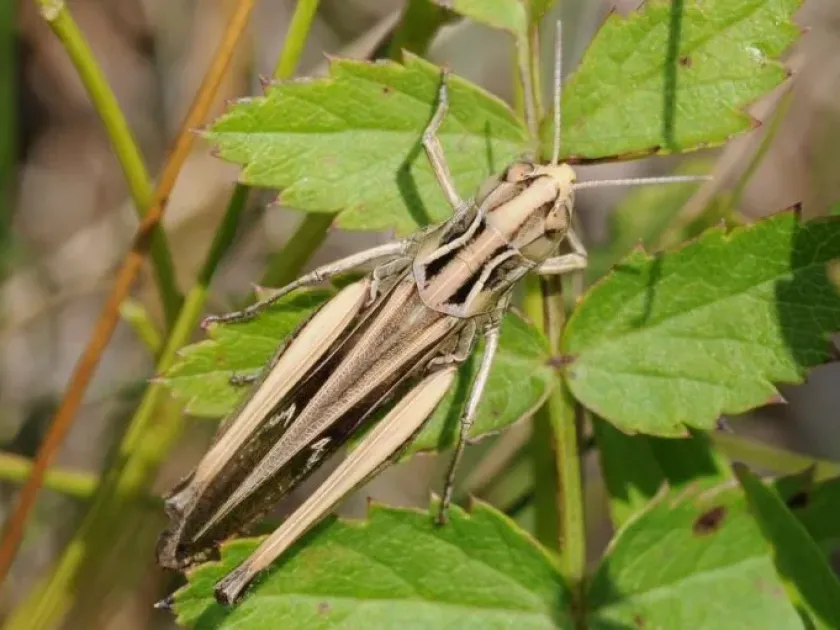
Description
How to identify
The stripe-winged grasshopper (Stenobothrus lineatus) belongs to the order Orthoptera and the family Acrididae. This species is widely distributed across temperate regions and is recognized as a potential pest in agricultural landscapes and pasturelands.
Adults are medium-sized, exhibiting a camouflage coloration ranging from vibrant green to shades of brown or grey. This cryptic appearance helps them remain hidden within the vegetation, making visual inspection challenging for field workers.
The name comes from the distinctive stripes on the tegmina (forewings), which serve as a primary identifying characteristic. Females are typically larger and more robust than males, displaying variations in color intensity based on environmental factors.
Like other members of the genus, they possess powerful hind legs designed for jumping, which they use as an escape mechanism. Their body structure is adapted to various grass-based habitats, including fields, meadows, and grain crop borders.
Identification is further confirmed by morphological details, including the shape of the pronotum and specific wing venation patterns, which are essential for accurate taxonomical classification by professional agronomists.
What it damages
The stripe-winged grasshopper is a polyphagous pest, though it shows a marked preference for various grass species. Cereal crops, including wheat, barley, and oats, are highly susceptible to damage throughout their developmental stages.
Both nymphs and adults feed on the leaves and stems of young plants. By chewing on the green tissue, they reduce the photosynthetic surface area, which leads to stunted growth and reduced grain yield potential for the affected crop.
In addition to foliage consumption, these grasshoppers can damage the reproductive parts of plants, such as young ears. Severe infestations often result in total crop failure within localized spots, commonly referred to as hotspots.
Pastures are also significantly impacted by this pest, as it consumes valuable forage grasses, thereby reducing the availability and quality of feed for livestock and negatively affecting the overall productivity of the land.
The mechanical damage inflicted by their mouthparts creates entry points for secondary infections, including various fungal and bacterial pathogens, which can further weaken the crop and complicate the recovery of the plants.
When it appears
The life cycle of the stripe-winged grasshopper is univoltine, meaning it completes one generation per year. The overwintering stage occurs in the form of eggs laid in the soil by females during the late summer and early autumn months.
Nymphs emerge in the spring as soil temperatures begin to rise. The timing of this emergence is highly dependent on local climatic conditions, with warmer springs typically leading to earlier appearances of the pest in fields.
Throughout the summer, the grasshoppers undergo several molting stages, growing progressively larger. During this period, their feeding activity intensifies as they accumulate the energy required for their adult reproductive phase.
Adults are most active during the peak of summer, focusing on feeding and mating before the females begin the process of oviposition. This reproductive stage ensures the survival of the species through the winter in the egg stage.
Environmental fluctuations, particularly excessive moisture during the nymph emergence period, can naturalistically regulate population numbers by encouraging the development of entomopathogenic fungi, providing a form of natural control.
Signs of infestation
The most common sign of infestation is the appearance of jagged edges on leaf blades. Unlike pests that skeletonize leaves, stripe-winged grasshoppers typically feed from the margins inwards, leaving characteristic uneven marks.
Visible patches of thinned or destroyed vegetation are strong indicators of a significant population density. When walking through a field, one can observe individuals jumping away from the vegetation as a reaction to disturbance.
Premature yellowing and wilting of plants in specific areas of the field, which cannot be attributed to drought or disease, often suggest intense feeding activity. The plants may appear stripped and physically weakened.
The presence of grasshopper frass (droppings) on the soil surface and lower leaves is a clear indicator of recent feeding. Monitoring these signs allows farmers to estimate the population size and the potential threat to the crop.
Early morning observations are the most effective way to identify the presence of these grasshoppers, as they are more likely to be found on the upper parts of the vegetation before the heat of the day drives them lower into the canopy.
Control measures
Effective management begins with sound agronomical practices. Deep plowing of the fields in autumn is a highly recommended method to disturb and destroy egg pods in the soil, significantly reducing the success of the following year's generation.
Maintaining clean field margins by removing weeds reduces potential refuges for the pests. Eliminating this non-crop vegetation deprives the grasshoppers of suitable habitats and food sources during the off-season.
When the population threshold for economic damage is exceeded, the application of chemical insecticides becomes necessary. Targeted spraying, focused on hotspots rather than entire fields, can be effective in controlling the nymphs.
Integrated pest management (IPM) encourages the preservation of natural predators and the use of biological control agents to keep grasshopper populations within manageable levels, minimizing the need for synthetic inputs.
- Implementing deep tillage to destroy overwintering egg pods.
- Regular monitoring during the spring emergence phase.
- Keeping field edges free from weeds and high grasses.
- Applying authorized insecticides only when threshold levels are reached.
- Practicing crop rotation to disrupt the grasshopper lifecycle.
Taxonomy
- Latin name
- Stenobothrus lineatus
- Order
- Orthoptera (locusts)
- Family
- Acrididae
- EPPO code
- STNBLI
Discussion
No discussions yet — be the first.