
Fischer's grasshopper
Stenobothrus fischeri
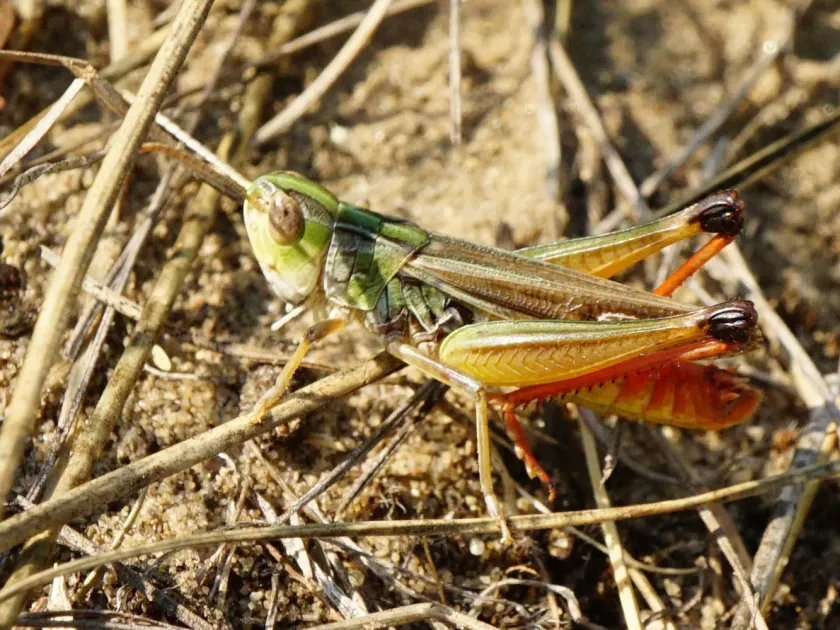
Description
How to identify
Fischer's grasshopper (Stenobothrus fischeri) belongs to the order Orthoptera, family Acrididae. It is a typical member of the slant-faced grasshopper group, known for its slender body and agility within dense vegetation.
The insect possesses protective coloration, typically ranging from green to brownish hues, which aids in camouflage. The pronotum usually features distinct lateral keels that curve slightly inward in the anterior region.
Adult body length ranges between 15 and 22 millimeters. Well-developed wings, which reach or slightly exceed the tip of the abdomen, provide the insect with high mobility for food foraging.
The venation of the forewings displays characteristics specific to the genus Stenobothrus, particularly the arrangement of the radial sector and the structure of the stridulatory apparatus responsible for the males' characteristic chirping.
Nymphs undergo several developmental instars, gradually increasing in size and acquiring adult features, with their color potentially varying based on environmental humidity levels.
What it damages
This species primarily damages cereal crops and both perennial and annual forage grasses. As a phytophage, it prefers the vegetative parts of plants, leading to a significant reduction in the overall green mass of the crops.
The most severe damage is observed in pastures and hayfields, where high population densities lead to the degradation of the sward. These insects actively consume leaves, diminishing the photosynthetic capacity of the plants.
During mass outbreaks, Stenobothrus fischeri may shift to young cereal seedlings, which becomes critical during drought periods. Weakened plants become more susceptible to secondary diseases and infections.
The harm is caused not only by direct consumption of tissues but also by mechanical damage to the stems, which reduces the quality of the fodder. Contamination with excrement makes the forage less attractive to livestock.
The economic impact of this species increases in steppe and forest-steppe zones, where climatic conditions facilitate rapid population growth during specific vegetative seasons.
When it appears
The developmental cycle of this pest includes an egg stage that overwinters in the soil. Nymph emergence occurs in the spring as the topsoil warms, coinciding with the onset of active grass growth.
Nymph development passes through five instars, a process lasting one to two months depending on temperature. Adults appear in mid-summer and persist until autumn.
Mass emergence of adults typically occurs in July and August. This period marks the peak of activity, associated with mating processes and subsequent egg-laying into the soil.
Dry and warm weather conditions are favorable for the insect's development. Prolonged rainfall during the nymph emergence period can significantly reduce the population due to high mortality rates among the juveniles.
There is no pupal stage, as grasshoppers develop via incomplete metamorphosis. The life cycle is strictly univoltine, producing one generation per year across most of its distribution range.
Signs of infestation
The first sign of the pest's presence is chewed leaf edges on cereal grasses. Damage marks appear as irregular notches or completely consumed leaf blades, leaving only the central midrib.
A large number of active individuals in the sward that scatter when disturbed is a clear indicator. Walking through the field often triggers the characteristic jumping and flying of the insects.
Audible chirping of males during hot daylight hours, which becomes particularly intense when population density is high, serves as a vital diagnostic sign of the species' presence.
In heavily infested patches, yellowing and premature wilting of the sward are observed. The vegetation takes on a "grazed" or ragged appearance, sharply reducing hay yields and pasture productivity.
Excrement and feeding traces can be found on the ground or at the base of plants, which differ significantly from damage caused by rodents or leaf-eating caterpillars.
Control measures
The primary control method is agronomic, including discing the soil in egg-laying sites. This leads to the mechanical destruction of egg pods and reduces the size of the subsequent generation.
Timely harvesting and strict weed control deprive the pest of its food source. Tall grasses around field margins should be mowed to prevent grasshopper migration into the crops.
If population thresholds are reached (typically exceeding 5-10 individuals per square meter), chemical control methods are applied. The use of broad-spectrum insecticides, such as pyrethroids or organophosphates, is recommended.
The application of biological control agents, including natural entomophages or entomopathogenic fungi, can be effective within integrated pest management (IPM) systems.
- Implementation of crop rotation to limit pest buildup.
- Monitoring of nymph density in spring for early intervention.
- Targeted edge treatments with insecticides for localized infestations.
Taxonomy
- Latin name
- Stenobothrus fischeri
- Order
- Orthoptera (locusts)
- Family
- Acrididae
- EPPO code
- STNBFI
Discussion
No discussions yet — be the first.