
Stathmopoda auriferella
Stathmopoda auriferella
Description
How to identify
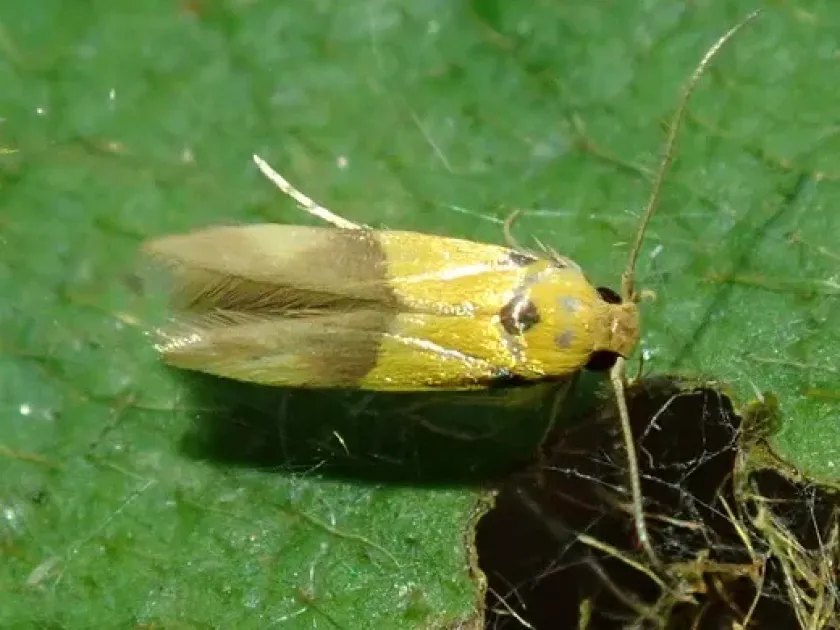
Stathmopoda auriferella belongs to the family Stathmopodidae, order Lepidoptera. The adult moth has a wingspan of approximately 10–15 mm and a characteristically slender body shape.
The coloration of the moth ranges from yellowish-brown to golden-yellow, which gives the species its specific name. The forewings are narrow and often marked with small dark spots or transverse lines.
The larvae are typically creamy-white or pinkish with a distinct dark head capsule. They are hidden feeders, living within the tissues of buds, flowers, or developing fruits.
The life cycle encompasses four stages: egg, larva (five instars), pupa, and adult. In warmer climates, this species is multivoltine, producing multiple generations per growing season.
Overwintering usually occurs in the pupal stage. They form cocoons in protected sites such as bark crevices, dried leaf clusters, or inside mummified fruits remaining on the host tree.
What it damages
This pest is a significant polyphage known to attack a wide variety of fruit and agricultural crops. Common hosts include apples, pears, peaches, persimmons, grapes, and pomegranates.
The primary damage is caused by larvae feeding on reproductive plant parts. They burrow into flower buds, causing them to wither, and into developing fruits, leading to premature drop.
In orchards, the damage to blossoms reduces the potential yield significantly. Larvae consume pistils and stamens, which prevents pollination and proper fertilization of the developing fruit.
Damage to the fruit skin and internal tissue provides entry points for opportunistic fungal pathogens and secondary bacteria, leading to rot and further crop losses during the harvest period.
For commercial growers, even minor infestations can result in significant economic damage as affected fruits lose their marketability and cannot be stored for long periods.
Signs of infestation
The presence of frass (larval excrement) around entry holes on the surface of buds or fruits is the most reliable early indicator of an active infestation.
Prematurely dropped fruits or buds with tunneling marks inside are clear signs of larval activity. Dissecting these damaged items often reveals the larvae feeding inside the tissue.
During the flowering season, watch for buds or blossoms that appear wilted or brown before they have a chance to bloom. These often contain larvae that have tunneled into the base of the flower.
Surface deformations on growing fruits, such as small depressions or necrotic spots, indicate that a larva is actively feeding beneath the epidermis, affecting the development of the fruit.
Monitoring using pheromone traps is standard practice for professional growers to detect the initial flight of moths, which is essential for timing insecticide applications effectively.
Control measures
Sanitation is the first line of defense: growers should collect and destroy all fallen fruit and remove mummified fruits from trees to eliminate potential overwintering sites.
Maintaining orchard hygiene, such as scraping away loose bark from trunks, helps remove cocoons. Deep cultivation of the soil around the base of trees in autumn can also disrupt the life cycle.
Chemical control involves the application of registered insecticides during peak larval emergence. Monitoring with pheromone traps helps determine the exact timing for these applications.
Biological control using formulations based on Bacillus thuringiensis is an effective and environmentally friendly option, especially when targeting young larvae before they enter the fruit.
- Deploying pheromone traps to disrupt mating and monitor population levels.
- Sanitary pruning of infested clusters to reduce the local pest load.
- Rotating pesticide groups to prevent the development of resistance.
Taxonomy
- Latin name
- Stathmopoda auriferella
- Order
- Lepidoptera (butterflies)
- Family
- Stathmopodidae
- EPPO code
- STATAU
Discussion
No discussions yet — be the first.