
Blue-winged grasshopper
Sphingonotus caerulans
Description
How to identify
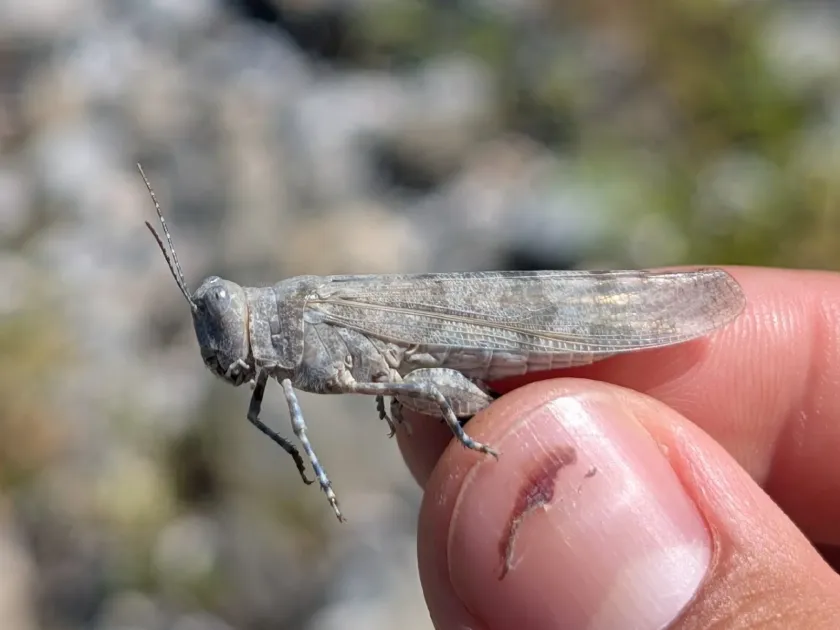
The blue-winged grasshopper (Sphingonotus caerulans) belongs to the family Acrididae. These insects are typically 15 to 30 mm long, with a body color ranging from light grey to sandy, perfectly camouflaged for life on open, stony, or sparse soils.
The most distinctive feature is their hind wings, which are translucent with a striking blue base and a black arc-shaped band. This unique color is only visible when the grasshopper takes flight, making it easy to recognize in the field during the summer months.
Nymphs resemble smaller, wingless versions of the adults. They undergo several molts as they grow, during which they remain in the same habitats as the adults, constantly feeding on various plant species.
These insects prefer warm, dry, and sparsely vegetated environments. They are frequently found in steppes, along road verges, on fallow land, and in rocky terrain, from where they may invade nearby cultivated agricultural fields.
The species is highly resilient to arid conditions. Females lay their eggs in the soil, protected by a hard, earthen structure called a pod (ootheca), which allows the eggs to survive harsh winter conditions and emerge in the following spring.
What it damages
The blue-winged grasshopper is a generalist feeder (polyphage) that consumes a wide range of vegetation. In agricultural landscapes, they can cause significant damage to various crops, particularly during drought conditions when natural forage becomes scarce.
Cereal crops, such as wheat, barley, and oats, are the most frequent targets. However, in cases of high population density, they can also cause substantial harm to corn, sunflower, and various vegetable crops grown in or near infested areas.
The greatest threat is posed to seedling stages, where the grasshoppers can consume entire plants, leading to severe thinning of the crop stand. Beyond foliage consumption, they may damage stems, affecting the structural integrity and growth of the plant.
By consuming leaves, the pests reduce the plant's photosynthetic capacity, which directly translates into lower yields. Furthermore, damaged tissues are more susceptible to opportunistic secondary infections by bacteria and fungi.
Economic damage is most severe in years following a hot, dry summer, which favors the reproductive success of the grasshoppers. Without proper control measures, losses can be significant, especially along the field edges where the population density is usually higher.
When it appears
The life cycle of the blue-winged grasshopper is univoltine, meaning there is one generation per year. The winter is spent in the egg stage, safely buried in the soil within their protective pods, awaiting the warming temperatures of spring.
Hatching usually occurs in late May or early June, depending on soil temperatures. The nymphs develop through several stages over the course of about a month, becoming increasingly voracious as they approach maturity.
By mid-summer, the insects reach the adult stage. At this point, their mobility increases significantly as they gain the ability to fly, allowing them to disperse from natural habitats into agricultural fields to feed.
The peak period of activity, including mating and egg-laying, lasts through July and August. After depositing their eggs into the soil, the adult grasshoppers eventually die off with the onset of autumn cooling.
Monitoring for nymphs in the early summer is essential for effective management. Timely detection of the juvenile stages allows farmers to implement control measures before the insects become highly mobile and more difficult to manage.
Signs of infestation
The primary sign of an infestation is the appearance of ragged or chewed leaves on crop plants. Unlike some caterpillars that eat entire leaves, grasshoppers often leave irregular, tattered edges.
Observation in the field is the most reliable method for identification. As you walk through the fields, the sudden flight of grasshoppers revealing their bright blue hind wings serves as an immediate indicator of their presence.
Concentrations of insects are often observed at the edges of fields bordering non-cultivated areas. Spotting these localized clusters helps in mapping the infestation and targeting treatments efficiently.
Thinning of seedling stands along the perimeter of the field is a classic sign of grasshopper migration from adjacent wastelands or meadows. If this thinning is accompanied by the sound of insects, an inspection is warranted.
Finding empty egg pods in the soil of adjacent uncultivated land early in the spring provides a warning of potential future infestations, allowing for preventative soil management in those areas.
Control measures
Management of the blue-winged grasshopper combines cultural and chemical strategies. Cultural control is highly effective, starting with the deep plowing or harrowing of fallow land and field margins to destroy egg pods before they hatch.
Weed control is also vital, as maintaining clean fields and boundaries reduces the food sources and shelter available to the nymphs. A well-managed crop is less attractive to grasshoppers than a field surrounded by weeds.
When the population threshold is reached, chemical control using approved insecticides is necessary. Targeted applications along the field edges are often sufficient to prevent the spread of the pest into the center of the crop.
Biological control using entomopathogenic fungi or protecting natural predators, such as ground beetles and birds, can help maintain population levels in check, reducing the need for intensive chemical applications.
- Deep tillage of non-crop areas to destroy eggs.
- Regular monitoring of field margins during spring.
- Localized insecticide spraying when nymphs are in early stages.
- Promoting a healthy ecosystem to support natural pest predators.
Taxonomy
- Latin name
- Sphingonotus caerulans
- Order
- Orthoptera (locusts)
- Family
- Acrididae
- EPPO code
- SHNGCA
Discussion
No discussions yet — be the first.