
Blue-winged sand grasshopper
Sphingonotus
Description
How to identify
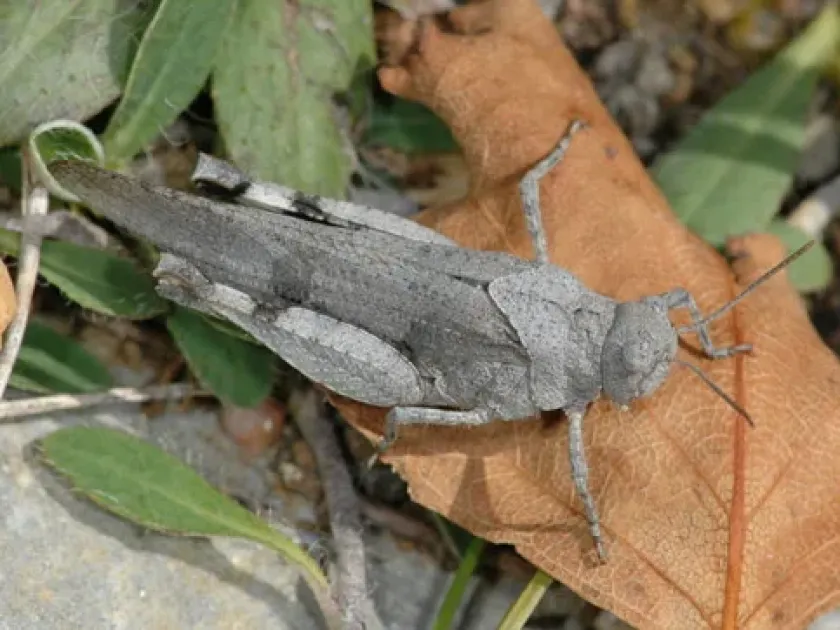
The blue-winged sand grasshopper (genus Sphingonotus) belongs to the order Orthoptera and the family Acrididae. These insects are well-adapted to arid environments, possessing a camouflage coloration that perfectly mimics sandy or stony substrates.
The most distinctive feature of this genus is the presence of a colorful band on the hind wings, which can be blue, pink, or dark. These wings are typically hidden when the insect is resting and are only revealed during flight.
Their bodies are often mottled with small spots and patterns, providing excellent concealment against soil backgrounds. This cryptic coloration makes them difficult to spot until they take flight.
They possess powerful hind legs designed for jumping, allowing them to escape predators quickly. Their wings are robust, enabling long-distance dispersal in search of favorable feeding grounds and breeding sites.
Nymphs resemble smaller, wingless versions of the adults. As they pass through various instar stages, they grow in size and gradually develop the functional wings and sexual characteristics of mature grasshoppers.
What it damages
The blue-winged sand grasshopper is a polyphagous insect, meaning it feeds on a wide range of plant species. It poses a significant threat to agriculture in arid and semi-arid regions.
The primary crops affected include cereals like wheat, barley, and millet, as well as various forage grasses. In vegetable production areas, they can cause substantial damage to young seedlings.
Feeding damage occurs when adults and nymphs scrape the epidermis and consume the leaf tissue, leaving irregular holes. In cases of high infestation, they can strip plants of their foliage entirely.
This loss of leaf surface area leads to a reduction in the plant's photosynthetic capacity, resulting in stunted growth, delayed maturation, and significant yield losses in terms of both grain and biomass.
Because they often congregate in large numbers, the cumulative impact of their feeding can devastate localized patches of fields, creating a patch-like pattern of damage across the crop area.
When it appears
The lifecycle of Sphingonotus is closely synchronized with the moisture and temperature cycles of its habitat. Overwintering occurs in the egg stage, with eggs buried in the soil.
Nymph emergence typically occurs in the spring, triggered by rising soil temperatures. Sufficient moisture is essential for the successful development of the embryos and the survival of early-stage nymphs.
The insects undergo a series of molts, progressively increasing in size throughout the late spring and summer months. The adult stage is generally reached by mid-summer, coinciding with the peak of their activity.
The species usually completes one generation per year. However, in regions with exceptionally warm climates, the timing of their emergence and breeding can be quite flexible to accommodate environmental conditions.
Mass reproduction often follows periods of increased rainfall, which promotes lush vegetation growth, thereby providing an abundant food source for the growing population of grasshoppers.
Signs of infestation
A primary indicator of their presence is the sight of numerous grasshoppers jumping away as one walks through or near a field. The flash of colored hind wings during flight is a diagnostic sign.
Visual inspection of the foliage will reveal characteristic ragged or "holed" edges on the leaves. As the infestation progresses, these small feeding marks merge into larger areas of damage.
The presence of fine, granular frass (insect droppings) on the soil surface beneath the plants is a clear indication of recent feeding activity by the grasshoppers.
Wilting, discoloration, or slowed development of specific plants within a field can suggest localized pressure from these pests, even before widespread damage becomes apparent.
At high densities, farmers may observe a distinct "mowing" effect, where large sections of the field are left with only stems remaining, which is a sign of critical pest infestation.
Control measures
Effective management begins with rigorous monitoring of non-crop areas, such as field margins, roadsides, and abandoned lands, which often serve as reservoirs for initial populations.
Agricultural practices like deep plowing of fallow ground can help disrupt egg pods, reducing the hatching success of the next generation significantly.
When economic thresholds are reached, the application of registered insecticides becomes necessary. Both contact and systemic products can be effective depending on the age of the insects.
Application timing is crucial; spraying is most effective when performed in the early morning or evening hours, when the grasshoppers are less active and the temperature is cooler.
Integrated pest management (IPM) strategies, including biological control agents where available, should be encouraged to keep populations below damaging levels without relying solely on chemicals.
Taxonomy
- Latin name
- Sphingonotus
- Order
- Orthoptera (locusts)
- Family
- Acrididae
- EPPO code
- SHNGSP
Discussion
No discussions yet — be the first.