
Great golden digger wasp
Sphex ichneumoneus
Description
How to identify
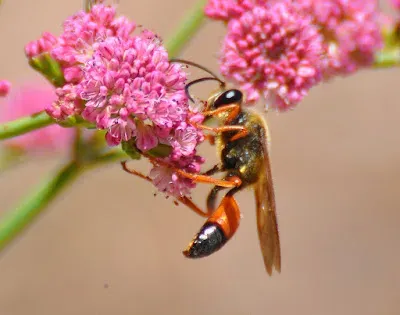
The great golden digger wasp (Sphex ichneumoneus) belongs to the Sphecidae family. It is a large, solitary insect known for its striking appearance, featuring a bright orange-red abdomen and a black head and thorax.
These wasps typically measure between 20 and 30 mm in length. They are distinguished by their slender petiole (the narrow "waist" connecting the thorax and abdomen) and somewhat smoky-colored wings.
Unlike social wasps, they do not live in colonies. Each female is responsible for digging her own burrow in the soil, which serves as a nursery for her future offspring.
They are primarily identified by their nesting behavior, as they are often seen flying close to the ground, searching for suitable sandy or loose soil patches to excavate.
From an agricultural perspective, they are often misunderstood as pests due to their large size, though they are actually specialized predators of crickets and grasshoppers.
What it damages
The great golden digger wasp is generally not categorized as a significant plant pest. They do not consume plant tissues, roots, or fruits, making them harmless to crop yield directly.
The primary concern for farmers is their nesting habit. Because they burrow into the soil, they can occasionally disturb the root systems of young seedlings or delicate garden plants.
In highly intensive gardening, numerous burrows can create voids in the soil, potentially causing localized dehydration or instability for root structures in very young crops.
Secondary damage is minimal and usually restricted to cases where the density of nests is extremely high in a localized area, which is rare in managed agricultural fields.
In many cases, they are considered beneficial because they help regulate populations of grasshoppers and katydids, which are known plant eaters.
When it appears
The active life cycle of the Sphex ichneumoneus begins in early summer, once temperatures are sufficiently high to support their nesting activity.
Mid-summer, specifically July through August, marks the peak of their activity. During this time, the wasps are most visible as they provision their nests with prey.
As the season progresses toward late summer, the females finish their nesting cycle. The larvae then remain in the subterranean burrows, passing the winter in a diapause state.
The new generation of adults emerges in the following year, following the same seasonal patterns dictated by soil temperature and environmental conditions.
Monitoring their arrival is essential for early identification, as they tend to return to the same favorable, warm, and sun-exposed soil patches year after year.
Signs of infestation
The most prominent sign of their presence is the appearance of small, clean, circular holes in the ground, usually about 1 cm in diameter.
The entrance of these burrows is often accompanied by a small mound of excavated soil, indicating active digging by the female wasp.
Seeing a large, orange-and-black wasp flying low over the garden soil, especially during sunny days, is a clear indicator that a nest is nearby.
Soft or collapsing soil in specific spots can indicate that a wasp has created a deep burrow beneath the surface, which might be detrimental to nearby seedling roots.
During the nesting process, one may observe the wasp carrying prey—typically paralyzed grasshoppers—into the burrow entrance.
Control measures
Most agricultural experts do not recommend active control measures for Sphex ichneumoneus because they do not pose a serious threat to crops and provide natural pest control.
If their activity becomes bothersome in a specific area, cultural management techniques are the most effective way to discourage them from nesting.
- Maintain adequate soil moisture through regular irrigation, which makes burrowing more difficult for the wasps.
- Apply mulch or ground covers to prevent the wasps from finding easy, exposed soil to dig.
- Use physical barriers or protective netting around highly sensitive young crops.
- Avoid leaving large patches of bare, dry, sandy soil within the main gardening areas.
Chemical intervention is unnecessary and generally discouraged, as it can harm beneficial pollinators and other useful insects within the garden ecosystem.
Taxonomy
- Latin name
- Sphex ichneumoneus
- Order
- Hymenoptera
- Family
- Sphecidae
- EPPO code
- SPEXIC
Discussion
No discussions yet — be the first.