
Sand Wasp
Ammophila sabulosa
Description
How to identify
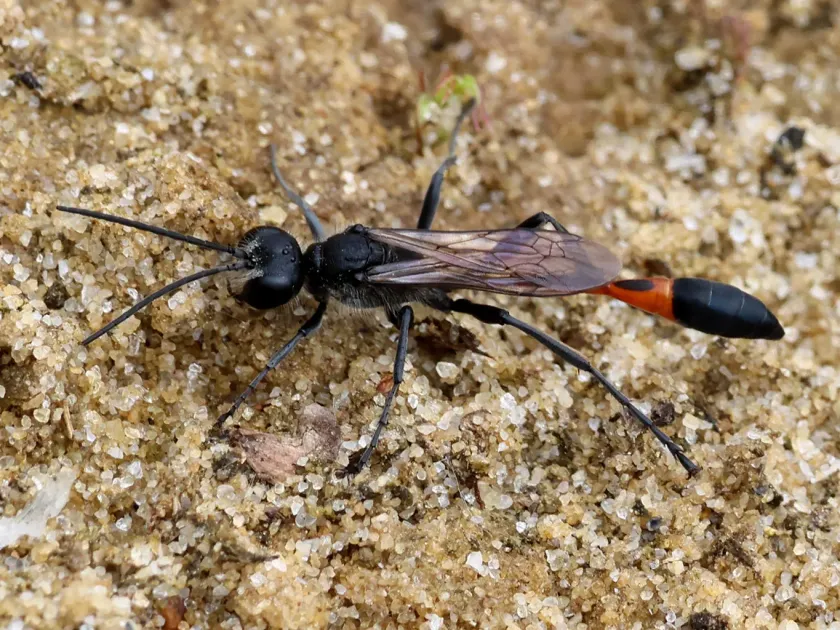
The sand wasp (Ammophila sabulosa) is a predatory digger wasp belonging to the family Sphecidae, order Hymenoptera. The adult insect has a distinctive narrow abdomen attached to the thorax by a long, slender petiole, which makes its body appear elongated.
The wasp's body is typically black with bright reddish patches on the abdomen. Adult insects reach a length of 15–25 mm. The wings are transparent with a light brownish tint and are folded in a fan-like manner when at rest.
Sand wasp larvae develop in soil burrows that the adult female digs in sandy or loamy ground. The larva is a white, legless, and sedentary worm-like organism.
The insect's life cycle involves complete metamorphosis: egg, larva, pupa, and adult. The female exhibits a pronounced maternal instinct, providing its offspring with paralyzed prey.
Unlike many other wasps, the sand wasp lives a solitary life, not creating large colonies or complex social structures, which makes its behavior harder to detect for agronomists.
What it damages
The sand wasp is not a phytophage in the traditional sense; it does not consume leaves or roots of cultivated plants. Its harmfulness is indirect and related to agronomic aspects.
The main issue is that females dig numerous deep burrows in loose soil in beds, home gardens, and nurseries, which disrupts the root systems of young plants.
Mass colonization of a plot by these wasps can lead to local soil compaction or, conversely, excessive loosening, which disrupts the water balance for seedlings and young transplants.
Although adults feed on plant nectar, at high population densities they may damage delicate flower buds and the epidermis of young shoots while collecting pollen.
Indirect damage also involves wasps potentially carrying pathogens on their legs as they move from infested weeds to cultivated crops.
When it appears
The active period of the sand wasp begins in late spring, around mid-May, when the soil warms up enough for nest construction activities to begin.
The peak activity of adults occurs in June and July, when mating takes place and the wasps actively store food for their larvae in soil burrows.
Activity begins to decline in August, though in warm seasons, individual wasps can be found until September, continuing to complete their development cycle.
The development cycle of one generation from egg to adult takes about 30–40 days, with one or rarely two generations developing per season in moderate climates.
The sand wasp overwinters in the prepupal stage inside a cocoon hidden deep in the soil, making the insect quite resistant to low temperatures.
Signs of infestation
The primary sign of the insect's presence in a plot is the appearance of characteristic 5–8 mm diameter holes in the ground, often surrounded by small mounds of sandy soil.
Observing adult wasps flying low over the soil surface and periodically disappearing into burrows confirms the presence of active nesting.
Damage to the root system of young crops in nesting areas is often accompanied by wilting of plants that appear healthy but have undermined soil at their base.
The presence of empty, paralyzed caterpillars or other insects near the burrows is a direct indicator of the sand wasp's biological activity.
- Appearance of multiple burrows in open, sunny areas
- Noticeable wasp activity during daylight hours
- Loss of turgor in seedlings without visible leaf damage
- Presence of larval food caches in the soil
Control measures
Control of the sand wasp is rarely needed as a chemical intervention because the wasp is considered a beneficial entomophagous insect that regulates populations of harmful caterpillar pests.
To prevent nesting, frequent mulching of the soil is recommended, as these wasps prefer bare, open sand for their burrows.
Compacting the soil in areas with burrow clusters and regular watering of beds make the ground unsuitable for nest building, forcing the wasps to leave the site.
In cases of critical damage to nurseries, the use of contact insecticides applied locally to burrow entrances in the evening is permissible.
The use of protective covers for young plants, such as agricultural fleece (agrofibre), prevents wasp access to the soil and protects the root zone from mechanical disturbance.
Taxonomy
- Latin name
- Ammophila sabulosa
- Order
- Hymenoptera
- Family
- Sphecidae
- EPPO code
- AMMPSA
Discussion
No discussions yet — be the first.