
Digger wasp
Sphex
Description
How to identify
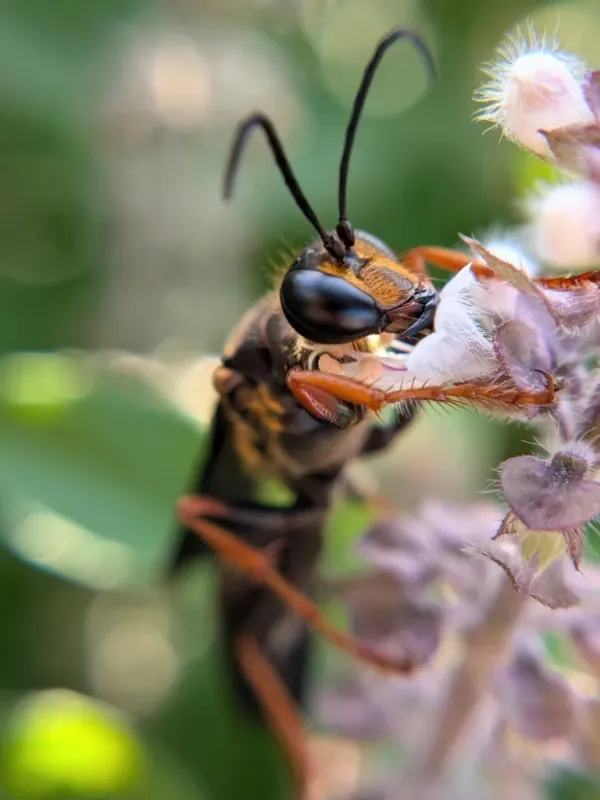
The Sphex genus, commonly known as digger wasps, belongs to the family Sphecidae within the order Hymenoptera. These insects are characterized by their robust bodies and distinct narrow waists.
They typically reach sizes between 20 mm and 30 mm, displaying black or black-and-orange colorations depending on the specific species.
Unlike colonial wasps, Sphex are solitary insects. Each female is responsible for excavating her own burrow, hunting, and providing for her offspring independently.
Their flight is strong and purposeful, often seen during hot summer days as they search for nesting sites in areas with loose, sun-exposed soil.
The morphology of these wasps is well-adapted for digging, featuring strong mandibles and specialized legs used to move soil during the nest-building process.
What it damages
It is crucial to clarify that Sphex are not considered agricultural pests. They do not feed on crops, plant tissues, or roots, posing no direct threat to harvest yield.
As adult insects, their diet consists primarily of nectar and pollen, meaning they act as minor pollinators within the garden ecosystem.
They are specialized hunters that prey on other insects, particularly members of the Orthoptera order like grasshoppers and locusts, which are often legitimate crop pests.
While their burrowing activity disturbs the soil surface slightly, this impact is localized and trivial compared to the benefits provided by their predatory behavior.
Therefore, any attempt to eradicate these wasps is generally counterproductive, as they help regulate the population of insects that actually damage plants.
When it appears
Digger wasps are strictly seasonal, with peak activity occurring during the warmest months of the year, usually from June through August.
Their life cycle is highly dependent on ambient temperatures, as they require warm ground to successfully incubate their eggs and develop their larvae.
During the day, they are most active under direct sunlight, which is when most nesting and hunting activity is observed by gardeners.
As autumn approaches and temperatures drop, the adult generation completes its life cycle and dies off, leaving the next generation to overwinter underground.
Understanding this seasonality is key to managing a garden without unnecessary intervention, as their presence is temporary and confined to the peak growing season.
Signs of infestation
The most common sign of Sphex presence is the occurrence of small, circular holes in the soil, usually accompanied by a small pile of excavated dirt.
Observing a large, solitary wasp flying low over the ground and occasionally landing to probe the earth for nest sites is a primary visual indicator.
In some cases, gardeners may spot the wasp dragging a paralyzed grasshopper or cricket towards its burrow, which is a classic behavior of this species.
These wasps prefer clearings, bare soil, or sparse grass, so these are the specific areas where you are most likely to encounter their nesting tunnels.
Finding these nests in a garden bed is a sign of healthy, loose soil structure rather than an indication of a pest infestation.
Control measures
No formal control measures are required for Sphex, as they are beneficial or neutral contributors to the garden rather than agricultural pests.
If their presence is considered a nuisance, the most effective mechanical control is frequent soil cultivation, which collapses their nesting tunnels.
Covering bare soil with mulch or dense vegetation can deter them from nesting, as they require open, sun-warmed patches to build their burrows.
The use of chemical insecticides against these wasps is strongly discouraged, as it indiscriminately harms pollinators and other beneficial insect predators.
Maintaining a balanced, integrated pest management strategy ensures that you do not disrupt the natural predatory services these wasps provide for your crops.
Taxonomy
- Latin name
- Sphex
- Order
- Hymenoptera
- Family
- Sphecidae
- EPPO code
- SPEXSP
Discussion
No discussions yet — be the first.