
Thread-waisted wasp
Ammophila
Description
How to identify
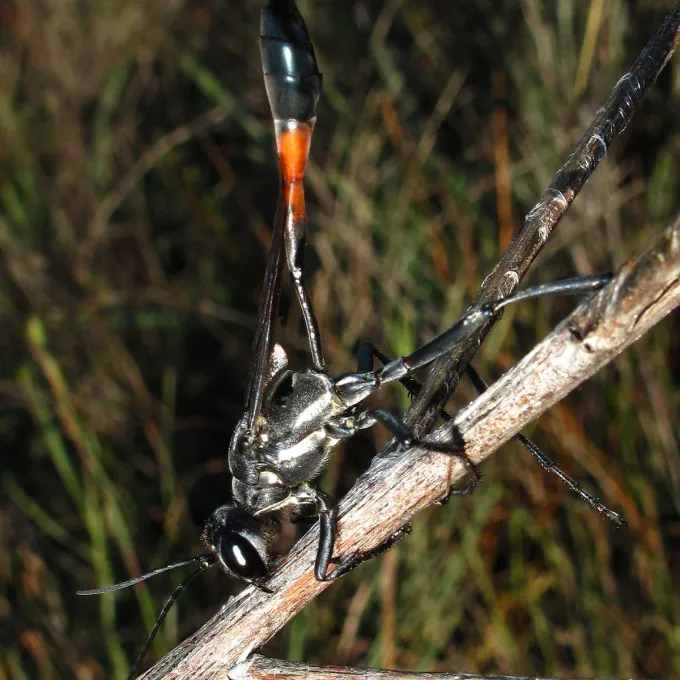
The thread-waisted wasp (genus Ammophila) belongs to the Sphecidae family. They are easily identified by their distinctively slender and long petiole, which connects the thorax to the abdomen.
These wasps are typically black or black-and-orange in color, with a body length usually ranging between 15 and 25 millimeters. Their wings are transparent, sometimes with a faint yellowish tint.
They are solitary insects, meaning they do not build large social nests or exhibit colony behaviors like common yellowjackets or honeybees.
Females are highly skilled at excavating individual burrows in sandy soil, which serves as a nursery for their larvae. They are known for their sophisticated behavior of using small stones to pack the burrow entrance.
Despite their somewhat intimidating appearance, these wasps are generally non-aggressive toward humans unless handled directly, as they focus entirely on hunting and nesting.
What it damages
Thread-waisted wasps are not plant pests. They do not consume plant tissues, roots, or fruit and therefore pose zero threat to agricultural crop yields or garden plants.
On the contrary, they are beneficial predatory insects. They act as natural regulators by hunting caterpillars, which are among the most destructive pests for gardens and farms.
The female wasp paralyzes a caterpillar with its venom and drags it into her burrow, providing a fresh and essential food source for her developing larva.
By keeping caterpillar populations in check, these wasps contribute to the overall health and productivity of your garden, serving as a form of biological pest control.
Any concerns regarding their "damage" are usually based on misunderstandings regarding their burrowing activities in loose soil, which do not harm the plants themselves.
When it appears
Adult Ammophila wasps are most active during the summer months, typically from June through August, when the weather is warm and dry.
They specifically seek out areas with sandy or loose, well-draining soil that can be easily excavated and warmed by the sun to provide optimal conditions for the larvae.
The lifecycle involves the female preparing several nests throughout the season, each provisioned with a paralyzed caterpillar to ensure the offspring's survival.
While the larvae develop underground in protective cocoons, the adults are frequently observed foraging on flowers, where they feed on nectar to sustain their high energy levels.
As autumn approaches, the activity declines as the new generation enters diapause within their underground cocoons to survive the winter temperatures.
Signs of infestation
The primary indication of their presence is the appearance of small, neatly formed circular holes in the ground, often accompanied by a small pile of sand or soil.
Watching a wasp maneuver a caterpillar or a stone toward its hole is a fascinating sight and a clear sign that a beneficial predator is active in your soil.
Unlike subterranean pests, thread-waisted wasps leave the surrounding vegetation completely untouched, with no yellowing, wilting, or chewed foliage present.
If you observe wasps visiting flowers in your garden, it indicates that they are foraging for nectar, which is a positive sign for pollination and ecosystem balance.
Distinguishing their burrows from those of actual soil pests is simple: Ammophila burrows are isolated, tidy, and lack any associated plant damage or wilting nearby.
Control measures
Control measures against thread-waisted wasps are neither necessary nor recommended, as they perform a valuable service as natural biocontrol agents.
If the burrows are bothersome in a specific area like a pathway, simply wetting and compacting the soil is enough to discourage the wasps from using that spot without harming them.
Avoid the use of broad-spectrum insecticides, as these will kill off the beneficial wasps and potentially lead to an explosion in the population of harmful leaf-eating caterpillars.
To encourage their presence, maintain patches of bare, sandy ground and provide flowering plants that supply the necessary nectar for the adult wasps.
- Preserve sandy soil areas for nesting.
- Avoid chemical treatments that affect soil-dwelling beneficials.
- Plant nectar-rich flowers to support the adult wasp population.
Taxonomy
- Latin name
- Ammophila
- Order
- Hymenoptera
- Family
- Sphecidae
- EPPO code
- AMMPSP
Discussion
No discussions yet — be the first.