
Sicus ferrugineus
Sicus ferrugineus
Description
How to identify
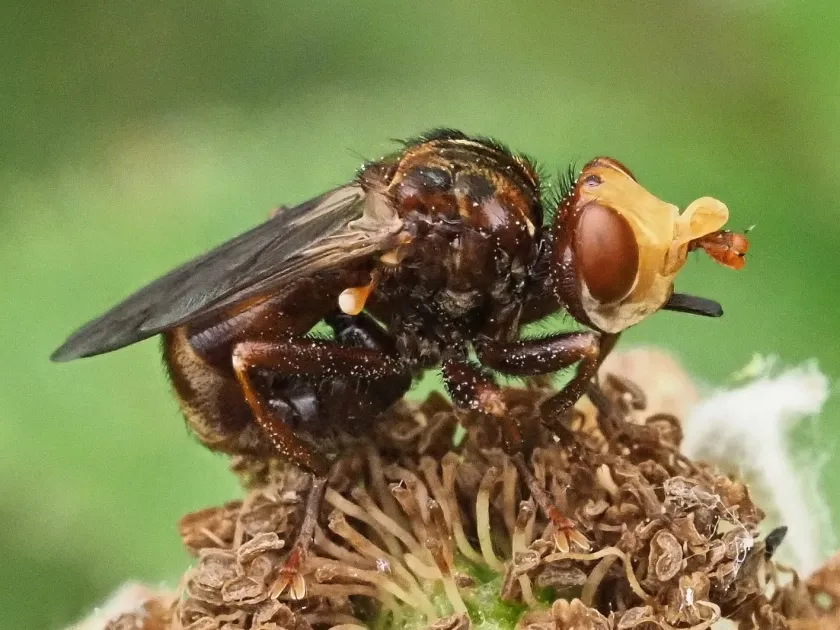
Sicus ferrugineus is a member of the family Conopidae, commonly known as thick-headed flies. These insects are easily confused with wasps due to their body shape and coloration.
Adults typically measure between 10 and 14 mm in length and display a distinctive rusty-brown color. They possess a large head with prominent eyes and a slender, curved abdomen.
The larvae of this species are specialized endoparasitoids. They are legless and white, evolving inside the abdominal cavity of their host throughout their larval stage.
Adult flies are often observed on flowers, where they feed on nectar. This positioning allows them to ambush bumblebees, which are the primary hosts for their offspring.
Distinguishing them from wasps involves observing their flight pattern and the lack of traditional bee-like or wasp-like social behaviors, as they are solitary insects.
What it damages
Sicus ferrugineus does not cause direct damage to agricultural crops as it does not feed on plant tissues, stems, or fruits.
The negative impact is indirect and significant for agriculture: they parasitize bumblebees of the genus Bombus. The female fly lays eggs inside the bee while in flight.
The development of the larva inside the bumblebee leads to the bee's eventual death. This reduces the overall population of bumblebees within the agricultural area.
A decline in the bumblebee population results in decreased pollination efficiency for crops that rely on buzzing pollination, such as tomatoes, peppers, and various berries.
While the fly is part of the natural ecosystem, high local densities of Sicus ferrugineus can disrupt the success of natural pollination programs in farms.
When it appears
The life cycle of Sicus ferrugineus is strictly aligned with the activity period of its bumblebee hosts. Adults emerge in early June.
Their peak activity occurs throughout July and August, corresponding with the peak season for bumblebee colonies in meadows and orchards.
During this period, female flies are actively searching for hosts to continue the reproductive cycle. There is only one generation per year.
The species overwinters in the larval stage inside the dead or hibernating host, remaining dormant until the following spring and early summer.
By late August, adult activity declines significantly, and the species disappears from the fields as they transition into the overwintering phase.
Signs of infestation
Monitoring the presence of Sicus ferrugineus is primarily done by observing insects feeding on flowers, particularly those visited by bumblebees.
A noticeable decrease in bumblebee traffic on crops, combined with the presence of rust-colored flies on surrounding flowers, can indicate an active population of parasitoids.
Finding deceased bumblebees in the field and performing a dissection may reveal the presence of Sicus larvae or puparia inside the bee's abdomen.
Behavioral signs include observing flies waiting on blooms and making fast, darting attacks at bumblebees landing on the same or neighboring flowers.
There are no specific crop symptoms, as the impact is strictly ecological and focused on the pollinator population dynamics.
Control measures
There are no standard chemical control measures for Sicus ferrugineus, as the use of insecticides would prove far more damaging to the bumblebees themselves.
Management strategies focus on protecting and fostering healthy bumblebee populations, which act as the main resource for pollination.
Implementing habitat conservation practices, such as maintaining hedgerows and wildflower strips, provides bumblebees with better nesting sites and survival options.
Strict limitation of pesticide applications during bloom periods is the most effective way to ensure that pollinator populations remain robust and resilient.
By supporting ecological balance and biodiversity, farmers can mitigate the impact of natural parasitoids on their bumblebee-dependent agricultural production.
Taxonomy
- Latin name
- Sicus ferrugineus
- Order
- Diptera (flies)
- Family
- Conopidae
- EPPO code
- SICUFE
Discussion
No discussions yet — be the first.