
Sicus
Sicus
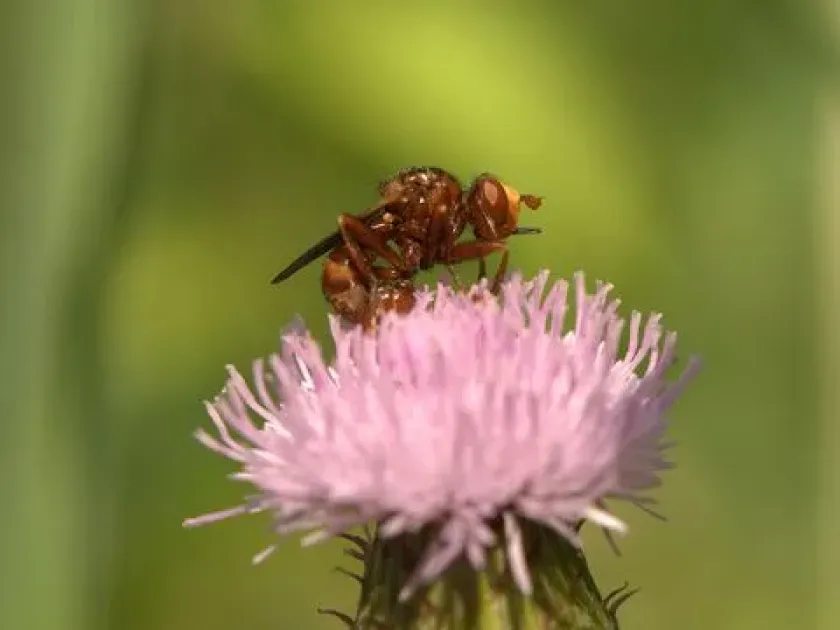
Description
How to identify
The genus Sicus belongs to the family Conopidae, order Diptera. These flies are widely recognized for their mimicry, often closely resembling wasps or bees, which provides protection from predators.
The adult body is typically slender, often featuring a distinctively curved abdomen. This physical structure is a hallmark characteristic of the Conopidae family.
The head is large, equipped with prominent compound eyes that allow for precise tracking of flying hosts. A long proboscis is a specialized feature used for nectar feeding on various flowering plants.
Larvae possess specialized morphological adaptations for their endoparasitic lifestyle inside the abdomen of Hymenoptera hosts.
Identification at the species level usually requires precise microscopic inspection of genitalia and chaetotaxy, as external visual identification is often insufficient.
What it damages
Sicus flies are not crop pests in the traditional sense; they do not consume plant tissues. Instead, they act as endoparasitoids that impact insect populations.
The primary hosts are bumblebees (genus Bombus), which are essential pollinators for many agricultural crops including legumes and greenhouse vegetables.
Parasitism by Sicus larvae typically results in the sterilization or death of the host, which directly reduces the efficiency of bumblebee colonies in pollination.
While the fly is a natural part of the ecosystem, large-scale infestation can lead to a localized decline in pollination services, indirectly affecting crop yields.
Therefore, Sicus is considered a biological factor that regulates the abundance of key pollinators in agricultural landscapes.
When it appears
Adult Sicus flies typically emerge during the summer months, starting from June, coinciding with the peak foraging activity of bumblebee colonies.
The breeding season is strictly synchronized with the flowering periods of nectar-rich plants, where the flies wait to ambush their hosts.
The lifecycle generally consists of a single generation per year, a common life-history strategy for many Conopidae species in temperate climates.
The overwintering phase usually occurs as a larva or pupa inside the host body, with the host typically dying as the season concludes.
By late summer and early autumn, adult activity declines significantly as the population enters a diapause state until the next flowering cycle.
Signs of infestation
Visual detection of Sicus in the field is challenging due to their mimicry and swift flight. They are often overlooked by casual observation.
A sign of significant presence is an unexplained decrease in bumblebee density in areas where pollination services should be abundant.
In laboratory studies, the presence of the parasite is confirmed by dissecting deceased bumblebees, revealing the larvae or puparia in the abdominal cavity.
Researchers often use yellow sticky traps or pan traps set in the field to monitor the arrival and peak activity of Sicus adults.
Observers might notice these flies hovering near flowers, demonstrating a distinctive behavior as they stalk potential hosts.
Control measures
Direct chemical control against Sicus is not advised, as any broad-spectrum insecticide use would likely kill the bumblebee hosts, causing severe agricultural losses.
Conservation of natural habitats is the most effective approach to ensure that bumblebee populations remain robust enough to withstand natural parasitoid pressure.
Integrated Pest Management (IPM) practices should focus on avoiding insecticide applications during the times when pollinators are most active in the field.
Maintaining floral diversity around fields supports a broader range of insect life, which can help buffer the effects of Sicus parasitism on bumblebees.
Ultimately, a healthy agricultural ecosystem supports both the hosts and their natural enemies in balance, minimizing the need for specific interventions.
Taxonomy
- Latin name
- Sicus
- Order
- Diptera (flies)
- Family
- Conopidae
- EPPO code
- SICUSP
Discussion
No discussions yet — be the first.