
Thick-headed fly
Myopa buccata
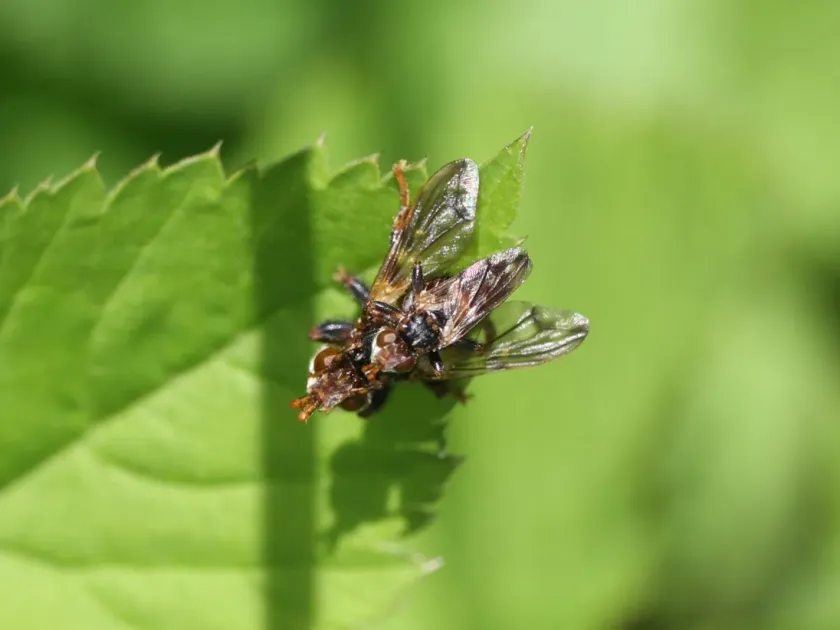
Description
How to identify
The thick-headed fly (Myopa buccata) belongs to the order Diptera and the family Conopidae. Visually, the insect resembles a small wasp or bee due to its coloration, but it possesses a distinctively large, inflated head, which is the defining feature of the family.
The body of the adult reaches 8–12 mm in length and is colored in yellow and black tones. A characteristic structural feature is the long, proboscis-like mouthpart directed forward, which is used for feeding on nectar.
Larvae of thick-headed flies have a specific body shape adapted to a parasitic lifestyle. Unlike adults, the larvae are hidden inside the host's body, making them difficult to detect in field conditions.
Adults are diurnal and are often seen on flowering plants in gardens and forest edges. They are strong fliers and active consumers of pollen and nectar.
Entomologists note the high plasticity of the species, allowing it to successfully inhabit various biotopes, from natural meadows to agroecosystems where honey bees are present.
What it damages
It is important to understand that Myopa buccata is not a direct pest of agricultural crops in the traditional sense; it does not damage leaves, stems, or fruits. However, this species poses a serious threat to agroecosystems.
The pest is an obligate parasite of honey bees and bumblebees. Thick-headed fly larvae develop inside the abdomen of an adult bee, which inevitably leads to the death of the pollinator.
Considering the role of bees in increasing the yield of most fruit and berry crops, the indirect damage caused by this fly can be significant for commercial farms.
A decline in bee populations on a plot leads to incomplete pollination of flowers, the formation of deformed fruits, and an overall reduction in total harvest.
Thus, the harmfulness of this species lies in undermining the biological potential of natural pollinators, which requires special attention to their protection during orchard blooming periods.
When it appears
The life cycle of the thick-headed fly is closely tied to the activity of its Hymenoptera hosts. Adults appear in early spring, usually in April or May, when the first spring bees start flying.
The lifespan of an adult is several weeks, during which mating and host searching for egg-laying occur. Eggs are laid directly on the flying bee in mid-air.
Upon entering the bee's abdomen, the larva begins to develop, feeding on the host's internal organs. This process takes several weeks, passing through several larval stages.
Pupation occurs inside the body of the deceased bee, which usually falls to the ground or settles in secluded places. The pupa often overwinters in the soil until the next spring.
The species usually has one generation per year, related to the phenology of bees emerging from hibernation and the period of their highest activity.
Signs of infestation
Detecting an infestation in an apiary or garden is difficult because visual signs of infection appear only at the stage of the adult bee's death.
An indirect sign of the fly's presence is the observation of abnormal behavior in bees: they become sluggish, lose orientation, and do not return to the hive. During the dissection of dead bees, a larva or puparium of the fly can be found inside the abdomen.
Increased numbers of adult flies on flowering plants near apiaries in the spring can serve as a signal to monitor the health of local bee populations.
The absence of external damage to plants leads agronomists to look for causes of poor pollination in other factors, so diagnostics must include an analysis of the entomofauna.
In case of a massive appearance of Myopa buccata, a sharp decline in bee activity in fields with entomophilous crops is observed, which is a critical signal for the agronomist.
Control measures
There are no specialized chemical pesticides against thick-headed flies, as their use would inevitably lead to the death of beneficial pollinators, which are the hosts for this parasite.
The primary control method is creating favorable conditions for bee health and minimizing pesticide use during the insects' active flight period.
Biological control methods aimed at maintaining species diversity on the plot are recommended, which allows the population of parasitic species to be regulated by natural enemies.
- Maintaining cleanliness in and around the apiary.
- Avoiding insecticide treatments during blooming.
- Setting up monitoring traps for fly populations if numbers become critical.
- Creating buffer zones with plants that do not attract thick-headed flies but are beneficial to bees.
A comprehensive approach, including agrotechnical measures and careful handling of entomophages, is the most effective way to reduce the negative impact of this parasite.
Taxonomy
- Latin name
- Myopa buccata
- Order
- Diptera (flies)
- Family
- Conopidae
- EPPO code
- MYPABU
Discussion
No discussions yet — be the first.